Last night I had the first nightmare I have had for decades
about nuclear war. I imagine that I last dreamed about it during the cold war –
or maybe the Yom Kippur War. Last night I saw an American rocket taking off. It
was quickly followed by a nuclear explosion which was approaching burning up an
oak tree. “Don’t look at it,” I said to the woman next to me. But it was too
late. Brighter than a thousand suns, it swept towards us. We were blind.
MND Musings - This is a record of a chronic illness, Primary Lateral Sclerosis, a Motor Neurone disorder, like a slow MND / ALS. My body may not be very cooperative; in fact it's become as stubborn as a donkey, but I'm not dead yet.
Friday, 22 December 2017
Thursday, 26 October 2017
MND matters
We drove to London on 16th under a red sun and a
livid sky. It was weirdly beautiful. That evening we shared a great mixed meze
at Galata Pera (http://www.galatapera.co.uk/), a Turkish restaurant by the
river in Brentford, with a long-standing friend. It was the best meal I’ve
enjoyed in London (except the one cooked for me by my then girl-friend many
years ago!). The next morning we made our way to the QEII Centre in Westminster
where there was to be an APPG (All Party Parliamentary Group) and MNDA (Motor
Neurone Disease Association) Reception. But before that we shared a drink with
the admirable Vicky Beeching (https://vickybeeching.com/). She is one of the
bravest women I have ever met – and I have met many of them. She is gentle and
strong, and full of integrity. The abuse and trolling when she came out was without understanding, compassion or excuse.
![]() |
| With Vicky Beeching at the QEII Centre |
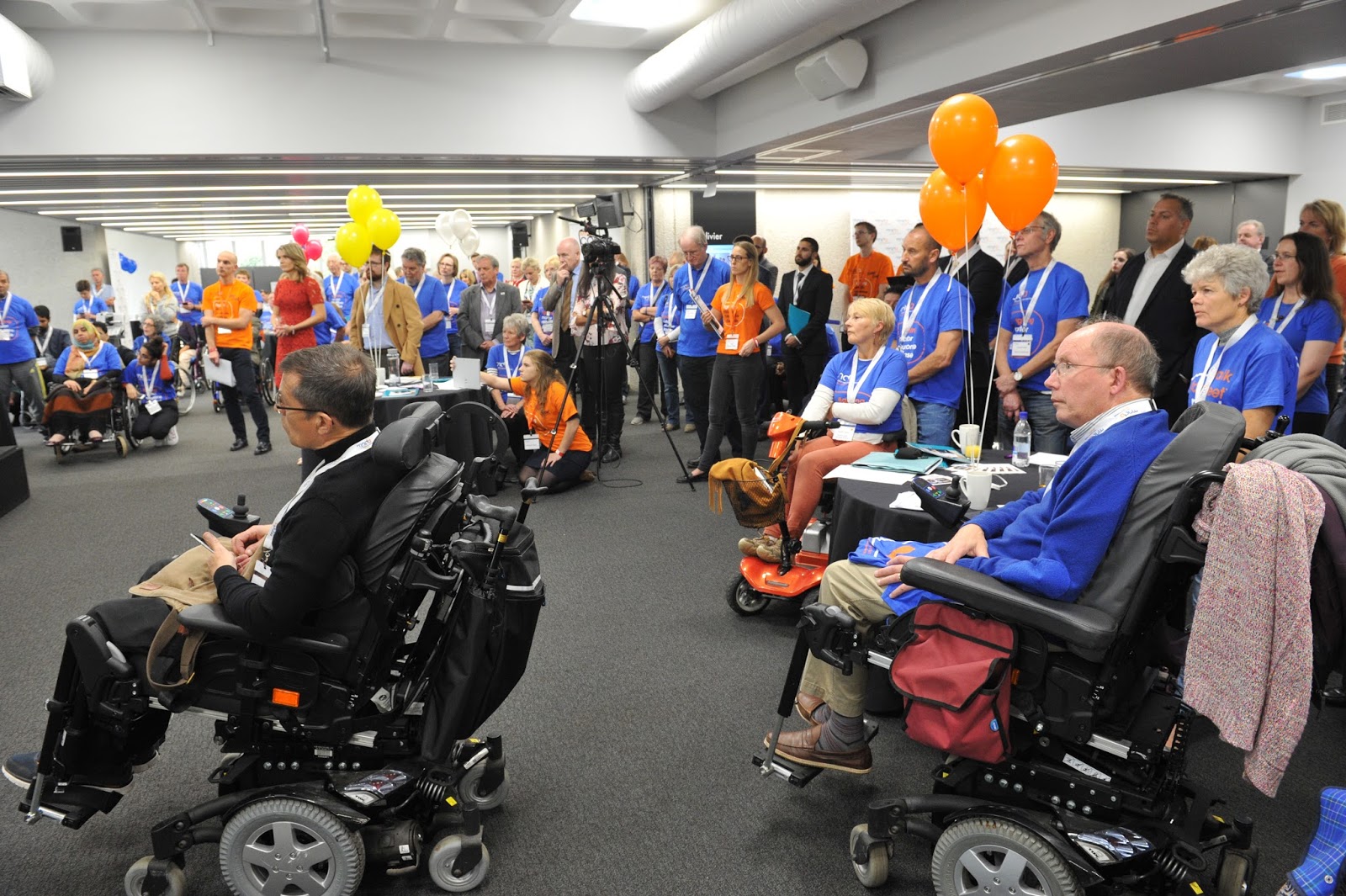
Then it was upstairs to the Parliamentary Reception, which
was a very moving experience. The sandwiches were nice, but the meat of the
event were the keynote speeches and the conversations with MPs. The speeches
were given by Chris Evans MP who is an officer of the APPG on MND, Rob Owen who
is living with MND, TV Presenter and MND Association Patron Charlotte Hawkins,
and Penny Mordaunt MP, Minister for Disabled People, Work and Health.
Undoubtedly the most impressive were those given by Rob Owen and Charlotte
Hawkins.
Rob Owen talked about his experience of applying for PIP
(Personal Independence Payment), the benefit granted to people with extra
financial demands from ill-health and disability. In brief he was first
assessed by a health professional who understood his needs. Later he was called
for reassessment, which was carried out this time by a non-professional – and
his monthly payment was reduced. Nonsensical since MND is an untreatable
degenerative disease. When he queried it, he was again treated to an amateur
tick-box assessment and had his payment removed entirely. It was only by
formally appealing to a panel including a magistrate and a medic that he was
given the maximum amount of PIP – backdated to the beginning. What a waste of
nervous energy and taxpayers’ money!
![]() |
| With Charlotte Hawkins |
Charlotte Hawkins talked from the point of view of family,
and painted a vivid picture of watching someone you love die from MND; as she
put it, seeing the person you love disappear before your eyes. Her father died
in 2015. She moved us all and opened MPs’ eyes to the reality of the disease.
(You can hear the speeches here: MNDA Parliamentary Reception).
![]() |
| With Robert Courts MP |
Sadly only one of the six Oxfordshire MPs came to the
reception. Indeed although I had sent a personal invitation to my local MP, I
did not receive so much as an apology – simply a proforma bit of
party-political spiel about how much the government cares about conditions like
MND… a week after the event. You might tell I’m not overly impressed! However,
at least, new MP, Robert Courts, from Witney was there, and listened and was
concerned.
The focus of the reception was to inform parliamentarians
both about the disease and its costs – and how important it is that people who
have it receive the support they need WHEN they need it, which in the vast
majority of cases is very quickly as the disease so rapidly removes your
independence. And of course how unnecessary reassessment is with a progressive
degenerative disease, assuming it’s been correctly carried out in the first place.
And so back home – and this week. On Tuesday Jane forewent
her usual gym class so that we could attend my fourth and final meeting of the
Oxford MND Care Centre Steering Group. I’ve been the patient representative.
I’ve said often how excellent the Centre here is. We have two top-rate
consultants (who happen also to be professors), a specialist nurse (who
coordinates the show), an OT (who is the country’s expert on wheelchairs for
neurological patients) plus access to specialist physios and respiratory
nurses. The local MNDA branch also supplies volunteers who welcome you and make
sure you know what’s going on and who to see when. Part of the meeting was
devoted to an audit which, I think, the Centre has to do in order to continue
to be recognised (and supported) by the MNDA. There’s a danger, it seems to me,
of extending the already pervasive evil culture of performance indicators. The
Oxford Centre is always working at improving and being responsive to patients’
needs. It doesn’t need to waste its health professionals’ time in filling out
tick boxes and sending out questionnaires.
The Association faces the understandable dilemma of not
wanting to fund what should be statutory provisions, such as nurses or
dieticians, and yet there are charities which successfully augment the NHS – such
as Macmillan Care, Marie Curie and many others. The MNDA is comparatively well
supported with an income of £17,391,000 in the 11 months up to December last
year. The staff (189 of them) cost £6,268,000, for whom private medical
insurance (!) was £43,000. I wonder if they could fund some hospice beds or
nursing home rooms – or even adapted holiday places. Don’t get me wrong; the
MNDA is a very effective charity and does a great deal of good for us,
particularly at the local level. I wonder if it just might be a tad top-heavy.
Saturday, 14 October 2017
A book worth waiting for
Tanya Marlow, Those
who Wait 2017
For an evangelical (i.e. Bible-believing) Christian to
confess that the Bible no longer excites and delights him sounds like heresy.
However, I suspect I am not alone among my generation in feeling that way. We
read it (or even study it occasionally) out of duty or habit, but it doesn’t
feel “living and active”, as we are told it is. It has become over-familiar. We
know the stories and the lessons well; we have after all heard them or read
them often over the years, and we or they have become jaded. It is only the
exceptional teacher or preacher who revives its immediacy for us.
Tanya Marlow is one of those exceptional teachers. Sadly we
are denied listening to her as she has suffered from myalgic
encephalomyelitis for over twenty years and been largely confined to her bed for the last seven of them.
(See Tanya Marlow talking about ME.) However she writes a blog
called “Thorns and Gold” (Tanya's website and blog), and has written a
downloadable book. Now she has written Those
who Wait (Malcolm Down Publishing, £9.99), which looks at four characters
in the Bible and their experience of waiting: Sarah, Isaiah, John the Baptist
and Mary. What Tanya does is imagine them telling their own stories. However
her retelling is always backed up with scholarship, the book ending with
discussion about the theological and historical issues involved on the way.
Each character’s story is told in five short chapters, with pauses for
reflection after each. Finally there is a section entitled, “The God who
waits”, reminding us that we are not alone in the experience of waiting.
I think this is a brilliant book. For one thing it’s
multi-purpose! You can use it for personal devotion; you can use it in group
studies; a church fellowship could use it for Advent (you might detect the
characters follow an Advent pattern, beginning with the patriarchs and
prophets). Mainly it’s brilliant in the way it shines light on the Bible
narrative, reminding us that it’s about God’s interaction with people like us
and their reaction to him in their own struggles with life. Tanya Marlow shows
us, not only does the Bible engage with real people, but through it we can find
a God who’s concerned with the issues where the rubber hits the road. The section
headings illustrate this: “Sarah’s story – Dealing with Disappointment; Waiting
for Joy”, “Isaiah’s story – Dealing with Delay; Waiting for Peace”, “John the
Baptist’s story – Dealing with Doubt; Waiting for Justice”, “Mary’s story –
Dealing with Disgrace; Waiting for Jesus”. If you’ve never been troubled by any
of those eight concerns, the book will probably be of only academic interest to
you; but if you recognise them, this book will encourage you that you’re not
alone, and that you’ve not been forgotten by the Comforter who caused the
stories to be written in the first place.
I’ve read quite few Lent and Advent books over the years.
This is quite the most readable and exciting I’ve come across. I loved the way
it reengaged me with the Bible by quite unexpected roads. I especially liked
the Celtic-like blessings after each character’s section, such as this:
“May
you who are cloaked in and choked by cynicism
Be
broken by the grace of God.
May
you who are in hiding
Find
God’s hands held out to you
As
an open invitation of love.
May
you see God’s face when it all feels too late,
And
may you encounter the God who sees you, knows you, loves you still.
Amen.”
I suspect that this vibrant book is the product of years of
enforced silence and frustration, rather like a minor prophet's. It will probably
have a wider audience than Tanya would ever had from one pulpit or conference
platform. My hope is that it will have a huge circulation. It deserves it.
(Those who Wait is published on 16th October, and can be ordered from Wordery and other online and retail outlets, I believe.)
Friday, 29 September 2017
Playboy Hefner dies
Hugh Hefner, whose death was announced yesterday, wasn't, one gathers, the nicest of men - although he does have his advocates among those who knew him well and those who regard him as a vanguard of progressive values. I might harbour doubts about his ethics, though there's no doubting his business acumen in cashing in on the mores of the post-war years.
However, my single brush with the Playboy empire was quite different.
40
years ago Jane and I had been married for three years and had started a
family, with our first child. I was
teaching in my second teaching post at our local Catholic comprehensive near
Watford. We didn’t have much spare cash,
and had bought a grey two-door Morris Minor from a clearly trustworthy gentleman
who was involved in a religious youth movement.
My
wife’s parents had a holiday home in the Isle of Wight. Our new (old) car’s first long run was to
visit them there. To avoid the traffic
we set off very early with our daughter on the back seat in her rectangular
no-frills cumbersome brown carrycot – there were no fancy multi-purpose buggies
in those days and of course no M3. All
was fine and carefree until we were well away from London. I think we’d got as far as Hampshire down the
A3 when the engine began to stutter; and steam – or was it smoke? – billowed
out from beneath the bonnet. We pulled
off the road. The first thing to do was to rescue our daughter from the back
seat before the car caught fire. Then
what? No AA membership and anyway no
mobile phones. And hardly any traffic. The only thing must be to walk until we found
a garage.
I
don’t know if we prayed, but at that moment a white Ford Escort drew up and an
attractive blonde emerged, and asked if we needed any help. By now it was clear that the radiator had run
dry. The young lady knew the road and
told us there was a garage a mile or so down the road. She offered to drive us there. While my Jane looked after our daughter with
our car and belongings, I went with our rescuer to the garage for some
water. She then drove me back to our
car, where I was able to put enough in to get us on our way again. (Subsequently we repaired the radiator with
sealant.)
It
was only as she drove away that we noticed the small sticker on the rear of her
car. It was the unmistakable Playboy rabbit
silhouette. We concluded that she was a
bunny girl driving home after a long night on duty. I’m sure we thanked her at the time. But if she should ever read this, we’d love say thank
you again, for an unexpected act of kindness in rescuing a desperate young
family by the roadside. I like to think
we met an angel in disguise that early morning.
Saturday, 23 September 2017
A tale of two paradoxes
Two news stories have struck me this week.
One is the extraordinary ineptness of the contractor employed to carry out tests for PIPs (Personal Independence Payments) for disabled people in the North East, who has hired rooms in a luxury spa owned by multi-millionaire, Duncan Bannatyne, for the purpose. I can imagine few things worse than being pushed in my wheelchair through a place thronging with healthy and wealthy spa-goers padding around in fluffy slippers and snow-white bath robes on their way to a massage, a manicure, and a meal of coleslaw and prosciutto, or working off their excess weight on cross-trainers, or showing off their finely toned bodies between the swimming pool and the sauna. It is hard to imagine a more inappropriate venue for what is already a humiliating enough experience - an assessment designed to save the government £1.3bn by 2020, by cutting the number of people who receive DLA (Disability Living Allowance, being replaced by PIPs) and in particular the mobility element which gave disabled people freedom to get out and about.
It is true that supporting the disabled costs us all a lot of money. It's also true that the introduction of PIPs has already caused a lot of personal harm and hardship. "PIP assessments have so far led to Motability cars being taken away from 50,000 disabled people.
When the new assessments were announced to replace the Disability Living Allowance (DLA) in 2016, it was estimated that entitlements would be cut by up to £150 a week for more than half a million people." See Huffington Post article. See Huffington Post article. The irony is that the sum result of a lot of misery for a section of the population will in the end barely dent our social services bill a jot, if at all.
I do realise that a while ago I made a resolution not to whinge so much. But really! Sometimes it all gets too much. So here's my second one. It's about Theresa May's much touted Florence speech. I'm not entirely clear why her minders chose to stage it there. I gather it might have been because of the trading/banking history of the city, or it might have been some sort of convoluted symbolism to do with the Renaissance. Here she was, in the tradition of Michelangelo and the Medicis, launching a second Renaissance in Europe, Mrs May's Renaissance. From the news reports that seems to have been the gist of her message. Brexit is not an end; it's a beginning. It's not a divorce; it's a new glorious "partnership". There were precious few details of what the partnership would look like, just like nothing we had seen before and we need some more time to think about it. What must puzzle objective observers is, then what Brexit was all about. In the referendum campaign we were constantly told that it was about breaking off with the EU, having done with it, breaking free from its shackles. Which sounded very much like a divorce, a very acrimonious one at that. It sounded like "a plague on all your 27 houses".
"Brexit," Mrs May intoned, like a mantra, "is Brexit." Now it appears, "Brexit is Brentrance." Whether Europe will allow us to have our cake and eat it remains to be seen.
Saturday, 9 September 2017
Who decides what is NEWS?
I get that Hurricane Irma like Harvey is a major natural disaster. Having a friend holiday in the Dominican Republic at the time, I was concerned to know how it would affect her. I understand that its effects for the people of Barbudas and Saint-Martin have been catastrophic, destroying their islands beyond recognition.
The human death toll from Harvey which flooded Houston was at least 70; Irma so far has killed 23 people. Which is tragic. No wonder they have received blanket coverage in our news every day for a fortnight now.
Meanwhile in South Asia over 1400 people have died and over 40 million have been affected by flooding in the last two months - but there's a difference. For some reason the floods affecting swathes of Nepal, India and Bangladesh have received minimal news coverage in the UK, despite being among the poorest of countries. The same is true of the flood-created mudslide in Sierra Leone with its death toll of over 1000, earlier in August. Jagat Patna points out that news of such events should be shared as they are symptoms of a phenomenon that affects us all (see Floods in Texas and South east Asia).
![]() |
| Photo: TEAR Fund |
What's the reason for the disparity? I fear it may be that resurgent ugly trait of colour prejudice. Perhaps it is the dark side of the US/UK "special relationship": that side of the Atlantic matters much more than the rest of the world, or those lives are that much more valuable.
It seems that we haven't learned that from Shylock's most potent expression of the common humanity of all people, irrespective of creed, colour or any other distinction.
"I am a Jew. Hath
not a Jew eyes? hath not a Jew hands, organs,
dimensions, senses, affections, passions? fed with
the same food, hurt with the same weapons, subject
to the same diseases, healed by the same means,
warmed and cooled by the same winter and summer, as
a Christian is? If you prick us, do we not bleed?
if you tickle us, do we not laugh? if you poison
us, do we not die?" (Merchant of Venice 3.1).
Of Irma one commentator likes to say, "This is a very very bad storm." Although news clearly isn't a mere calculus of numbers or size, nevertheless one has to ask what are the criteria by which our opinion-formers decide what we will see or hear by way of the news. And maybe this particularly egregious instance of selectivity over a global phenomenon which should concern us all will make them realise why so many of us now prefer to find our news via other means such as social media.
Wednesday, 30 August 2017
Rachels' books
To Pete, Jane & Evelyn
I've recently had a birthday, and among the very lovely presents I was given were two books by authors whose Christian names (or forenames, as we're meant to call them now) are both Rachel. They both, for different reasons, captivated me - which you can tell because I who these days am a slow reader read them quickly.
The first is The Music Shop by Rachel Joyce, whose other novels (The Unlikely Pilgrimage of Harold Fry and The Love Song of Queenie Hennessy) I also recommend. It is primarily set in 1988, with the final chapters 20 years later. The story revolves around the single-minded, arguably obsessive, Frank for whom the only worthwhile form of recorded music is vinyl and his shop in a run-down cul-de-sac in a cathedral city which is itself depressed and still bears the scars of wartime bombing. The remaining shops in the street are a florist, a Polish baker, an undertakers', a tattooist, a Catholic souvenir shop, and Frank's music shop. On the other side of the street are terraced houses in various states of disrepair.
All the while there are threats from a development company and racist gangs. It is a picture of a community under pressure from progressive and reactionary forces.
Frank is no musician, but he has inherited from his Bohemian mother both a love of music and a fear of relationship. However he has a unique gift - the ability to hear instantly what music every person needs. His world and the life of the street is profoundly changed when a woman in a green coat collapses unconscious outside the music shop. All the characters in the book have their own back-stories and carry their own scars. I won't spoil the plot, but content myself with saying that, as with Rachel Joyce's other books, it is ultimately hopeful and carries a message that redemption is possible though hard won.
At the moment Jane is reading it. I shall be interested to hear whether she was as captivated as I was.
The other book, which arrived out of the blue from my least "respectable" cousin, is Evolving in Monkey Town (now retitled Faith Unravelled). What a gift! It's by Rachel Held Evans (from whose blog I've previously quoted : Pain in the Offering). It's not a new book, published in 2010. It recounts her growing up in the southern states of America, and in particular Dayton, Tennessee, where her father went to teach theology in the conservative Bryan College. For one thing, she is an excellent writer. Dayton was the site of the famous 'Scopes Monkey Trial', staged to draw publicity to the small town. In 1925 John T Scopes, a secondary teacher, was prosecuted by the state for teaching evolution in a state school. The whole thing turned into a debate between 'Modernism' and 'Fundamentalism', between creationism and evolution, and gained worldwide notoriety.
This Rachel tells how she developed from knowing all the right Christian answers to sceptics' and seekers' questions to being open to accept the mystery of faith. She ends, "If there's one thing I know for sure, it's that serious doubt - the kind that leads to despair - begins not when we start asking God questions but when, out of fear, we stop. In our darkest hours of confusion and in our most glorious moments of clarity, we remain curious but dependent little children, tugging frantically at God's outstretched hands and pleading with every question and every prayer and every tantrum we can muster, 'We want to have a conversation with you!'
"God must really love us, because he always answers with such long stories."
I found the book invigorating and liberating. It helped me to understand my own journey and myself. As I commented to a friend who asked me how my summer had been: I suppose what reading Rachel’s book helped me see was, a. that I wasn’t a freak and b. that I do still have faith - which has been a considerable relief and a sort of liberation. My doubts and questions are by no means fatal. Phew!
Subscribe to:
Posts (Atom)