Showing posts with label God. Show all posts

Monday, 11 October 2021

A new Pietá

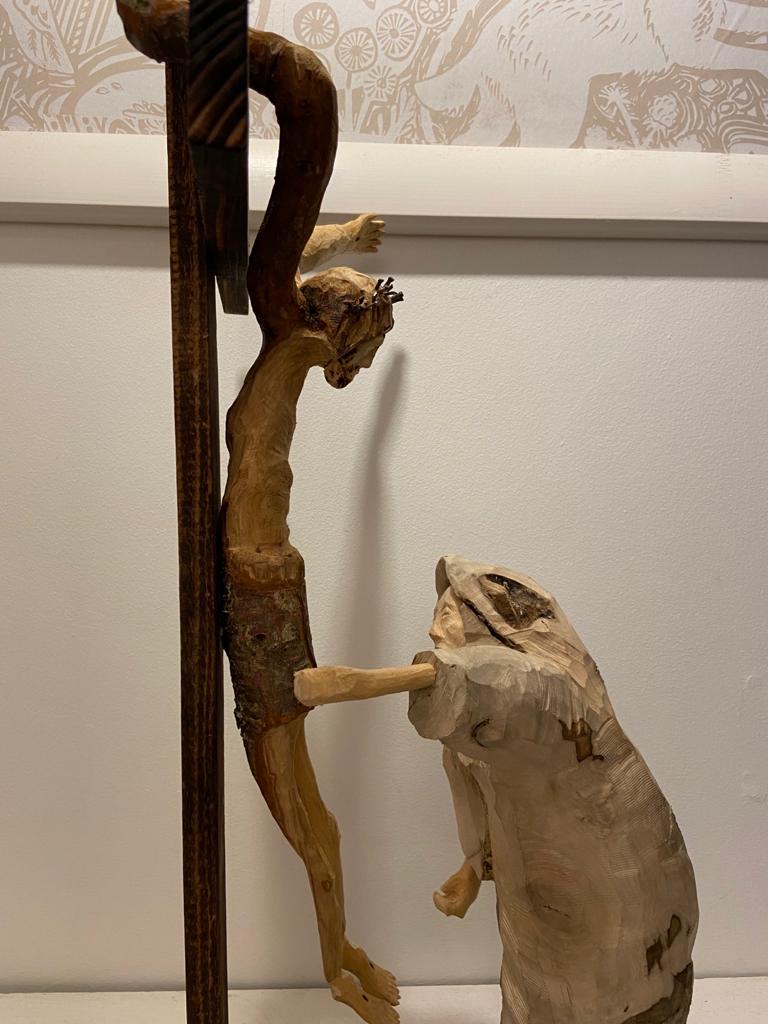
Yesterday I was presented with a work of art which left me speechless. It was crafted by a relatively unknown South Devon artist. Here it is in its temporary resting place.

 © Pietá by David Milnes


David Milnes and I have been friends since schooldays. In correspondence with him in August, I wrote: "As for the 'commission', in one of my novels I wrote about someone facing the loss of someone she loved identifying with Mary at the cross. She seems to me the person who most experiences the desolation of dereliction in the Bible. And I’ve long thought that evangelicals have failed to engage our imaginations in the gospel story. What must it have been like at the moment of Jesus’ death? So I’ve been looking for something that expresses the grief, disappointment and pain as they begin to take the body down. The characters I was looking at around the cross were Mary the mother, John the friend and Mary Magdalene who’s in love with Him (parent, saint and sinner - all humankind). It seems to me that all of us in our dark moments think the God we believed in and who is love has died and abandoned us. For many a resurrection morning never dawns. Which, I guess, we all fear and which is why, I think, we need each other to hold on to as we wait."  

David immediately set to work. He'd picked up, to his relief, that I wasn't looking for an serene scene carved in marble like Michelangelo's masterpiece. He'd been impressed by Fenwick Lawson's Pietá in Durham cathedral carved from "the rough split rawness of large logs".

© Picture Durham Cathedral
 

This is David's description of his own work. "For the figure of Christ I have used a section of a plum tree   in our garden. It is dead, twisted and covered in lichen. Two side branches looked like contorted arms writhing in pain and desolation. The connection between the arms is not realistically correct but suggests dislocation and extreme pain. The main branch is thinner than the body should actually be, but elongated bodies suggesting suffering were good enough for El Greco, so why not? In order to make the hands, feet and face stand out and in order to emphasise their vulnerability, I carved them separately in lime wood that enabled me to include greater detail. The marks of the nails and the spear in his side were burnt into the wood. 

"The cross is not a beautiful, smooth and varnished piece of neat carpentry. It is a rough piece of pallet wood which I have scorched. Burning has close associations with pain and destruction.

"For the figure of Mary, as she reaches out to help remove her badly mutilated son from the cross, I used a piece of holly wood which is solid and heavy with sorrow. It has twists and knots and rotted areas which are indicative of the terrible trauma and devastating blows that she has endured. It is very different wood from that used for the figure of Christ but it suggests suffering which is different but just as all consuming."

I love the rawness of this Pietá. It is certainly a discomforting addition to a sitting room. I like the fact that Mary is not portrayed as a beautiful young saint but as a middle-aged mother whose years of bringing up children in occupied territories have taken their toll on her physically. She is one of the many middle-eastern women grieving for their sons killed in a reprisal air raid. I like the proportions of the carving. To her Jesus is still the small child she held in her arms. I like David's choice of woods: Using for Mary the wood of the holly tree, which two Christmas carols associate with the suffering of Mary - "the holly bears a bark as bitter as any gall". And he has used fruit wood for the body of Christ. Humankind's fall from grace came through eating the forbidden fruit; its restoration to grace comes through "eating my body", as Christ put it. And the wood on which he hangs, a discarded pallet to crucify the rejected carpenter's son. The artist's brother pointed out that Mary is seen as left-handed - so maybe represents despised minorities and those considered weak. Theologians may recognise in the emaciated crucified body a depiction of what they call κένωσις, Christ emptying himself "taking the form of a slave and becoming obedient even to death on a cross".

As my son commented, "What a gift!" Whether he meant what a talent or what a present, I don't know. Probably both. And on both counts he's right.

© Photo Courtesy John Milnes

© Photo Courtesy John Milnes

© Photo Courtesy John Milnes


© Photo Courtesy John Milnes


Saturday, 16 July 2016

We should be angry

I was at a meeting on Thursday, discussing social media. I happened to say to someone there how hard it was to express our negative thoughts together to God. And then came along a third major atrocity in France within 18 months. 
Back at home, I heard that 84 people, including 10 children, had been killed by a man repeatedly driving a lorry into a crowd watching a Bastille Day fire​work display in Nice. At the time of writing, 54 children lie in hospital fighting for their lives. And so-called ISIS gloat over one of their "soldiers" committing an act of such deluded barbarity. How can we tell God how awful it is? How dreadful and demonic? How much we hate it? Are we allowed to? Can we find words that match the moment? Well, I think we may, we should and we can.

Photo: Huffington Post twitter
In the days when psalms were a regular part of daily Anglican worship, I've never once heard the most difficult one sung or said in its entirety. It's Psalm 137. It's one of several laments which come in the book of ​Psalms - the Jewish hymn book. It expresses the most raw pain and anger of any worship song I know.
Here it is:
By the waters of Babylon,
    there we sat down and wept,
    when we remembered Zion.
On the willows there
    we hung up our lyres.
For there our captors
    required of us songs,
and our tormentors, mirth, saying,
    “Sing us one of the songs of Zion!” 
How shall we sing the Lord's song
    in a foreign land?
If I forget you, O Jerusalem,
    let my right hand forget its skill! 
Let my tongue stick to the roof of my mouth,
    if I do not remember you,
if I do not set Jerusalem
    above my highest joy!
Remember, O Lord, against the Edomites
    the day of Jerusalem,
how they said, “Lay it bare, lay it bare,
    down to its foundations!”
O daughter of Babylon, doomed to be destroyed,
    blessed shall he be who repays you
    with what you have done to us!
Blessed shall he be who takes your little ones
    and dashes them against the rock!


It seems so unChristian, doesn't it? Especially those last lines. And yet... and yet, to be candid, that is the way that we feel in our inner, secret depths. "Give them exactly what they dealt out to us and our loved ones." That's natural justice. ​​​​It's a cry of utmost pain. It's how much it hurts - or it should be. It's appropriate.​ For a time anyway. And if it is​ what we feel, then pretending to God that we don't is pretty pointless. ​​Perhaps it would be good at times like this to share this psalm, even say it together, and then listen to familiar words of Jesus in Matthew 5:
 "You have heard that it was said, 'You shall love your neighbour and hate your enemy.' But I say to you, Love your enemies and pray for those who persecute you, so that you may be sons of your Father who is in heaven…" 
And then be quiet for a very long time.

Tuesday, 1 April 2014

A rainbow world


In May 2004 we travelled with our great friends Anthony and Ruth to Florence, staying in the Hotel Berchielli near the Ponte Vecchio. Jane's and my bedroom, I remember looked down on this quiet square, Piazza del Limbo, with the 11th century Santi Apostoli church opposite. That was the first time that I appreciated the relief and the hazards of wheelchair travel. It was an unforgettable four days. Among the sights in one of the large piazzas there was a peace vigil - it was a year after the invasion of Iraq with all the messy mopping up. The vigil was largely young people and students. They were selling peace ('PACE') flags, and so I bought one as my souvenir of Florence, not as beautiful as Tchaikovsky's Souvenir de Florence sextet, but there we go. I still have it.

I remember my family asking me when I proudly showed it them, "Do you know what it means, Dad?" So I told them it was an Italian peace flag and I'd got it from a vigil in Florence. They told me it also was the symbol of the lesbian and gay movement. (In fact I have now discovered that they were wrong for reasons I'll explain.) However at that time I was - I was going to say ambivalent about homosexuality, but that's too kind to myself - I was anti-gay. ("Love the sinner; hate the sin" - that sort of thing.) I put my peace flag away in a drawer. Readers of my blog will know that comparatively recently I have repented of my ignorant arrogance, as a result of encounters, study and reflection - see here, and here, and here. I've concluded that normally sexual orientation is not a lifestyle choice but an innate gift.

I was reminded of my flag with the great celebration in the media of the introduction of equal marriage at midnight on Friday. I was very glad when Archbishop Justin Welby went on record saying, "I think the church has reacted by fully accepting that it's the law, and should react on Saturday by continuing to demonstrate in word and action, the love of Christ for every human being." Strangely, for such a moderate statement, it will no doubt have exposed him to a good deal of hate mail and brickbats, probably from all sides. Nonetheless as The Guardian commented it did represent a shift in tone, rather as Pope Francis's "Who am I to judge?" answer did. I was surprised to read about the reaction to the American charity, World Vision's decision to open employment to people in a same-sex marriage. As one blog put it, the gates of the social media were stormed by people arguing for what they felt was the truth. "Additionally, and almost unbelievably, many chose to withdraw their child sponsorships in order to send a loud, clanging-symbol  of a message to World Vision." I suppose it was not surprising, albeit shameful, when World Vision quickly reversed its decision. A friend of mine was on the receiving end of very nasty trolling when she commented, "Someday the Church will look back on the fight over same-sex relationships with same incredulity & shame as with slavery & women’s suffrage." However, I hope she is proved right - in the not too far distant future.


Meanwhile I am looking forward to joining with lesbian friends of ours who are marrying on Friday. We feel very privileged to have been invited and are looking forward to congratulating them - and I shall be praying that God will bless them as they will have made their lifelong marriage vows to each other. Every such lifelong commitment needs every blessing, I reckon.

The LGBT flag has, you'll notice, the red stripe on top and the purple at the bottom and has the turquoise missing. The stripes represent (starting at the top): life, healing, sunlight, nature, serenity/harmony, spirit.


As I sit in my chair, I still value the rainbow as the reminder of God being utterly faithful and loving us too much ever to destroy the world, despite all our attempts. It reminds me of the eternal love that is at the heart of existence. It reminds me that even I am loved by the creator of everything. Hard to credit, but apparently true. "His steadfast love - for everyone - endures for ever."

PS The reason I have been quite vocal on the issue is the harshness of the criticism heaped on LGBT people, often sadly by followers of Jesus who had nothing to say on the subject but was very explicit on judging: "Judge not, that you be not judged." This is my way of saying I'm sorry.

Monday, 10 September 2012

Days at the Paralympics

The starting line
One of my family has observed my recent blogging black-out. One of my excuses was tiredness following last Friday and Saturday when we went to two of the Paralympic venues. So I thought a quick photo journal would be a jolly way to update this. Reflections might follow given inspiration. I have to say the opening ceremony of the Paralympics was a real disappointment after the class act of the Olympic equivalent, but the actual paralympic competitions I thought were more impressive than the able-bodied ones, and certainly more moving.

Anyway, our first visit was to Eton Dorney where the rowing events took place. It was a bright cool day.
The young toffs' boathouse

Two spectators in Grandstand 
We'd prebooked parking, which meant we were ushered to very near the entrance and security checks. We didn't actually have to take our shoes off, as in Twenty Twelve, but Jane and Rachel went through the electronic screening and I was frisked by a polite young soldier. All the time we we surrounded by hordes of volunteers offering advice and hoping we'd enjoy ourselves - which we did.

A minibus whisked us halfway down the course, where we paid our first visit to the abundant and super-duper loos. I don't where the 10,000 of them are going after the Games, but the disabled ones certainly should not be scrapped. They were something else!
Nick Beighton and Sam Scowen
The coxed fours

We ensconced ourselves in Grandstand 2, opposite the big screen, and where you could see both the start and the finish, though it's hard to judge who's in the lead because of the angle across the lake. We saw three sets of heats, in all of which Brits did well, the mixed double sculls, the men's single sculls and the coxed mixed fours - in which unusually the cox lies at the front of the boat. The GB 'four' (5 including Lily the cox) 

went on to win the gold in the final. Sadly for Tom Aggar, and Sam Scowen and Nick Beighton, they came fourth in their finals - which is a hard place to end up, especially when the media raise people's expectations about you. Tom Aggar, the favourite in the Arms and Shoulders Only sculls, just said he was gutted. (I must say it struck me there was a refreshing blunt honesty about the Paralympians in the post-event interviews.)

The gold-medal four


The one downer about the arrangements was the volume of loudspeakers bang in front of our seats, which fell quiet only at points in the races - otherwise they had excessively loud music or some cheerful charlie keeping up an entertaining (I suppose) chatter. As you can see, there were thousands in the crowd, merrily marshalled by helpers in the purple and orange uniforms (you can see one girl perched on her umpire's chair behind the departing mob). On the way out we were regaled by a band of the Marines, and a chap up another umpire's chair shouting, "God bless you!" As we drove home, we felt He had done so.
  
Lee Pearson on Gentleman


Jo Formosa on Worldwide PB


On the Saturday after a more leisurely start we set off for South East London. Had we relied on Sean the satnav we might have made it with more time to spare. However I knew better. Thus it was that we reached the south end of the equestrian arena in the nick of time to see the 1b Dressage tests begin - at the old naval college in Greenwich. I have to say I found watching those very disabled riders from all over the world controlling tons of horse with amazing accuracy very moving. I think it was that afternoon which really engaged my attention with the Paralympics.

Mutual support on the medal rostrum
Many of the riders had been paralysed after riding accidents. Some had cerebral palsy and other neurological conditions. Lee Pearson, riding for Great Britain, has the rare arthrogryposis but humour with it. He'd already won a gold medal with the GB team; this time he won the silver to add to his hoard of medals from previous games. The winner was Jo Formosa from Australia who persuaded her horse, Worldwide PB, to produce a beautiful performance, with instructions shouted from the sidelines above the roar of passing jets.
Lee Pearson acknowledging the fans
What was most moving was the medal ceremony. The riders' skill is such that you're hardly aware of how severe their disabilities are, but once they're off their horses you see the full extent. Also obvious is their obvious mutual respect and affection. That's a characteristic of the Paralympics which really struck me much more than in the able-bodied competition - the generosity to each other after competing, whether in victory or defeat. It seemed that all the Paralympians had empathy for each others' efforts, pain, achievements or disappointments. They, more than anyone, knew what it cost. Which, by the way, was what made the disabled commentators and analysts on TV so refreshing. What a change from those tired old chauvinistic regulars! 
The final capitulation - Team GB flags
on my wheelchair!

I'm glad we weren't successful in applying for the "real" Olympics. Impressive and exciting though those were, in my view they were outshone by the Paralympics, the parallel Olympics.                                                                                Oh yes, I almost forgot to mention the weather! I'd have thought a passing word of thanks to the Almighty would be in order, as certainly LOCOG wasn't responsible for arranging that. I was sorry that although the Olympic opening ceremony had reference to God, the final closing ceremony reverted to New Age paganism with its invocations of the spirits of the seasons. Really! Why on earth London (of all places!) 2012 should have been so blessed with so much sunshine in the midst of the wettest summer on record (etc etc), I have no idea. It seems Jesus was right, "Your Father who is in heaven... makes his sun rise on the evil and the good, and sends rain on the just and the unjust."

Tuesday, 22 March 2011

Manipulation and information

I'm a bit concerned. I've just typed in my email address on a website beneath a grey square with the word "GOD" in white diagonally across it, and I've clicked on a lozenge beneath saying "Unsubscribe". I imagine my atheist friends will be sighing (or chuckling with glee), "At last. Physics is being proved right. 'Religion is set for extinction' - and here's the evidence! The rot's well and truly set in, if Michael's unsubscribing from God." I don't know if you've seen the news item - which I'm glad to see the BBC has filed under Weird and Wonderful (along with 'Germany's star polar bear Knut dies' and 'Colombian keeper to run for president') - Religion's last legs? . It goes some way to substantiate the old aphorism, "Lies, damned lies and statistics" (Disraeli, via Mark Twain to West Wing Episode 21).

The story, as far I can see, is about some apparently serious academics in America who have been looking at census figures in 9 countries over a century (not the US or Britain) and deducing a mathematical model which "proves" that religion will eventually become extinct. As a dodo? I don't think so. Wasn't it meant to expire in communist Russia and China? Far from it, it came up fighting fit. Funny that, sounds a bit like the resurrection.... I guess too that's why atheism's Militant Tendency is getting so up-tight. They can see that religion is far from moribund. Otherwise they could just put their feet up and watch it wither and die.

By the way, I was just unsubscribing from the God Channel's mailing list, mainly because I don't have time to watch it, but also because every mailing has a big Donate Now! appeal attached.

I was interested in the mini-storm over the musical background to the Wonders of the Universe led by the master of the Queen's Music, Sir Peter Maxwell Davies, who berated the "muzak morons". I have to say I sympathise with him, and with the hard of hearing for whom serious discursive programmes are rendered unintelligible. Documentary becomes drama. For example, wildlife filming has background music which imposes an entirely specious emotional response on it. It is merely manipulative. Significantly Professor Brian Cox admitted as much in his defence of the music's volume. The programme, he said, "should be a cinematic experience - it's a piece of film on television, not a lecture". So next time you watch a programme with a musical undercurrent, remember it's entertainment, not education. I don't think Professor Sandels' excellent series on justice had muzak accompaniment.

Monday, 14 March 2011

Local scenes and global perspectives 2

I must say I was having something of an argy-bargy with God over the weekend. It doesn't happen often, but last week's events got under my skin. That documentary about Kibera in Kenya, as you'll have gathered, moved me a lot. A million people crammed into one and a half square miles of mud huts with corrugated tin roofs, with communal toilets (up to 1000 sharing) with open sewers running down the centre of the alleys, awful child mortality. As Angela Rippon commented, "Here 'hand-to-mouth' literally means hand to mouth." Lennie Henry was lodged with five orphans, living in squalor, and couldn't take it. He was so upset that he broke the 'rules' of the film and asked to buy them a house with his credit card. It was an expensive house (£800) for Kibera, but hardly a palace. Samantha Womack was put with a young mum who worked as a prostitute to support her children and extended family up-country. Contrary to my expectations I understood why she did so, and how Jesus loved and forgave 'sinners'.

"Why, God, don't you get out your celestial credit card and rehouse the whole lot of them?" Actually, I know there is something much larger, more systemic, than bad housing conditions behind places like Kibera. My friend, Katie, recently wrote from holiday in Cape Town, that she "has been blown away by the poverty in the local township here... 40.000+ people crowded into a small space....." And, of course,  I know that God doesn't use American Express and doesn't bale out every result of human or satanic folly. That's something to do with free will, isn't it? I guess one of his questions is "Why don't you feed, or house, this multitude?"
Tsunami debris (Photo: Reuters/Kyodo)

And then came the earthquake happened off northern Japan, and its devastating consequences started to dawn us like the tsunami it caused, so that now Japan holds its breath lest a plutonium reactor melts down and explodes. Already the radiation levels have increased 100 miles away. Tens of thousands of people are dead or missing as the tsunami swept all in its irresistible path. And, what's more, the Tokyo stock market has plunged. I've heard it all described as "an act of God", an instance of the awesome power of nature, an example of the limits of the most sophisticated human technology, and the result of Adam and Eve's fall from innocence.... I find it very hard to understand as either the first or the last of those. I don't think we can thank God for the good things about it, such as the tsunami not causing damage in other Pacific Rim countries, if we rule him out of the bad parts. And while I'm happy to believe that "the whole creation has been groaning with the pains of childbirth until now", as Paul of Tarsus put it, it feels too simplistic a correlation to make to primal sin.

Rescue in Japan with body-bags (Photo ABC Australia)
I guess it's just part of inhabiting a planet formed as ours was. And a consequence of rising populations and increasing urbanisation, so that although the incidence of earthquakes hasn't noticeably increased, their human effects have become more catastrophic. We have an odd instinct to blame when disasters occur, blame someone or something for things going wrong. Blame whoever built nuclear power station on seismic fault lines, blame whoever built cities on them (though I gather that humans have chosen to live in such places from the beginning), blame authorities who allowed it all, and in due course blame someone for failures in rescue operations and in the reconstruction effort.

Photo © Ian Salisbury
And then today I've heard that another of my lovely young friends has cancer. Give us a break. Maybe it's copping out, but I'm cornered into concluding, as I was about my illness, that God is love (for which I have good evidence), but that love is far more incomprehensible than I'd imagined - so that somehow personal and international catastrophes both fall within that love, as does rescue from them. So I move backwards from Psalm 135.6, "Whatever the Lord pleases, he does in heaven and on earth, in the seas and all deeps", to Psalm 131.1, "O Lord, my heart is not lifted up... I do not occupy myself with things too great and marvellous for me."

We certainly live in a mysterious and beautiful universe. This is a picture I was sent last week of the moon over the North Pole, with the sun just above the horizon. I understand the moon has recently been nearer than usual.
(Unknown source)