Showing posts with label Rugby World Cup. Show all posts

Tuesday, 6 October 2015

An antidote to World Cup Fever

No doubt by now my English readers are recovering from Saturday's experience of cold turkey so heartlessly administered by our Australian cousins, and the owners of ITV are vainly trying to persuade advertisers that the viewing figures for future fixtures will be unaffected. And meanwhile some women are refraining from reminding their dearly beloveds that, after all, it's only a game.

The Rugby World Cup, anticipated as the next great sporting event in the country after the Olympic and Commonwealth Games, already shows signs of going the way of all flesh. I suppose the consolation for the RFU is that they have already sold tickets for the potential "hot" matches at vast prices to corporate clients and individuals. The best hope for them and the broadcasters must be that at least one of the home nations comes good and so preserves some great British enthusiasm for the whole show.
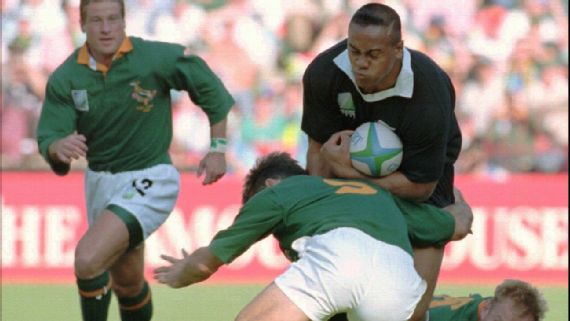


The famous tackle on Jono Lomu in 1995 (AP Photo/John Parkin)
Meanwhile it was all put into perspective for me by Miles Pilling who's in the middle of raising cash and awareness for MND with brilliant photographer, Cristian Barnett (26 Miles 4 MND). Miles, like me, has the PLS form of MND. I spent a couple of hours a few weeks ago on a photoshoot with them for their project. He sent me a link to the story of Joost Van Der Westhuizen. I did know about this legend of South African rugby, their scrum half in the World Cup winning team celebrated in the film, Invictus. The championship took place in 1995, a year after Nelson Mandela being elected president of South Africa, and the alliance between Mandela and Francois Pienaar, the team captain, did much to heal the rift left by apartheid.

Van Der Westhuizen's first symptom occurred seven years ago, but it was not until 2011 that he was finally given the diagnosis of Amyotrophic Lateral Sclerosis (ALS), the commonest, rapid form of MND, with a prognosis of two to five years. Last night I watched a series of YouTube clips (a documentary and some interviews) which vividly and painfully illustrate the nature of the disease. Early on he talks about about his determination to fight the disease and to set up a foundation mainly to provide care and facilities for sufferers of MND (the J 9 Foundation) - 9 being the scrum-half's shirt number. Here are three of the clips: A Life of Two Halves, with Jim Rosenthal, Interview with Dr Mol (South Africa), The Rugby Show.
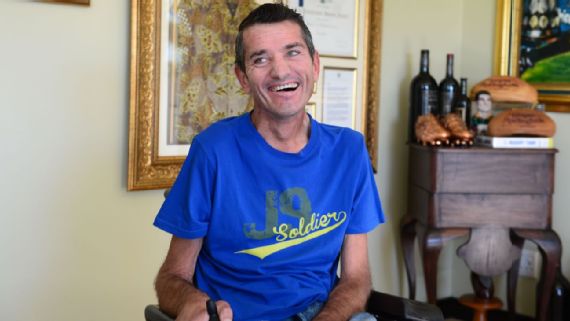
At home with his rugby memorabilia (Gallo Images for ESPN)

I ended by reading an article by James Peacock for BBC Sport, Joost Van Der Westhuizen: still fighting on his deathbed, which, despite its sensationalist headline, is well worth a read. At one point he reminded me of my co-author of I Choose Everything, Jozanne Moss, also a young parent of a boy and a girl, when he says, "'But I know that God is alive in my life and with experience you do learn. I can now talk openly about the mistakes I made because I know my faith won't give up and it won't diminish.
'It's only when you go through what I am going through that you understand that life is generous.'"

You do realise that even for an outstanding sportsman such as Joost Van Der Westhuizen there is much more to life than the glamorous and lucrative world of professional sport - there's his family, there's the gift of being alive, and there's God. There are more important things than winning. There's living.

(PS Apologies for the malfunction of the link to the good BBC article. My fault. It now works.)

Thursday, 2 February 2012

(Sir) Fred the Scapegoat

As I've observed before, we seem to have developed a predilection for scapegoats in our public discourse. Rather than discussing and dealing with the complex causes of problems, we seek out an individual, or some individuals, to hang blame on. Usually, of course, in matters of politics, ethics and even as far as sport, it's never the fault of one individual. The failure of the England rugby team in New Zealand wasn't just Martin Johnson's fault, and yet the press were quick to bay for his scalp. The collapse of our cricketers against Pakistan wasn't one man's fault. The corruption of the press wasn't the work of one woman. It was a culture created over the years by public appetite and corporate greed. Corruption in the Met and financial laxity among parliamentarians was a result of rising amorality in public life in general.

This is the rather powerful painting by the pre-Raphaelite artist, Holman Hunt, of The Scapegoat as described in the Pentateuch. Every year on the Day of Atonement the goat is chosen by lot out of two, and is driven out into the desert symbolically carrying the sins of the people from the previous year. Hunt captures not only the physical isolation but also the mental desolation of the scapegoat. However the point in this case is that the victim is not a person but an animal. No doubt there's a surge of sympathy from animal-loving readers, and yet the point is that this is precisely what we try to do to human scapegoats. At least we get them out of sight and hopefully out of mind.

The latest hate-figure to be driven into the wilderness is, of course, the former boss of RBS, Mr Fred Goodwin. As many others have pointed out, he isn't a bad man and he wasn't a bad banker; but he was chief executive when the bank made one disastrous acquisition. Let's be clear: it was a decision approved by the shareholders and the board, recommended by merchant bankers, passed by the FSA and presumably by the Treasury. Fred Goodwin didn't bring down either the bank or the economy single-handed. And yet the politicians bayed for his public humiliation and, sadly, the Queen constitutionally obliged and stripped him of his knighthood.

Andrew Strauss, England's able and successful cricket captain, was honoured with an OBE in 2011. Should he have it removed after the debacle of the crushing defeats in Dubai? The idea is absurd, and yet the principle is the same.

It seems to me too easy a debating-tool to single out an individual as the encapsulation of an issue. It's too easy to identify him or her as the problem itself, and therefore to claim that you've solved it with their removal. There's a sense of satisfied blood-lust which has a very uncivilised smell about it. And I'm sad to say that that our politicians and our journalists indulge in it with increasing frequency and ferocity.

I was watching the first programme, Protecting our Children, last night and I have to say that my heart ached for all involved, especially the family, whose parents clearly had inadequate role models for parenting and seemed to have no wider family to support them. The father in particular was completely out of his depth both in fathering and in dealing with kindly but highly articulate social workers. It was a painfully sad story. One thing that struck me was that dad's only recourse was to blame their young social worker, who "has always had it in for us". It was, it seemed to me, that primitive reaction to a mess to pin the blame on someone else, i.e. to find a scapegoat. In his case it was excusable, because he had such limited personal resources. However from first-class Oxford graduates, on whatever side of the political spectrum, who are trained to think and to argue issues through in the premier debating chamber of the country it is inexcusable. It is simply a lazy and low form of populism. 
It also avoids addressing the real underlying issues, and in that respect is simply laying up trouble for the future. The action preceding the animal scapegoat was for the people to examine and admit where they'd gone wrong. Without that we may feel better, but we get no better. As the Wikipedia article puts it:
"Since this goat is sent away to perish, the word 'scapegoat' has come to mean a person who is blamed and punished for the sins, crimes or sufferings of others, generally as a way of distracting attention from the real causes."

Friday, 16 September 2011

Things are never THAT simple

Oxfordshire's in the middle of the television digital switch-over, which seemed to be designed to make a generation of sets redundant, and create a whole new market for freeview boxes and digital TVs. Anyway it began this week. Being disabled I was eligible for the government scheme for help to make the transfer including a digibox. However I declined, as we already have one, and, so they said, it was just a matter of retuning the box.

All I can say is it's a good thing the rugby World Cup's on ITV, as the BBC reception here has been rubbish with all the channels duplicating themselves and cutting out to a blank screen within seconds. But fortunately ITV got the rights and my viewing hasn't been subject to that awful frustration - except yesterday when Pam Ayres appeared on the One Show. She of course was born and bred in Stanford in the Vale, and has just produced the memoir of that time, The Necessary Aptitude. According to the publishers:
"Pam Ayres' early childhood in Stanford in the Vale was idyllic in many ways, and typical of that experienced by a great swathe of children born in rural areas in the immediate post-war years. Though her parents' generation was harrowed by war, better times were coming. Everything the family needed was within walking distance in the village, and life with four older brothers and a sister in their crowded council house was exceedingly lively.

"In her late teens, Pam grew dissatisfied with her life as a Civil Service clerk with only the local 'hop' for scintillating excitement. Having seen three of her brothers called up for National Service and sent off to exciting destinations, Pam felt desperate for travel and adventure. She joined the WRAF and soon found herself in the Far East. There she began to write in earnest, and develop the unique talent that would make her one of Britain's favourite comics...

"Written with Pam's much-loved combination of humour and poignancy, The Necessary Aptitude is a beautifully written memoir of her early years."

Fortunately, I've since been able to listen to the programme on iPlayer. She is genuinely nice and unspoiled by success. 


Eventually, having googled duplicating channels in digital switch-over, I discovered that I was one among many having problems. It wasn't as simple as we've been told - things never are. I think I may have solved it now - but I'm not counting my chickens.