Showing posts with label Brexit. Show all posts

Wednesday, 22 March 2023

Devaluing unpaid care

 Seldom do I wander into the field of politics..., but sometimes something provokes me to put pen to paper (as we used quaintly to say). And two things have recently done that. One was the budget, and the other has been Ofsted. 

HMG profile

The urbane Jeremy Hunt's first budget contained some favourable news for me and some news which I welcomed for my family (until I learned the date of implementation for one particular measure). I suppose I should welcome the confirmation of the triple-lock on pensions, but that doesn't seem to me a priority (except as a vote catcher), but the section of the population that is really suffering from the cost of living crisis at the moment are young families - two of whom are represented in my family. So when the extension of childcare funding was trailed before the budget, I was pleased. However in the event it won't fully come into effect until September 2025 - which will not be of much use even to my youngest grandchildren. Of course the extension of the energy price cap for another three months, by when we all hope the price of energy will have come down, will help them and us. 

However my principle objection to the budget is its back-to-work agenda. It seems to me to be a move away from the family - which is the best basis for a society. We really did shoot ourselves in the foot with Brexit, didn't we? Our nurseries and hospitals, to say nothing of the farming and food industries, were dependent on EU citizens, for whom Brexit has created a hostile environment. Unsurprisingly they are reluctant to push through the barriers we've erected to keep them out. Now we desperately plead for workers from further afield to come, usually depriving domestic service sectors where their local needs are far more severe than our own. And so, while patting itself on its low unemployment level, the government is equally deperately seeking to suck every adult into the paid workforce. 

And what's the consequence? In due course every single child from the year dot will be entitled to funded care away from a parent for 30 hours a week. That will mean that, along with four others, they will have care from one adult. 

Now I have nothing against parents pursuing their own careers and fulfilling their own talents. Quite the contrary. But I do object to my government failing to reward parents caring for their own children. Had Mr Hunt included a provision to pay stay-at-home parents, acknowledging home care is quite as valid a contribution to the nation's good as nursery provision, I should have applauded him. And while he was about it, he could have properly funded baby and toddler groups and sure-start groups, instead of falsely "economising" on yet another social benefit. There's no doubt that this was an improvement on the autumn's kamikaze financial event. But, with its pension reward for the richest, who can afford to pay £60,000 (!) every year into their tax-free pension pot, it remains a monument to right-wing dogma. 

A very important article related to the Budget proposals has appeared today. 'Charities and academics criticised the move as “unconscionable”, saying it “devalues unpaid care” and would disproportionately impact single mothers, driving families into debt and vulnerable children into poverty.'

Ofsted must wait until my next post.


Sunday, 24 March 2019

In defence of Members of Parliament


Surprisingly I find myself moved to come to the defence of MPs. Yes, this is in response to our Prime Minister (for how long is in doubt) and her dis-graceful comments concerning her fellow Parliamentarians. I was out when she made her now infamous broadcast appeal to the nation for 10 Downing Street on Wednesday, but I did catch one of her comments in Prime Minister’s Questions at midday. Annoyed by Jeremy Corbyn, she describe the House of Commons contemplating its navel about Brexit and indulging itself in not coming to a conclusion over it. Unusually swiftly Mr Corbyn questioned the respect of Parliament shown by describing its deliberations as self-indulgence. I think Mrs May was attempting to demonstrate anger at the rejection of the deal painstakingly pulled together by UK and EU civil servants over many months, as she repeated the twin charges of navel gazing and self-indulgence as if from a script.

There was palpable anger among MPs at the idea that their honest wrestling with the Hobson’s choice with which they had been presented for the past few months was nothing more than an indulgent waste of time. However it seems that it was not a mere poorly phrased answer in the crucible of PMQs, because she compounded her contempt for her colleagues only a few hours later in her prime ministerial broadcast from Downing Street (which I gather was staged like the Kremlin). “You are tired of the infighting, you’re tired of the political games and the arcane procedural rows, tired of MPs talking about nothing else but Brexit…
“So far, parliament has done everything possible to avoid making a choice.
“Motion after motion and amendment after amendment has been tabled without parliament ever deciding what it wants.
“All MPs have been willing to say is what they do not want. I passionately hope MPs will find a way to back the deal I’ve negotiated with the EU, a deal that delivers on the result of the referendum and is the very best deal negotiable.” She implied an opposition between the people, who want “her” Brexit deal, and MPs, who don’t. “I am on your side.”

No wonder MPs were alienated. It seemed to be designed to undermine the public’s relationship with their representatives. It’s little wonder either that some MPs felt – and were – physically threatened. The Prime Minister appeared to shift responsibility for her own inept negotiating skill on to the shoulders of genuinely conscientious MPs. Her disdain for her colleagues in Parliament reminded me of Brutus’ description of Julius Caesar:
“to speak truth of Caesar,
I have not known when his affections sway'd
More than his reason. But 'tis a common proof,
That lowliness is young ambition's ladder,
Whereto the climber-upward turns his face;
But when he once attains the upmost round.
He then unto the ladder turns his back,
Looks in the clouds, scorning the base degrees
By which he did ascend.” i.e. the upwardly mobile tend to treat the lower ranks through which they rose with contempt.

I recall March wasn’t a good month for Julius Caesar.

As for me, I wish the honourable Members of Parliament every success in their search for a way through to a solution advantageous to the United Kingdom as well as to the European Union.

Friday, 8 February 2019

In defence of Dr Nikki Alexander and Dr Donald Tusk

As you may know, I’m an avid viewer of BBC Television’s Silent Witness. I’m always sad when a series comes to an end, as No 22 did on Tuesday. As ever, it was a contemporary storyline and it had an individual conundrum running through it. That was a crisis of trust in one of the team of forensic pathologists around whom the series revolves. Dr Nikki Alexander (played by Emilia Fox) is the scrupulous lead pathologist whose results are challenged in court in an appeal concerning the death of a policeman. Somehow the original evidence has been corrupted by an interested party. Here ends the plot spoiler.
The episodes end with Nikki as witness, as the individual responsible for sabotaging the forensic evidence appears in court. She is asked by the prosecuting barrister:
Dr Alexander, what are the consequences of the defendant’s actions on your work?
She replies:
“What’s the point of experts if nobody trusts them? What’s the point of evidence if it can so easily be contaminated? The whole integrity of what we strive to achieve could have been catastrophically undermined. What my colleagues and I seek to do is understand the cause and manner of a person’s death. But we don’t only deal with the dead; we deal with the living – the families, the judiciary, the coroner, the police, the public, the press. And they all have to trust us, and if there is a betrayal of that trust, there is a crime. The opposite of truth is not just a lie; the opposite of truth is chaos, chaos that is in danger of bringing down the institutions we depend on – to deliver justice.”
Thank you, Dr Alexander.

During the referendum campaign, The Daily Telegraph reported on 10th June 2016:
“I think people in this country,” declared Vote Leave’s Michael Gove, “have had enough of experts.” His fellow Brexiteers were quick to back him up. “There is only one expert that matters,” said Labour MP Gisela Stuart, also of Vote Leave, “and that’s you, the voter.” Nigel Farage, the leader of Ukip, suggested that many independent experts were actually in the pay of the Government or the EU. This concerted undermining of experts was a major tactic of the Leave Campaign. Warnings of the complexity and potential consequences of exiting from real experts were poo-pooed, and who can forget the nonsense of the red bus? "The opposite of truth is not just a lie; the opposite of truth is chaos, chaos that is in danger of bringing down the institutions we depend on…" And we are now reaping the whirlwind.

Which explains Donald Tusk, the European Council President’s comments: “I have been wondering what the special place in hell looks like for those who promoted Brexit without even a sketch of a plan to deliver it safely.” And I guess it also explains the intemperate response of leading Brexiteers to his musings. Commons leader, Andrea Leadsom, who campaigned for Britain's exit from the EU, said Mr Tusk should apologise for his "disgraceful" and "spiteful" comments.

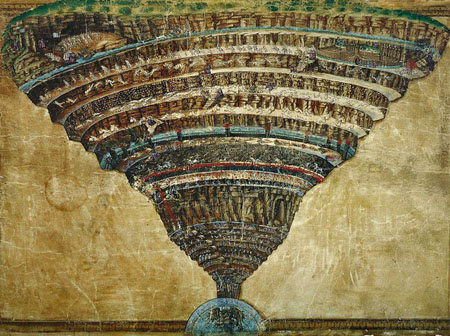
No doubt some of the Brexiteers realise that Donald Tusk might have been thinking about Dante’s Inferno (of which Wikipedia gives a useful summary for those who don’t want to read the whole allegory). “In the poem, Hell is depicted as nine concentric circles of torment located within the Earth; it is the ‘realm ... of those who have rejected spiritual values by yielding to bestial appetites or violence, or by perverting their human intellect to fraud or malice against their fellowmen’.”

Each circle is reserved for increasingly bad people. The bullseye at the bottom is reserved for the epitome of evil, the Devil. Two circles out from there is the eighth, the Circle of Fraud, which is subdivided into ten evil “ditches”, the Malebolge. Writing in the 1950s Dorothy L. Sayers described this as, "the image of the City in corruption: the progressive disintegration of every social relationship, personal and public. Sexuality, ecclesiastical and civil office, language, ownership, counsel, authority, psychic influence, and material interdependence – all the media of the community's interchange are perverted and falsified".

In the penultimate ditch Dante sees the “Sowers of Discord: In the Ninth Bolgia, the Sowers of Discord are hacked and mutilated for all eternity by a large demon wielding a bloody sword; their bodies are divided as, in life, their sin was to tear apart what God had intended to be united; these are the sinners who are 'ready to rip up the whole fabric of society to gratify a sectional egotism'. The souls must drag their ruined bodies around the ditch, their wounds healing in the course of the circuit, only to have the demon tear them apart anew.”
 
I don’t imagine at all that Donald Tusk sees the EU as God-given, merely as a proven instrument of peace and prosperity for Europe. Neither do I have reason to suppose his wondering went as far as consigning “those who promoted Brexit without even a sketch of a plan to deliver it safely” to the ninth ditch of the eighth circle of hell. But I wonder whether the cap fits.

Of course I am not so naïve as to suggest that the promoters of Brexit were the first or only perverters and falsifiers of all the media of the community's interchange. It was certainly one of their weapons, but we have seen it in such monsters as Cambridge Analytica, we have seen it in the political life of the USA, and in the widespread use of targeted disinformation used to justify military and economic interventions designed to destabilise societies. In this, patently, the internet is a pervasively powerful instrument, with the potential to cause more damage than an atom bomb. However, it is clear that the Brexit-movement has had the effect of magnifying unrest in many of whom we used to call our European friends, and who remain our European neighbours. Some Eurosceptics no doubt rejoice at witnessing the opening of Pandora’s box and anticipate Europe’s disintegration with glee.

“The opposite of truth is not just a lie; the opposite of truth is chaos, chaos that is in danger of bringing down the institutions we depend on…” We are now discovering that Dr Alexander was right. And “the living”, who are the next generation, are the ones who will have the task of bringing back truth, and rescuing order from the chaos.

Sunday, 2 December 2018

Are referendums democratic - or not? Let's get real.


I have kept my counsel with remarkable restraint for the past couple of years, but I’m sorry. I can do so no longer. Which is by way of a rant warning, but really… I have had enough of the continually repeated mantra, “Another referendum would be anti-democratic.”
Picture: LSE.ac.uk

For one thing you can’t have it both ways. For another it’s clearly fallacious. For a third I gather that if the government threatens that, if the House of Commons fails to approve Mrs May’s compromise Brexit deal, it will be presented for a vote again when, presumably, the markets’ negative reaction will have spooked MPs into changing their mind. For a fourth far from another referendum being a rerun of the June 2016 one, this would be the difference between voting on substantial proposals and voting on a promise of unicorns – and don’t dare tell me that the “ordinary voter” is too dim to understand what’s being proposed.

The pressure for a referendum came in the first place from the arch-Eurosceptics who had long peddled their myths about the EU. Now they have turned into a “research group” of sloganising Brexiteers who have been revealed as wearing the emperor’s clothes, or pin-striped suits. But they can’t have it both ways. They can’t claim that another referendum would not be democratic – if the first one was. Once you let the referendum cat out of the bag, as the logical Swiss know, there’s no way you can capture it again. It’s entirely democratic to say to the people, “Almost three years ago you voted by a small majority that we should leave the EU. Since then our keenest Brexiteers have been negotiating and this is the best package that your government have managed come up with. Is this what you want? The alternatives are to leave with no deal (which would mean the following…) or to stay in the EU and influence its decisions from within."

By the way, I have little patience with the Brexiteers’ bogus claim that the fact that both the Tories and Labour at the last election included implementing Brexit in their manifestoes indicates that 82.5% of people were in favour of that policy. What rubbish! I certainly voted for one of those parties. That does not indicate that I was voting for their every policy, but for the whole package that I judged would be best for the country and the team I trusted more. I suspect that is true of every voter in every election. That means that one is not entitled to extrapolate that each person who votes for a party also is endorsing each of its policies. It’s a fallacy. I voted to remain in Europe, but hoped that the parties would in the end see sense.

It's also a fallacy to call one plebiscite (referendum) an exercise of democracy and another a denial of democracy. You can argue that holding any referendum is a denial of representative, or parliamentary, democracy, based on the premise that the people vote for representatives they trust to debate and make informed decisions on their behalf. The 2016 referendum bears this out. The decision to hold a referendum was an abdication of parliamentary responsibility in the face of a fierce populist onslaught on the principle of parliamentary democracy.

There were rumours put out last week that, if Mrs May’s deal was not voted through on 11th December, then the MPs' Christmas break might be put off for another vote, I assume in the hope that there will enough hoo-hah from industry and the financial markets that they will change their minds. Their Christmas might even be cancelled! Hang on! If a second referendum is antidemocratic as is argued, how can a repeat vote in Parliament be democratic? You can’t have it both ways.

Another referendum on the other hand wouldn’t be a repeat vote. The issue is now quite different from June 2016. Then the question was simple: In or Out? But the evidence was all hypothetical. For example: Out, and the economy would suffer. Out, and the NHS would benefit by £35 million a week. Out, and we'll "regain control". Now we have a potential agreement for withdrawal and have concrete evidence for what would be entailed in the UK’s departure from the EU. And many MPs see that it is the worst of all worlds. I suspect more MPs are unhappy with the agreement now than ever were sceptical about the EU. What a pity they weren’t more effective in advocating its benefits all along.

As Brexiteers were wont to tell us and I agree with them, ordinary folk are quite capable of understanding facts and issues. The trouble before June 2016 is that they weren’t given them – because they weren’t known. We now know a whole lot more, for example about net migration, housing, schooling and the health service. We know exactly what the terms of the withdrawal agreement are. If the electorate was trusted once, why not trust them again? Perhaps the additional number of 18- to 20-year olds might affect the vote, which probably the Brexiteers fear. But in my opinion the outcome of any referendum is by no means a foregone conclusion. I fear Michael Gove might be right, "“I actually think if there were a second referendum people would probably vote to Leave in even larger numbers than they did before." However his claim that the very act of calling a second referendum would damage faith in democracy and rip apart the social fabric of this country would very much depend on him and his ilk. If damaging democracy becomes their strapline then a large minority of the population will swallow the bait, ignoring the fact that parliamentary democracy has already been damaged and relegated to being of less importance than plebiscite democracy. Were they to resist the Dominic Cummings' policy of social media slogans and discuss the real issues, it would be possible to reach the most desirable outcome of settling one way or another the present stalemate which is poisoning the UK’s body politic. 

I don't envy Theresa May and the Procrustean bed she chose to lie on. She has shown amazing courage in the past year as ministers have deserted her. I hope she will show yet more courage in trusting the people one more time. She might be surprised at the outcome. Will she, the government and MPs be prepared to take the risk of asking the country anew?

Saturday, 23 September 2017

A tale of two paradoxes

Two news stories have struck me this week. 

One is the extraordinary ineptness of the contractor employed to carry out tests for PIPs (Personal Independence Payments) for disabled people in the North East, who has hired rooms in a luxury spa owned by multi-millionaire, Duncan Bannatyne, for the purpose. I can imagine few things worse than being pushed in my wheelchair through a place thronging with healthy and wealthy spa-goers padding around in fluffy slippers and snow-white bath robes on their way to a massage, a manicure, and a meal of coleslaw and prosciutto, or working off their excess weight on cross-trainers, or showing off their finely toned bodies between the swimming pool and the sauna. It is hard to imagine a more inappropriate venue for what is already a humiliating enough experience - an assessment designed to save the government £1.3bn by 2020, by cutting the number of people who receive DLA (Disability Living Allowance, being replaced by PIPs) and in particular the mobility element which gave disabled people freedom to get out and about. 

It is true that supporting the disabled costs us all a lot of money. It's also true that the introduction of PIPs has already caused a lot of personal harm and hardship. "PIP assessments have so far led to Motability cars being taken away from 50,000 disabled people.  
When the new assessments were announced to replace the Disability Living Allowance (DLA) in 2016, it was estimated that entitlements would be cut by up to £150 a week for more than half a million people." See Huffington Post article.  See Huffington Post article. The irony is that the sum result of a lot of misery for a section of the population will in the end barely dent our social services bill a jot, if at all.

I do realise that a while ago I made a resolution not to whinge so much. But really! Sometimes it all gets too much. So here's my second one. It's about Theresa May's much touted Florence speech. I'm not entirely clear why her minders chose to stage it there. I gather it might have been because of the trading/banking history of the city, or it might have been some sort of convoluted symbolism to do with the Renaissance. Here she was, in the tradition of Michelangelo and the Medicis, launching a second Renaissance in Europe, Mrs May's Renaissance. From the news reports that seems to have been the gist of her message. Brexit is not an end; it's a beginning. It's not a divorce; it's a new glorious "partnership". There were precious few details of what the partnership would look like, just like nothing we had seen before and we need some more time to think about it. What must puzzle objective observers is, then what Brexit was all about. In the referendum campaign we were constantly told that it was about breaking off with the EU, having done with it, breaking free from its shackles. Which sounded very much like a divorce, a very acrimonious one at that. It sounded like "a plague on all your 27 houses".

"Brexit," Mrs May intoned, like a mantra, "is Brexit." Now it appears, "Brexit is Brentrance." Whether Europe will allow us to have our cake and eat it remains to be seen.

Wednesday, 26 October 2016

A nightmare versus a dream

The fact that the Conservatives won't oppose Zac Goldsmith in the by-election for Richmond Park says it all. What more eloquent testimony could there be for their lack of conviction that "this is the right thing for the country", as Chris Grayling, Secretary of State for Transport, has adopted as his mantra? If it is, then make the case so persuasively that the residents of Harmondsworth, Harlington, Sipson, Longford, and Richmond vote for you. See how those directly affected by the environmental pollution vote. They might agree.
Photo : Premier org.uk

The project will apparently generate employment for thousands and billions of pounds of national wealth. What's not apparent is why this proposal would generate more than any others - except perhaps in demolishing 950 homes and resettling their occupants, presumably in places not of their choosing, and bulldozing an ancient church and village green. As too often with current governmental decisions, the public rationale is financial and not human. Value for money is elevated above quality of life. There is the implicit accusation of selfish nimbyism. "Take a hit for the rest of us" has been the political philosophy of the past couple of administrations, addressed to the most vulnerable within society - the easiest to target.

However, it's all very well to be negative. What better solution is there? The London airport commission, we are told, thoroughly examined the alternatives and ruled in favour of a third Heathrow runway. Clearly I've not read the report, but I strongly suspect that its overriding criteria were economic. Reluctant though I am to admit any merits in one of Boris Johnson's madcap dreams, I do in fact think that his Thames Estuary island scheme was the most visionary. A brand new hub airport with approaches over the sea and 21st-century infrastructure into London would of course cost more than building an extra runway, but as the Transport Secretary has been at pains to affirm it would be provided by private finance. And the human cost would be far less. Maybe it would impinge on the good burgers of Essex and Kent, were the flight paths badly delineated. Yet one could envisage an eventual reduction in the impact of Heathrow as it ceased to be the hub airport for London, the UK and the world.

I recall the days when there were soundings for a new London airport in rural Buckinghamshire (for example at Wing). Fortunately those were binned. Hopefully Heathrow's third runway will go the same way, and Boris Island will rise from the waves. Now that would be a small legacy to offset the disaster of Brexit.