Showing posts with label Oxford. Show all posts

Thursday, 6 February 2025

The British silicon valley?

Rachel Reeves
 You might have imagined that, having been privileged to study at both Cambridge and Oxford, I would have been delighted with Rachel Reeves, the Chancellor of the Exchequer (Finance Minister), when last week she announced plans to create a "silicon valley" type corridor between the two university towns. However having been born a Geordie and having spent seven years (including a further degree) north of the Watford Gap services, I'm not entirely a southerner.

Sadiq Khan
She claimed it would add £78 billion to the UK economy - so it must be a good thing, mustn't it? (BBC report 29th January). It reminded me of the Yes Minister episode about why the M40 had been built; the answer was because all the top civil servants wanted a quick route to the feasts at their old colleges. I suppose the proposal for a third runway at Heathrow Airport is connected to the unnecessary development of the already over-developed south of England, despite the claims it would benefit regions as far away as Scootland (40% south-east / 60% the rest). The one thing no doubt the rest of the country should feel grateful for is that Londoners will have to endure the extra air pollution and aircraft noise. No wonder, having done so much to clean up the city, the mayor, Sadiq Khan, does not share Ms Reeves' enthusiasm for the plan.

Instead of pouring further resources into the already well-resourced south, why does not this Labour government which benefitted so greatly from the double collapse of the Tory "red wall" in the north of England and of the Scottish Nationalists north of the border - and it was a matter of collapse rather than of a victory of ideology - why does it not capitalise on their regional advances and invest in those areas? Failure to will, I fear and predict, lose it much of the ground it gained at last year's election. 

There are other academic centres of excellence apart from the privileged élites of Oxbridge. For example, Manchester is at the forefront of technical innovation; Sheffield University hosts pioneering medical research. And further north Scottish universities are no less vigorous. Isn't it time that a Labour government sets the lead in affirming its commitment to levelling up in more than token gestures such as removing charitable status tax relief from private (aka public) schools? Invest in trans-Penine links between Lancashire and Yorkshire, put money (encourage investment in) into developing regional airports, promote northern universities? Forget about Cambridge and Oxford - they don't need more help to swim.            

Thursday, 19 November 2020

Taking away and giving - we're not the only ones with COVID-19

After the heady and headline-grabbing political news of last week, I've noticed two hopeful pieces of news this week, which seem to have slipped by most media unremarked. One came in the shape of a speech on Tuesday; and the other was a comment on BBC Radio 4's Today programme this morning. 

Andrew Mitchell MP
The first was a speech made by Andrew Mitchell MP for Sutton Coldfield (formerly International Development Secretary) in the House of Commons, introducing a private member's bill entitled "Doctors and Nurses (Developing Countries) Bill". The gist of his speech is "The case we make to Parliament and the Government today is as follows: it is immoral and selfish for Britain, with its wealth and infrastructure, to poach doctors from the developing world. However, by taking the action I have suggested, we can turn that into a win-win for us and for developing countries." When we persuade a doctor from the developing world to come here, we do so in the knowledge that our gain will inevitably be their country’s loss. In this country, we have 215 doctors, nurses, health workers and midwives from Sierra Leone; from Nigeria, 4,099; from Pakistan, 3,394; from Ghana, 1,118; and from India, just short of 20,000. He pointed out the disproportion of the ratios of doctors per head of population here compared to that in countries we import from, and "how much we rely on those doctors and nurses and other healthcare workers who bring their talents and skills to this country to support our NHS from overseas. We respect them and we are hugely grateful to them. Indeed, if I may use a second world war analogy, much beloved by some of my hon. Friends, the heroes of this war against covid are not, as in the battle of Britain, the men and women of the Royal Air Force but, all too often, workers from overseas working in our hospitals, giving their all in our care homes, putting themselves in harm’s way, and often living on the minimum wage." 

So he proposed, "Why not do the following? For every doctor or nurse we poach from a developing nation, we should ensure that that developing country—on losing their trained professional to our advantage—receives from the existing British development budget sufficient resources to train up and replace them, two for one? When we are lucky enough to secure such professionals from the developing world, we should replace them twice over, and expand their public health services accordingly." 

What a brilliantly simple idea! Undoubtedly we owe a debt of gratitude to the nations from whom we poach professionals to prop up our National Health Service. Undoubtedly it is immoral to rob the poor to enrich the wealthy. Remember David and Bathsheba - and Nathan's parable? We're in the same territory.

Prof Andrew Pollard
The other news came in an interview with Professor Andrew Pollard from the Oxford Vaccine Group. Nick Robinson was asking him about the Oxford AstraZeneca vaccine. There's good news on that front as well as last week's from Pfizer/BioNTech and Moderna who seem to be in an efficacy arms race. The good news was that the Oxford vaccine seems to lose none of its effectiveness with us oldies; and moreover it's the vaccine in which the UK government has most heavily invested, having ordered 100 million doses. (Quite why the government wants a stockpile of 340 million doses, which it has ordered in total, even at two per person, with a population of 68 million beats me - maybe they intend to give the surplus away...) However the good news was that the Oxford vaccine unlike the BioNTech and Moderna equivalents does not require to be stored at temperatures more suited to the Arctic than the Tropics. "Right from the beginning our goal has been to develop a vaccine that could be distributed everywhere, and that's not a question just for the UK where of course we've got the infrastructure that can be put in place to manage whatever the storage requirements are, but we're looking globally. We really want to get to every corner of the world if indeed the vaccine is shown to work." As he implied later, if the virus persists in some parts of the world, the possibility of reinfection will always be there. 

How good it was to hear someone else looking beyond our shores and realising as Prince Charles remembered in Berlin on Sunday that no man and no country is really an island entire unto itself. Obversely how chilling to hear suggestions that the £16.5 billion defence budget increase might be at the expense of the overseas aid budget. I gather that the Treasury is trying to claw back some of the billions that have been splashed out on covid-related contracts from our overseas aid commitment of 0.7%. Tragic. 

A friend of mine commenting on Andrew Mitchell's proposal wrote, "This is what we ought to be doing and, if it happens, would make Britain truly great, and me proud to be British!" I agree.

Saturday, 20 August 2011

In with the in-laws

After a few heavy posts it's time for something lighter. On Thursday we bade a fond farewell to Jane's parents after a short stay here. Her mum, you may recall, recently fell down six steps in their garden. She's clearly made of tougher stuff than me! She's back in one piece and going like a Duracell bunny.

One mealtime I asked her father whether he was on HMS Paladin when HMS Cornwall was sunk on 5th April 1942 in the Indian Ocean. My late uncle was on board the Cornwall as doctor. It was attacked by Japanese dive bombers and sunk within 12 minutes. My father-in-law was on the Paladin which was one of the boats which rescued the survivors. So there's the intriguing possibility that my future father-in-law met my uncle in the middle of the war, even fished him out of the sea. He told me that the Cornwall's captain had kept the men singing (mainly hymns) as they waited in the sea for rescue, hanging on to debris and floats for up to 30 hours. I imagine Uncle Paul was leading the singing.

Tuesday was warm and sunny, if you remember, and so we decided an expedition was in order, nothing too demanding - just the Oxford Botanic Gardens and then across the road to have lunch in the Old Kitchens in Magdalen College, which we thought they'd like. I think I was the most excited to find an episode of Lewis being filmed there (the fictional Morse's promoted side-kick, to be

distinguished from Magdalen's brilliant real life don, C S Lewis). Anyway there the crew were hard at work: "Let's do it again... and again..." The crime scene seemed to be on the banks or in the waters of the Cherwell. And there were the actors and extras looking extraordinarily unexcited! I got Jane to ask an assistant when the episode would be - probably no 4 or 6 in the new series. I'll obviously have to record the series.


The gardens themselves gave me plenty of opportunities to use the camera Jane gave me for my birthday, with its zoom and  close-ups. Had a bit of trouble getting into the disabled loo but am happy to report it is a good one.

Then it was over to Magdalen. For wheelchair users they have to open the main wooden doors ("otherwise reserved for the Queen" - and anyone else who needs it!). The Old Kitchens are a good place for an economical lunch in congenial surroundings (e.g. £2 for a bowl of soup, croutons and a roll). Then we wandered through the grounds (herbaceous borders better than over the road, according to one gardener amongst us) and into the chapel with its remarkable copy of Leonardo da Vinci's Last Supper, before home.

Otherwise our time was spent together talking, puzzling over codewords and crosswords, and neglecting the TV - which I gather we in the UK watch for an average of 4.3 hours per day, to the detriment of our longevity. We should be out walking regularly instead enjoying the beautiful world we've been born into. And I reckon enjoying plenty of good company such as we've just had - and of course in the picture!

Monday, 11 April 2011

A tale of three parts

Snake's-head fritillary near our safe house
"Gallia est omnis divisa in tres partes" (All Gaul is divided into three parts). I'm glad to say my last week had nothing in common with Julius Caesar's Gallic Wars, except falling into three parts. These may conveniently be labelled the shires of Devon, Cambridge, and Oxford.
The stream in the valley

Part 1 - Devon.
Returned to our remote 'safe house' where we chilled out, enjoyed the neighbouring walks (Jane and Jess) and the views (Jane and me). Among other things the farm has wild flower meadows, enjoyed by the local bees and containing flowers as common as violets and unusual as snake's head fritillaries.
One of the two beehives

Budleigh Salterton front from the hill
As well as visiting Jane's parents, we spent most of Wednesday exploring down and up the Otter Trail (from Otterton to Budleigh Salterton). Bit of a facer there :-( . The public toilets at the east of the prom were being refurbished, and I'm sure they'll look very nice soon, but there was no notice of apology or indication where the nearest ones might be. We asked one workman. He wasn't local, so he shouted to his mate on the roof. "Where's the next loos? These folk is desperate." (Not really.) "800 yards along the front, up there!" He omitted to tell us one vital fact....
Man from Mars (note the aerials)

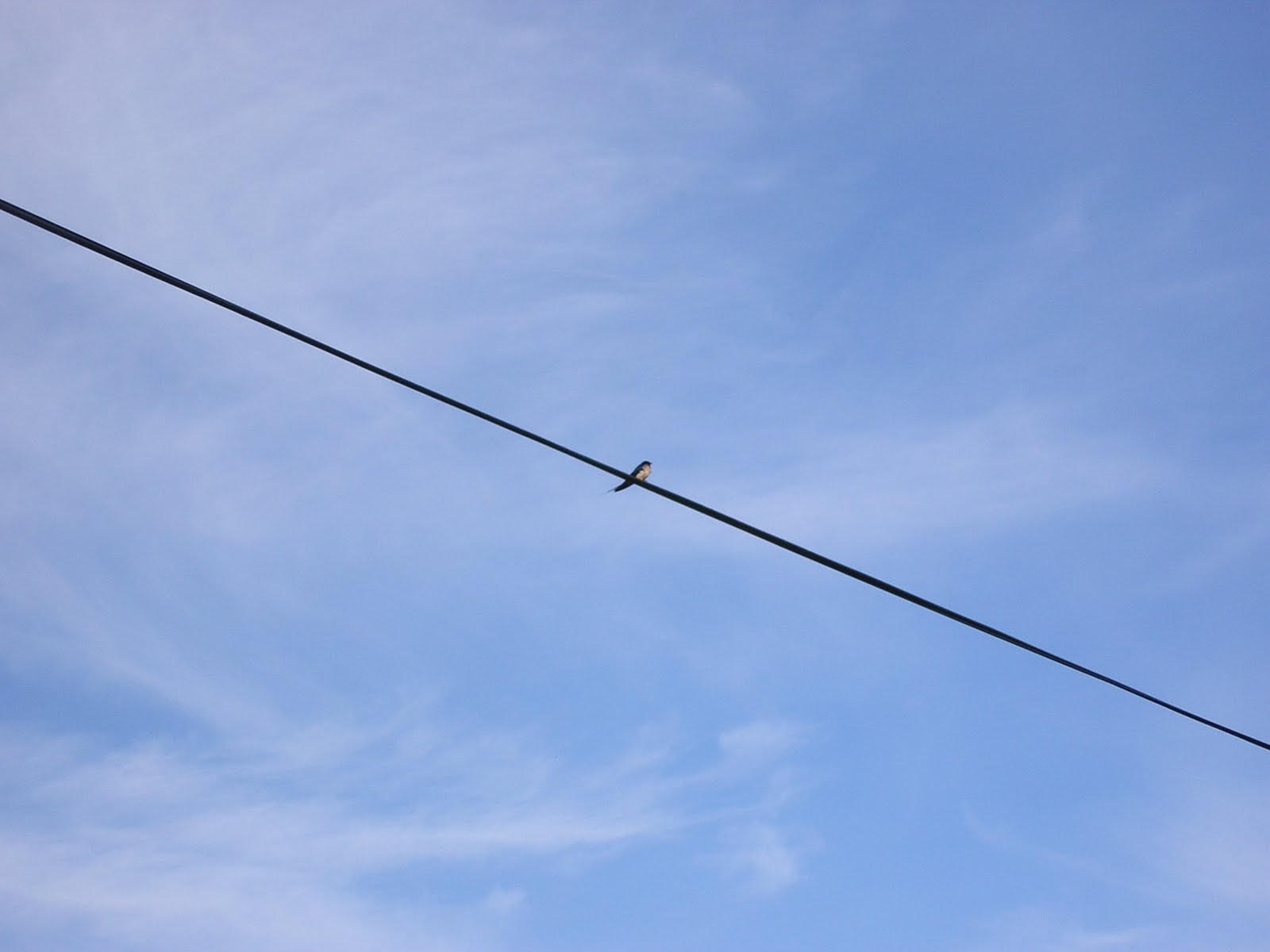
Very pleasant it was, sitting in the wheelchair, with the sound of the waves on the shingle and the cry of the gulls, and the sun shining on the lee of the cliff. Jane however had to push me. And it's not a gentle incline at the western end. In fact as the metres extended to kilometres, the lady we asked suggested we go through the village "as the slope's easier". I'm sure she was right but navigating a street with a wheelchair and a dog put us off, and Jane opted for the one in five hill. Undefeated, we reached our destination. The Gents had metal security gates and steps leading down out of sight. So round the corner in search of the Disabled. Nothing - just Ladies, with again a turnstile arrangement and steps down. Well, Jane availed herself, before pushing me back more than mile to the car - to be greeted by a couple of swallows. "Summer is a-cumen in" - I couldn't remember whether it's one swallow or two that don't make a summer. Whatever - it was a thoroughly summery day, topped off by a shared cream tea at Otterton Mill with its very friendly and obliging staff - including access to limited but adequate disabled facilities.
One obliging swallow
We had to come home on Thursday afternoon to be ready for Part 2, and so Part 1 ended with a relaxing morning and lunch at the cottage, disturbed only by a helicopter inspecting power lines.

Part 2 - Cambridge
Ridley's Walk (or Dewey's, for our generation)
It's 40 years since I left Cambridge. Consequently my old college, Pembroke, invited me to a Feast, along with my contemporaries, of course. A feast is not much good for me, trying to eat and mumbling to make myself understood against a background of decreasingly intelligent chatter, but an opportunity to see my long-lost (and highly intelligent) buddies seemed too good to be missed. So we arranged to go to tea first, to stay overnight and to have breakfast, and hope to see friends at greater leisure. And it worked well, with the bonus of a quiet meal with our good friends, Nic and Martin, with young daughter Hannah near Huntingdon.

The Guest Dormitory M4a
Our guest room had the advantage of being very conveniently situated, even if it looked as though it was awaiting the final phase of college modernisation. The weather of course was perfect - clear skies, blossom out... completing the illusion that student-life was one blissful summer. Sadly, again, we had to tear ourselves away from the realms of nostalgia to return to an altogether inferior place, the Holiday Inn in Oxford.

Part 3 - Oxford
Matt Jones & Team Diddy present £5100+
We were heading for the local MNDA Branch AGM, and considering the time we left Cambridge were creditably on time. There were the usual reports and elections. Perhaps the most significant fact I picked up was that expenditure was 30+% above income - of course need for help for MND patients never diminishes and demand is constantly being renewed. Although the MNDA has a very committed support base, clearly the squeeze affects its income as much as the next charity.

During the lunch break Tracy the MND Centre's speech therapist showed me the programmes for iPads, iPods and iPads for synthesising speech, as well as the different controls and speakers you can use. Unlike the old systems you can get English voices (and even Aussie), not just American, and they're much cheaper than the old market leading Lightwriter. I don't absolutely need one yet, but I can foresee it being a useful technology.

Kirstine Knox waiting (Colin Blakemore lt)
Then, after some technical projection problems, we had the MNDA's big boss, Kirstine Knox, talking about the scope and future of the association. She sent her young daughter fast asleep, but the rest of us were quite interested!

Glad to be home!
When we returned home, there were two NHS letters awaiting me: one from my consultant, Dr Donaghy, telling us he was retiring before my next appointment. It's a bit of a blow, because, as you know, I liked and trusted him a lot. However, he is handing me on to Prof Talbot who runs the MND Centre, and is also an exceedingly nice man. The other I though would be from the hospital summoning me to have my tooth removed, but no, it was from Didcot Dental Clinic summoning me for a full assessment at the end of the month. When Jane queried it by phone, she was told the waiting list at the hospital was "sometimes over a year" and that a specialist dentist would be seeing if something could be done in the clinic instead, and no, they wouldn't do treatment then.... Hmm. Is this the beginning of decay in NHS provision, I wonder.

Thursday, 31 March 2011

Inspiring evening

That was a big night out! Yesterday Jane and I went to the Private View of the Incurable Optimism exhibition in the beautiful Natural Museum in Oxford. Personally I think it's one of the best buildings in Oxford. Victorian neo-gothic at its lightest and most pleasing, welcome relief from all those olde-worlde piles that adorn Oxford's streets - to say nothing of its fascinating contents.

The exhibition which runs to 6th May is of the first 18 paintings of his projected 100 by Patrick Joyce, an artist who has aggressive MND. Patrick the optimist's website. You can see the portraits of people who've inspired him on his website, and the short films he's also made. They include his consultant, Martin Turner, carers like his wife and fellow sufferers of MND including Stephen Hawking. Patrick wants to have reached the 100 before he dies.
Patrick Joyce, the artist

That's half of the exhibition. The other half focuses on the cutting-edge research carried on by the MND team in Oxford, to do with finding a biomarker for diagnosis of MND (The BioMOx project). The BioMOx project has already found a "finger print" which can be detected by sophisticated MRI scans. It's led by Martin Turner. If you want to understand more about the human and scientific impact of the disease, here's a very good place to start - with no admission charge of course.
A good number of our Oxfordshire friends were there, most of us in our wheelchairs. Professor Colin Blakemore opened the exhibition, followed by Martin Turner explaining his research and his friendship with Patrick, who then also said a little. There was bubbly and juice and a host of canapés. Only shame restrained me! I met up again with Matt Jones (Blog:1st February) whose mother, Lorraine, was diagnosed last autumn. You may remember he was intending to run the Reading Half-Marathon to raise money for the MNDA. His target then was £500. He's since run it, and raised over £5,000 with more coming in. He told me about someone whose aim was to raise £100,000 in ten years; he still has some years to go but has already topped £70,000. I also met a friend's husband who is off to China for a week to walk along the Great Wall (not all 5,500 miles of it!) to raise money.
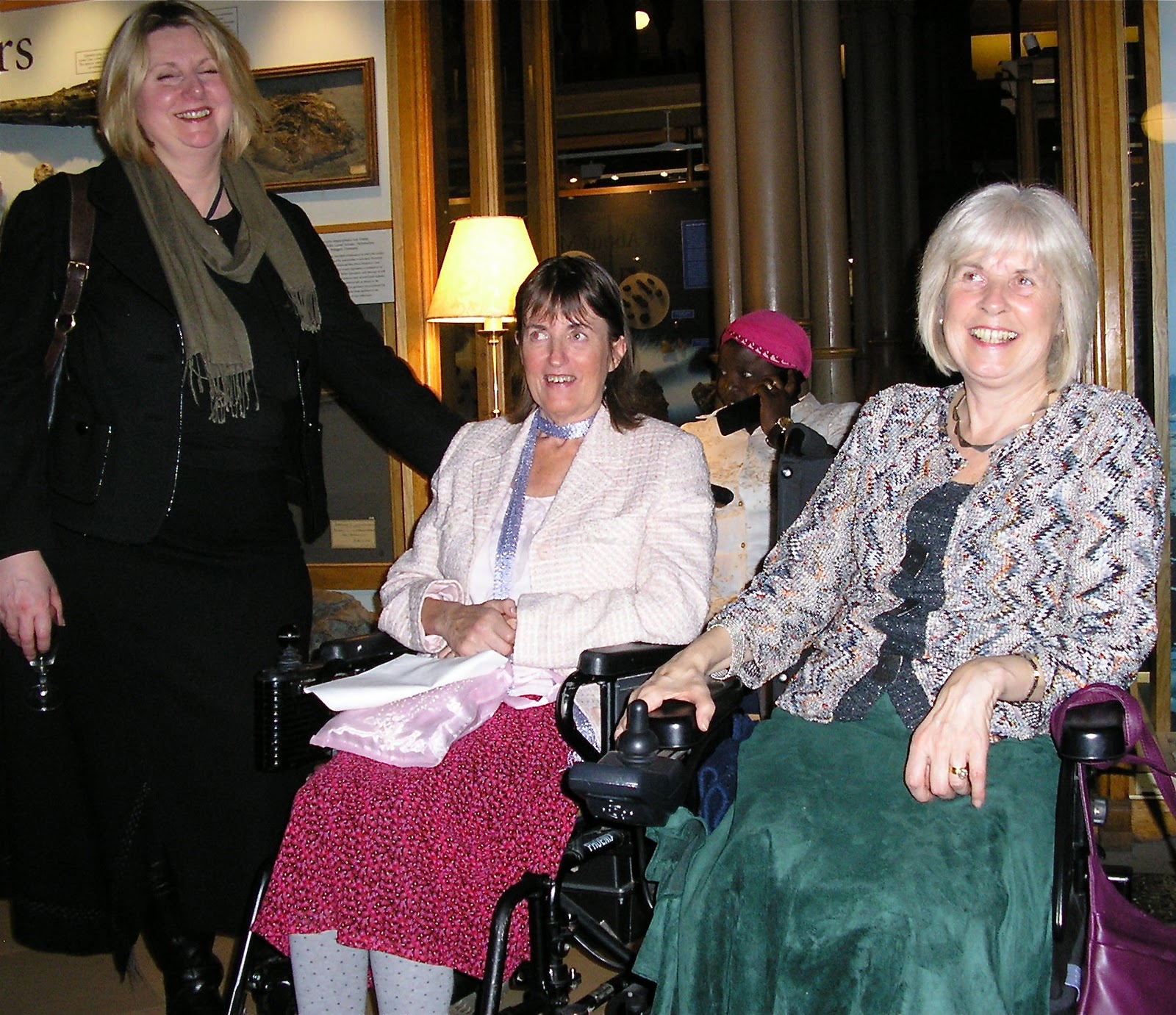
Jane, Moira & Jean

Mel, MNDA communications, & Jean, trustee

I suppose the severity and mystery of MND, as well as its relative rarity (compared for example with cancer), provokes urgency in those involved in any way to find its causes and treatments for it. I've commented before on the positive friendships that exist between MND patients. Anyway, as darkness fell outside, I remembered to take some photos before we descended in the lift and wended our way home.
Exhibition stands with great hall behind
PS If you come on Easter Saturday afternoon, you might find Jane and me manning the exhibition.