Showing posts with label the Cross. Show all posts

Saturday, 5 March 2022

A Word for the Day

We read Reflections for Daily Prayer most days. Today's, by Philip North, Bishop of Burnley, was particularly apt. As my wife commented, "I don't suppose he had any idea how appropriate it would be when he wrote it." Could Putin be a contemporary Pharaoh? I wonder.


"We live in a world in which the colossal global strongholds of political power, military might and corporate dominance seem all pervasive - a world in which the gentle teaching of a roving preacher who lived 2,000 years ago in Galilee can so swiftly be drowned out or perceived as irrelevant.                                                                                         "But just as mighty Pharaoh needed the jailbird, so even the powers of the twenty-first century need with all their hearts the man nailed to the cross."

Monday, 11 October 2021

A new Pietá

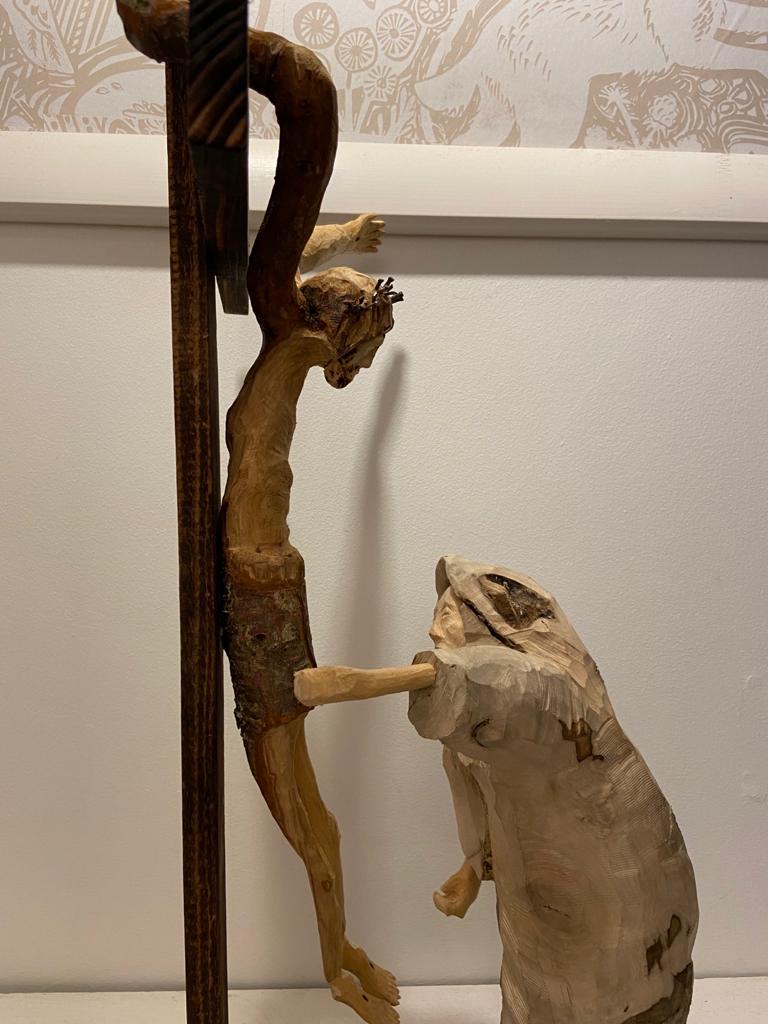
Yesterday I was presented with a work of art which left me speechless. It was crafted by a relatively unknown South Devon artist. Here it is in its temporary resting place.

 © Pietá by David Milnes


David Milnes and I have been friends since schooldays. In correspondence with him in August, I wrote: "As for the 'commission', in one of my novels I wrote about someone facing the loss of someone she loved identifying with Mary at the cross. She seems to me the person who most experiences the desolation of dereliction in the Bible. And I’ve long thought that evangelicals have failed to engage our imaginations in the gospel story. What must it have been like at the moment of Jesus’ death? So I’ve been looking for something that expresses the grief, disappointment and pain as they begin to take the body down. The characters I was looking at around the cross were Mary the mother, John the friend and Mary Magdalene who’s in love with Him (parent, saint and sinner - all humankind). It seems to me that all of us in our dark moments think the God we believed in and who is love has died and abandoned us. For many a resurrection morning never dawns. Which, I guess, we all fear and which is why, I think, we need each other to hold on to as we wait."  

David immediately set to work. He'd picked up, to his relief, that I wasn't looking for an serene scene carved in marble like Michelangelo's masterpiece. He'd been impressed by Fenwick Lawson's Pietá in Durham cathedral carved from "the rough split rawness of large logs".

© Picture Durham Cathedral
 

This is David's description of his own work. "For the figure of Christ I have used a section of a plum tree   in our garden. It is dead, twisted and covered in lichen. Two side branches looked like contorted arms writhing in pain and desolation. The connection between the arms is not realistically correct but suggests dislocation and extreme pain. The main branch is thinner than the body should actually be, but elongated bodies suggesting suffering were good enough for El Greco, so why not? In order to make the hands, feet and face stand out and in order to emphasise their vulnerability, I carved them separately in lime wood that enabled me to include greater detail. The marks of the nails and the spear in his side were burnt into the wood. 

"The cross is not a beautiful, smooth and varnished piece of neat carpentry. It is a rough piece of pallet wood which I have scorched. Burning has close associations with pain and destruction.

"For the figure of Mary, as she reaches out to help remove her badly mutilated son from the cross, I used a piece of holly wood which is solid and heavy with sorrow. It has twists and knots and rotted areas which are indicative of the terrible trauma and devastating blows that she has endured. It is very different wood from that used for the figure of Christ but it suggests suffering which is different but just as all consuming."

I love the rawness of this Pietá. It is certainly a discomforting addition to a sitting room. I like the fact that Mary is not portrayed as a beautiful young saint but as a middle-aged mother whose years of bringing up children in occupied territories have taken their toll on her physically. She is one of the many middle-eastern women grieving for their sons killed in a reprisal air raid. I like the proportions of the carving. To her Jesus is still the small child she held in her arms. I like David's choice of woods: Using for Mary the wood of the holly tree, which two Christmas carols associate with the suffering of Mary - "the holly bears a bark as bitter as any gall". And he has used fruit wood for the body of Christ. Humankind's fall from grace came through eating the forbidden fruit; its restoration to grace comes through "eating my body", as Christ put it. And the wood on which he hangs, a discarded pallet to crucify the rejected carpenter's son. The artist's brother pointed out that Mary is seen as left-handed - so maybe represents despised minorities and those considered weak. Theologians may recognise in the emaciated crucified body a depiction of what they call κένωσις, Christ emptying himself "taking the form of a slave and becoming obedient even to death on a cross".

As my son commented, "What a gift!" Whether he meant what a talent or what a present, I don't know. Probably both. And on both counts he's right.

© Photo Courtesy John Milnes

© Photo Courtesy John Milnes

© Photo Courtesy John Milnes


© Photo Courtesy John Milnes


Friday, 21 February 2014

To my friends (part 2)

In Elgar's dramatic oratorio The Dream of Gerontius there's a magnificent setting of what we know as the hymn "Praise to the Holiest"In the middle there's a section where the phrase, "O generous love", is echoed by the different voices in counterpoint.

I've been haunted by that phrase since writing the blog post To my friends , because it seems to me that in the two words, generous love, there lies the key to understanding what makes for good love. Although I am writing from within the Christian tradition, I hope that, whether you are of one faith or of none, you'll read through to my conclusion, which if it's right applies universally!
       
"O generous love! that He who smote
 In man for man the foe,
 The double agony in man
 For man should undergo;

 And in the garden secretly,
 And on the cross on high,
 Should teach His brethren and inspire
 To suffer and to die."
John Henry Newman’s poem in which generous love appears is clearly speaking about the self-sacrificial love (agapé) of the cross. "God is crucified - my Friend died - in some way, for me" (Justin Welby in his preface to Graham Tomlin's Looking through the Cross). However it could as well be a test for all other kinds of love, including sexual love (eros). In the often misinterpreted discussion of marital relations, husbands are told, "Love your wives, as Christ loved the church and gave himself up for her" (Ephesians 5.25).                              

Self-giving is the essence of every love. "Love one another as I have loved you." "Greater love has no one than this, that someone lay down his love for his friends." "Love does not insist on its own way."

The Song of Solomon is the Bible's great love poem. It is a passionate dialogue in which the two lovers are totally absorbed in the other. "My beloved is mine, and I am his". "Let my beloved come to his garden, and eat its choicest fruits." "Turn away your eyes from me, for they overwhelm me". "My dove, my perfect one, is the only one for me". The lovers seek only each other's good and pleasure. They are utterly uninterested in themselves, only their beloved. It's a high ideal of love. It's a world away from the contemporary cultivation of self-gratification, which is an inversion of love. That is, of course, self-love. 

No one is entirely free of self-love, especially in the realm of sexual relationship. It makes no difference; whether heterosexual or homosexual, there is a tendency to seek satisfaction for oneself. I'm reminded of James' vivid analysis of the causes of conflict and violence ("You desire and do not have, so you murder"). Rape is a perverted form of self-gratification which has no regard for the other. It is the extreme negation of love in what was intended as the ultimate expression of love.  Instead of being good, it is evil. Instead of being a creative act, it is a destructive one.

Creation in a sexual act is not confined to procreation. It is also the affirmation of the other as a person, imago Dei, in the image of God. It acknowledges their otherness. It asserts their beauty. As it used to say in the Marriage Service, it is an act of worship ("With my body I thee worship").

The test for everyone in a sexual relationship is, "Is your love generous?" In other words, at heart is it self-giving, not self-seeking? Is your desire not your own satisfaction, but the pleasure and satisfaction of the other? Do you surrender to your partner's wish, or do you insist on your own way?

And the ultimate test is, are you committed enough to give your life for the one you love? Will you stick with them whatever happens and whatever it costs until death separates you?

No one is entirely free of self-love. No one is perfect. However it seems to me that the nature of the love at the heart of our relationships, its generosity, is more important than the nature of our sexual orientation. Generous love is not a temporary madness; it is the greatest of divine gifts.