Showing posts with label truth. Show all posts

Saturday, 11 February 2023

Fear and trembling (part 1)

It was with a certain amount of trepidation that I started to watch the Wednesday afternoon's debate on prayers of blessing for same-sex partners in the Church of England's General Synod. What an arcane process! One wonders what mind devised such a weird institution to decide church affairs. What a depressing watch! So much distrust in a Christian community.

Apparently the Synod has powers to legislate in church matters devolved by Parliament - which might explain the convolutions and the politicking of speakers. It seemed an unholy spectacle of power-playing. Occasionally I had glimpses of what resonated to me as good theology. Mostly there were unsubstantiated assumptions, stated as unquestionable truths, for example that marriage always has been exclusively between one man and woman, that sex before marriage has always been regarded as wrong.

It turned out that my trepidation was justified. The members got tired and the debate extended to Thursday morning, and after 28 amendments and eight hours' discussion a vote on the motion (amended) was taken and narrowly won. The star of the show was undoubtedly Geoffrey Tattersall KC who gracefully chaired the whole thing and stuck to the standing orders much to the irritation of those who wanted to gun for the Bishops. Second to him was the Bishop of London, and formerly Chief Nursing Officer of England, Sarah Mullally. It was her job to answer every amendment which she did with reason and calmness. I was saddened by the refusal of many to trust her integrity and that of others.

There was, it seemed to me, a concerted effort by the procedural device of amendments to delay or thwart the Bishops' proposals. I had the sense of a flexing of muscles by some influential and well-endowed parts of the Church to have their own way. Well, I suppose that's the nature of democracy, but I'm not sure it's the way of Christ. There was talk of the sanctity of truth. However, I'm not sure whether it wasn't the old Hellenistic and Enlightenment view of truth, i.e. propositional reason, rather than the Christian view, that truth is relational. Hence faith and love are relational, not credal. 

Whether the Bishops will be given the grace to find what a friend describes as the way of "reconciliation – how to live with people one can’t bear – starting from oneself sometimes" remains to be seen. People of goodwill will pray so.

Friday, 8 February 2019

In defence of Dr Nikki Alexander and Dr Donald Tusk

As you may know, I’m an avid viewer of BBC Television’s Silent Witness. I’m always sad when a series comes to an end, as No 22 did on Tuesday. As ever, it was a contemporary storyline and it had an individual conundrum running through it. That was a crisis of trust in one of the team of forensic pathologists around whom the series revolves. Dr Nikki Alexander (played by Emilia Fox) is the scrupulous lead pathologist whose results are challenged in court in an appeal concerning the death of a policeman. Somehow the original evidence has been corrupted by an interested party. Here ends the plot spoiler.
The episodes end with Nikki as witness, as the individual responsible for sabotaging the forensic evidence appears in court. She is asked by the prosecuting barrister:
Dr Alexander, what are the consequences of the defendant’s actions on your work?
She replies:
“What’s the point of experts if nobody trusts them? What’s the point of evidence if it can so easily be contaminated? The whole integrity of what we strive to achieve could have been catastrophically undermined. What my colleagues and I seek to do is understand the cause and manner of a person’s death. But we don’t only deal with the dead; we deal with the living – the families, the judiciary, the coroner, the police, the public, the press. And they all have to trust us, and if there is a betrayal of that trust, there is a crime. The opposite of truth is not just a lie; the opposite of truth is chaos, chaos that is in danger of bringing down the institutions we depend on – to deliver justice.”
Thank you, Dr Alexander.

During the referendum campaign, The Daily Telegraph reported on 10th June 2016:
“I think people in this country,” declared Vote Leave’s Michael Gove, “have had enough of experts.” His fellow Brexiteers were quick to back him up. “There is only one expert that matters,” said Labour MP Gisela Stuart, also of Vote Leave, “and that’s you, the voter.” Nigel Farage, the leader of Ukip, suggested that many independent experts were actually in the pay of the Government or the EU. This concerted undermining of experts was a major tactic of the Leave Campaign. Warnings of the complexity and potential consequences of exiting from real experts were poo-pooed, and who can forget the nonsense of the red bus? "The opposite of truth is not just a lie; the opposite of truth is chaos, chaos that is in danger of bringing down the institutions we depend on…" And we are now reaping the whirlwind.

Which explains Donald Tusk, the European Council President’s comments: “I have been wondering what the special place in hell looks like for those who promoted Brexit without even a sketch of a plan to deliver it safely.” And I guess it also explains the intemperate response of leading Brexiteers to his musings. Commons leader, Andrea Leadsom, who campaigned for Britain's exit from the EU, said Mr Tusk should apologise for his "disgraceful" and "spiteful" comments.

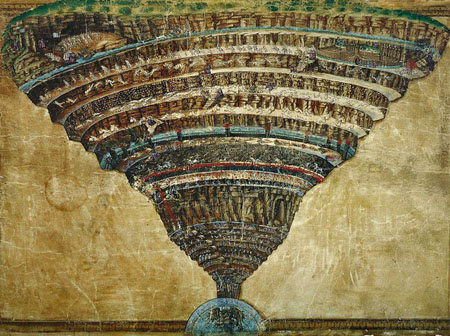
No doubt some of the Brexiteers realise that Donald Tusk might have been thinking about Dante’s Inferno (of which Wikipedia gives a useful summary for those who don’t want to read the whole allegory). “In the poem, Hell is depicted as nine concentric circles of torment located within the Earth; it is the ‘realm ... of those who have rejected spiritual values by yielding to bestial appetites or violence, or by perverting their human intellect to fraud or malice against their fellowmen’.”

Each circle is reserved for increasingly bad people. The bullseye at the bottom is reserved for the epitome of evil, the Devil. Two circles out from there is the eighth, the Circle of Fraud, which is subdivided into ten evil “ditches”, the Malebolge. Writing in the 1950s Dorothy L. Sayers described this as, "the image of the City in corruption: the progressive disintegration of every social relationship, personal and public. Sexuality, ecclesiastical and civil office, language, ownership, counsel, authority, psychic influence, and material interdependence – all the media of the community's interchange are perverted and falsified".

In the penultimate ditch Dante sees the “Sowers of Discord: In the Ninth Bolgia, the Sowers of Discord are hacked and mutilated for all eternity by a large demon wielding a bloody sword; their bodies are divided as, in life, their sin was to tear apart what God had intended to be united; these are the sinners who are 'ready to rip up the whole fabric of society to gratify a sectional egotism'. The souls must drag their ruined bodies around the ditch, their wounds healing in the course of the circuit, only to have the demon tear them apart anew.”
 
I don’t imagine at all that Donald Tusk sees the EU as God-given, merely as a proven instrument of peace and prosperity for Europe. Neither do I have reason to suppose his wondering went as far as consigning “those who promoted Brexit without even a sketch of a plan to deliver it safely” to the ninth ditch of the eighth circle of hell. But I wonder whether the cap fits.

Of course I am not so naïve as to suggest that the promoters of Brexit were the first or only perverters and falsifiers of all the media of the community's interchange. It was certainly one of their weapons, but we have seen it in such monsters as Cambridge Analytica, we have seen it in the political life of the USA, and in the widespread use of targeted disinformation used to justify military and economic interventions designed to destabilise societies. In this, patently, the internet is a pervasively powerful instrument, with the potential to cause more damage than an atom bomb. However, it is clear that the Brexit-movement has had the effect of magnifying unrest in many of whom we used to call our European friends, and who remain our European neighbours. Some Eurosceptics no doubt rejoice at witnessing the opening of Pandora’s box and anticipate Europe’s disintegration with glee.

“The opposite of truth is not just a lie; the opposite of truth is chaos, chaos that is in danger of bringing down the institutions we depend on…” We are now discovering that Dr Alexander was right. And “the living”, who are the next generation, are the ones who will have the task of bringing back truth, and rescuing order from the chaos.

Wednesday, 7 February 2018

Tweeting truth


I want to gripe again. My question is this. When do you ever hear what a politician really thinks?
 
Cartoon from Cartoon Stock
Maybe Donald Trump’s tweets are genuinely his thoughts. But if they are, then where do his more reasonable speeches come from? Are they really what he thinks and wants? Or are they what his speech-writers reckon will go down well with his audience at the time? Certainly his minders minded when in the early days he strayed off-script. And it’s probable that they now also try to vet his tweets, with limited success it must be said.

Meanwhile on our side of the pond it’s fairly obvious that our prime ministers don’t have the time to write the host of speeches they choose to deliver every week. One imagines that their party minders, the ones who pre-brief on coming speeches, suggest a promising topic as well as a crowd or party pleasing line; the PM chooses it and the speech writers produce it for her to deliver. And so we have the curious phenomenon of shifting policy arguments stated with all the conviction of a university debating chamber.

How I long for a politician whom one knows where they stand! And I don’t think I am alone. I suspect the perceived straightforwardness of Jeremy Corbyn accounted for the unexpected success of Labour at the last general election, and the beautifully articulate rigidity of the honourable member for the 18th century, Jacob Rees-Mogg, explains similarly his unaccountable and regrettable popularity among certain circles. Even the wily Father of the House, Ken Clarke, remains consistent  at the expense of his colleagues falling asleep.

There is, it seems, a struggle between politicians of convenience and politicians on conviction. Sadly often those with political aspirations start off with conviction but the pressures of expediency and the pursuit of power soon squeeze them into the mould of convenience.

It would be nice to believe that a good interviewer might elicit the truth from a politician. But of course the party machines have that awful possibility covered as well. Their representatives are intensively trained in interview technique, which we recognise all too well. It seems to boil down to, “Don’t answer the question asked. Have a sound bite and repeat it at every opportunity. Above all, stay on message.” In my view, the adversarial nature of the interviewing game has done nothing for honest politics. Belligerent interviewers such as John Humphrys simply produce defensive politicians.
 
E B Herbert, The Fox Hunt
Let me add one thing. I’m not blaming politicians more than anyone else. The rest of us have a mob mentality, like a pack of hounds led by journalists on their high horses, seeking out any weaknesses and hunting down our prey to their political extinction. We relish the chase. Perhaps if we respected our politicians more, who are entrusted with a huge responsibility on our behalf, we might receive the respect of their honesty in return.

So, meanwhile, are Donald Trump’s tweets the nearest we will get to knowing the honest views of a politician? If this is as good as it gets, how sad.

Saturday, 30 March 2013

Hope or nothing?

On Wednesday evening, when Sir Terry Pratchett was yet again "Facing extinction" on the BBC, I chose to read a remarkable book we'd been lent by a medical student (via her mother), called Proof of Heaven. It's written by Dr Eben Alexander, an eminent American neurosurgeon. He inexplicably contracted the vanishingly rare e coli meningitis, which rendered his neocortex effectively "dead" and sent him into deep coma from which his colleagues expected him never to emerge. Clearly he did emerge and live to tell the tale, and his story is remarkable. As a neurosurgeon he knows what he is talking about when it comes to brain function and he has seen patients in all states of consciousness. He describes himself as having been a convinced scientific sceptic about all things spiritual. However what he experienced in his coma and what he describes with as much scientific objectivity as possible completely changed his mind.

I have certainly read accounts before of near death events (NDEs), which frankly I found anecdotal and somewhat fanciful. I have heard one person talking about experiencing heaven, to whom I was inclined to give some credence in the light of the impact it made on her life, though I suppose some people might describe her as "flakey". However, I basically held the sort of view that this man of science had before his coma: "I doubted their veracity, mainly because I had not experienced them at a deep level, and because they could not be readily explained by my simplistic scientific view of the world.
"Like many other scientific skeptics, I refused to even review the data relevant to the questions concerning these phenomena. I prejudged the data, and those providing it, because my limited perspective failed to provide the foggiest notion of how such things might actually happen. Those who assert that there is no evidence for phenomena of extended consciousness in spite of overwhelming evidence to the contrary, are wilfully ignorant. They believe they know the truth without needing to look at the facts" (p.153).

Well, in his fairly unique sort of coma (with the entire neocortex not functioning) he experienced what he could only afterwards conclude was an experience of consciousness completely independent of the brain. What's more, this experience was extremely vivid and detailed, but has none of the naïveté and self-referential aspects of other NDE survivors' accounts whose comas have been less complete. He gives an astonishingly objective account of the experience, in terms which make sense to the modern mindset, for example about the huge number of dimensions and the ability to comprehend without words. It does of course present him with a problem when he tries to describe the indescribable in language! However having made it his first priority after his medically improbable recovery to note down his memories as fully as possible, he gave himself the data to provide a coherent account. He experiences three regions or states, the muddy darkness of "the Realm of the Earthworm's View", the green brilliance of "the Gateway" and the black but holy darkness of "the Core".

At one point, he concludes, "love is, without doubt, the basis of everything. Not some abstract, hard-to-fathom kind of love but the day-to-day kind that everyone knows - the kind of love we feel when we look at our spouse and our children, or even our animals. In its purest and most powerful form, this love is not jealous or selfish, but unconditional. This is the reality of realities, the incomprehensibly glorious truth of truths that lives and breathes at the core of everything that exists or that ever will exist, and no remotely accurate understanding of who and what we are can be achieved by anyone who does not know it, and embody it in all of their actions.

"Not much of a scientific insight? Well, I beg to differ. I'm back from that place, and nothing could convince me (otherwise than) that this is not only the single most important emotional truth in the universe, but also the single most important scientific truth as well....

"It is my belief that we are now facing a crucial time in our existence. We need to recover more of that larger knowledge while living here on earth, while our brains (including the left-side analytical parts) are fully functioning. Science - the science to which I've devoted so much of my life - doesn't contradict what I learned up there. But far, far too many people believe it does, because certain members of the scientific community, who are pledged to the materialist worldview, have insisted again and again that science and spirituality cannot coexist.

"They are mistaken...." (pp. 71-73).

I can't help being struck by the contrast of the different views of reality and, therefore, meaning presented by Eben Alexander and Terry Pratchett. Strangely Alexander's seems to me to invest the present with the greater significance - it is part of a greater reality. What you see is not all you get. And the certainty that "love, unconditional love, is the basis of everything" invests existence with an unparalleled luminosity.

At this point this week it is good to have a scientist's testimony that we do not all face extinction when our brains finally pack up, but that our souls, our essential selves, will survive. As St Paul said, "If in Christ we have hope for this life only, we are of all people to be pitied. But in fact...."

PS Dear BBC, How about giving some air time to Dr Alexander's hope, instead of the diet of gloom you seem so fond of? And before you dismiss the idea, do you dare read the book with an open mind, right to the end, where the final evidential proof comes? It's available on Amazon and Kindle.

PPS Eben Alexander's version of what he experienced will not please a lot of Christians or people of other faiths, as he is not propagating a party line. He is simply trying to describe his experience and understand it in his terms. I think it's worth reading because of who he is and the profound impact his experience made on him - and because it brings the possibility of hope nearer. For me, nonetheless, the final and best proof of life after death remains what we celebrate tonight and tomorrow. "But in fact Christ has been raised from the dead, the first fruits of those who have fallen asleep."

Wednesday, 14 November 2012

Happy Birthday, BBC?

 
Today, the blushing birthday girl keeps reminding us, she's 90 years old. That is, on 14th November 1922, the first radio broadcast was listened to simultaneously by what I heard described by Professor Jean Seaton as 11,000 radio "nerds". I don't like to be a party pooper, but....

I have to confess that I have not only changed my default news page on my laptop from BBC to The Independent, but also my default news channel on our television from BBC to Sky News. It reflects my growing sense that, for all its much-touted objectivity, one is on shifting editorial sands with the BBC. It's rather like the sensation of being on what you believe to be and what looks like solid ground only to find it's the treacherous Grimpen Mire in The Hound of the Baskervilles. At least with The Independent and Sky News you know what stables they come from and can make the appropriate recalibration. The BBC has, I know, a fine history of news presentation. But I was recently provoked to look at the BBC's charter, and was impressed (or not) by what a utilitarian document it now is, as redrafted in 1996, its object defined by its purposes, which include such things as sustaining citizenship, promoting education and "creativity", bringing the UK to the world etc. Nowhere is the ideal of telling the truth upheld. I suspect that's because those drawing up the revised charter said to each other, 'What is truth?' and couldn't come up with an answer - other than, "Well, there's my truth, and there's your truth, and everyone has their own truth" - truth doesn't exist.


However the idea of objectivity and impartiality depends on some universal concept of truth. This year has seen the myth of the BBC's objectivity finally exploded. I say "finally" because it's clear from the Savile saga that objectivity has not been defining the corporation's news coverage for some time. Whether it stretches as far back as the wartime demands for news restrictions, and, as some would regard it, propaganda, it is certainly not the case that it has broadcast unvarnished or unslanted versions of the news. Recently, for example, it is clear that it mouths the government line on such events as the Arab spring or Syria, where the "goodies" are the opposition and the "baddies" are the Assad regime. It is clearly true, as I observed before, that that regime has committed and is committing atrocious acts of repression. It hardly takes a great leap of imagination to understand how we in the UK would feel if "the world's most respected news outlet" were making that sort of moral judgement about our political parties, whoever was in power. It also had the practical effect, for better or worse, of encouraging the opposition to believe that West was on their side and would shortly arm and even assist them, and thus to plunge into a horribly costly conflict with a vastly superior government military machine.  Similarly Israeli activity against the Palestinians is reported whilst there is silence about rocket attacks the other way round. There is, whether we like it or not, an editorial stance at the BBC - which is largely that of the mouthpiece of the liberal establishment.

I wish Lord Patten and Mr Davie every success in reforming this aged lady whose care is now their unenviable charge. I'm not sure that it's not too late to teach an old dog new tricks. I'd suggest one area they might look at is the practice of outsourcing news programmes or items. It seems fairly obvious that there is a strong incentive for private production companies to come up with as sensational news stories as possible in order to obtain a contract as it appears the "Bureau of Investigative Journalism" did in the case of the shoddy Lord McAlpine Newsnight programme.  It seems that the BBC has quite sufficient news correspondents, chief reporters and ordinary reporters of its own not to need outside help and therefore extra levels of editorial supervision. 

Meanwhile, I'll be watching Sky News tonight. I fancy I won't be missed from the party.

PS Apologies to those who were puzzled by the rogue entry that popped up from two years ago. My mistake!

Tuesday, 1 May 2012

"Tra-la-la-la-la"

Casa Cristina, Roandola
"Now is the month of May" - so goes the madrigal, as far as I remember.  Apparently it's going to be a sunny 30º in Romania today, according to Laurie Webb who runs a B&B in Transylvania, called Casa Cristina. Sounds an attractive proposition to me at the moment, assuming you can face crawling through the airport immigration controls on your return - I suspect the flights go from Luton and Gatwick, to be fair. Anyway after quite a bright day yesterday, when I sat in the conservatory and Jane hung out two loads of washing (she's a canny lady!), we woke up this morning to rain belting down. I gather I slept through a whopper of a thunderstorm in the night.

It was raining too at dawn in Oxford as the choristers sang in May morning from the top of Magdalen College Chapel tower. The rain clearly dampened the enthusiasm at ground level of the usual inebriated (and sober) revellers - as, compared to last year's 18,000, the estimate for this year was between 3,000 and 6,000. Perhaps, thinking about it, the sober ones stayed in their beds, and just the inebriates took to the streets. Fortunately none of them was drunk enough or stupid enough to jump off Magdalen Bridge into the swollen and fast-flowing water of the River Cherwell.

I love this picture taken at the weekend by Luke Leary
and posted on Facebook.
I remain grateful for the continuing rainfall. Well, I can afford to, I suppose, as I just stay indoors when it's pouring. I am sorry, though, about Badminton Horse Trials being cancelled, as a very important, in my eyes, and lovely young lady was planning to go on Sunday. I was interested to hear the weathermen and the Environment Agency spokesman yesterday categorically declaring that although we've had the wettest April on record and although there were 120+ flood warnings out it would be having "absolutely no impact" on the deep water reserves from which we draw a lot of our water. None? Absolutely none? Perhaps by the evening they'd realised that no one quite believed them, as they'd changed their tune to "while the downpours help tackle the drought in many of the areas now suffering flooding, much more rain is needed in the coming months to fully (sic) replenish supplies". That sounded a bit more honest and consequently believable.