Showing posts with label MNDA. Show all posts

Thursday, 26 October 2017

MND matters


Quite a full seven days to do with MND inter al for us. 

We drove to London on 16th under a red sun and a livid sky. It was weirdly beautiful. That evening we shared a great mixed meze at Galata Pera (http://www.galatapera.co.uk/), a Turkish restaurant by the river in Brentford, with a long-standing friend. It was the best meal I’ve enjoyed in London (except the one cooked for me by my then girl-friend many years ago!). The next morning we made our way to the QEII Centre in Westminster where there was to be an APPG (All Party Parliamentary Group) and MNDA (Motor Neurone Disease Association) Reception. But before that we shared a drink with the admirable Vicky Beeching (https://vickybeeching.com/). She is one of the bravest women I have ever met – and I have met many of them. She is gentle and strong, and full of integrity. The abuse and trolling when she came out was without understanding, compassion or excuse.
With Vicky Beeching at the QEII Centre


Then it was upstairs to the Parliamentary Reception, which was a very moving experience. The sandwiches were nice, but the meat of the event were the keynote speeches and the conversations with MPs. The speeches were given by Chris Evans MP who is an officer of the APPG on MND, Rob Owen who is living with MND, TV Presenter and MND Association Patron Charlotte Hawkins, and Penny Mordaunt MP, Minister for Disabled People, Work and Health. Undoubtedly the most impressive were those given by Rob Owen and Charlotte Hawkins.
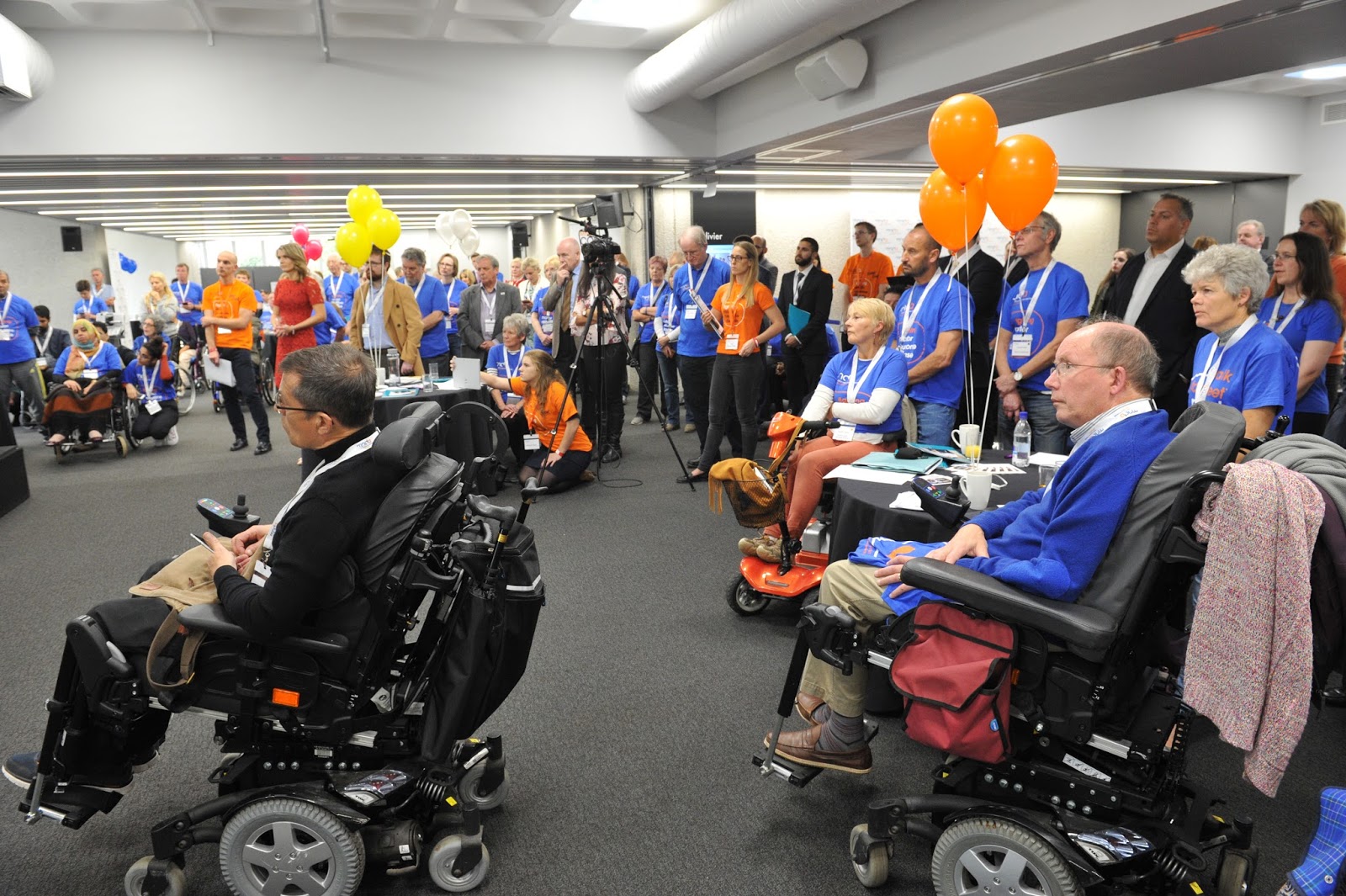

Rob Owen talked about his experience of applying for PIP (Personal Independence Payment), the benefit granted to people with extra financial demands from ill-health and disability. In brief he was first assessed by a health professional who understood his needs. Later he was called for reassessment, which was carried out this time by a non-professional – and his monthly payment was reduced. Nonsensical since MND is an untreatable degenerative disease. When he queried it, he was again treated to an amateur tick-box assessment and had his payment removed entirely. It was only by formally appealing to a panel including a magistrate and a medic that he was given the maximum amount of PIP – backdated to the beginning. What a waste of nervous energy and taxpayers’ money!
With Charlotte Hawkins

Charlotte Hawkins talked from the point of view of family, and painted a vivid picture of watching someone you love die from MND; as she put it, seeing the person you love disappear before your eyes. Her father died in 2015. She moved us all and opened MPs’ eyes to the reality of the disease. (You can hear the speeches here: MNDA Parliamentary Reception).

With Robert Courts MP
Sadly only one of the six Oxfordshire MPs came to the reception. Indeed although I had sent a personal invitation to my local MP, I did not receive so much as an apology – simply a proforma bit of party-political spiel about how much the government cares about conditions like MND… a week after the event. You might tell I’m not overly impressed! However, at least, new MP, Robert Courts, from Witney was there, and listened and was concerned.

The focus of the reception was to inform parliamentarians both about the disease and its costs – and how important it is that people who have it receive the support they need WHEN they need it, which in the vast majority of cases is very quickly as the disease so rapidly removes your independence. And of course how unnecessary reassessment is with a progressive degenerative disease, assuming it’s been correctly carried out in the first place.

And so back home – and this week. On Tuesday Jane forewent her usual gym class so that we could attend my fourth and final meeting of the Oxford MND Care Centre Steering Group. I’ve been the patient representative. I’ve said often how excellent the Centre here is. We have two top-rate consultants (who happen also to be professors), a specialist nurse (who coordinates the show), an OT (who is the country’s expert on wheelchairs for neurological patients) plus access to specialist physios and respiratory nurses. The local MNDA branch also supplies volunteers who welcome you and make sure you know what’s going on and who to see when. Part of the meeting was devoted to an audit which, I think, the Centre has to do in order to continue to be recognised (and supported) by the MNDA. There’s a danger, it seems to me, of extending the already pervasive evil culture of performance indicators. The Oxford Centre is always working at improving and being responsive to patients’ needs. It doesn’t need to waste its health professionals’ time in filling out tick boxes and sending out questionnaires.

The Association faces the understandable dilemma of not wanting to fund what should be statutory provisions, such as nurses or dieticians, and yet there are charities which successfully augment the NHS – such as Macmillan Care, Marie Curie and many others. The MNDA is comparatively well supported with an income of £17,391,000 in the 11 months up to December last year. The staff (189 of them) cost £6,268,000, for whom private medical insurance (!) was £43,000. I wonder if they could fund some hospice beds or nursing home rooms – or even adapted holiday places. Don’t get me wrong; the MNDA is a very effective charity and does a great deal of good for us, particularly at the local level. I wonder if it just might be a tad top-heavy.

Tuesday, 28 March 2017

Hot air, much wind and cool sense


Oh dear, oh dear! I’ve been looking back at the start of this blog. What a boring old fart I’ve become since then. My posts have increased in length and in grumpiness. I’m surprised anyone reads them any more. I know some people do. Probably my family….

Anyway, here I am today, sitting in my favourite Cornerstone café admiring the new kitchen in the children's corner, that Sarah the manager raised money for, by going without sugar throughout February. The sun is shining and all’s well with the world.

On Saturday we had the local branch MNDA AGM. As usual it was a friendly time. We did the business bit, and after lunch had a talk about the NIHCE Guidelines on MND. Wow, it’s a weighty tome! And I suppose GPs and Health Commissioning groups are meant to have a grip on scores of similar documents…. We also heard about the Happy Valley Festival, a seriously cool one-day music festival in aid of MND on 17th June (http://www.happyvalleyfestival.co.uk/) - tickets on sale tomorrow.

I asked one of our local MND experts what I could expect dying to be like. The answer was compassionate and honest: “The hardest part of MND is the living with it, not the dying. As the muscles weaken, the oxygen level drops, carbon dioxide rises. Usually people die in their sleep.” Or words to that effect. Reassuring. Confirmed my view that dying with MND is no more distressing for all involved than any other death.

Saturday, 20 June 2015

The Oxford MND Centre

I've often referred to our excellent MND Care Centre in Oxford. It's based in the West Wing of the JR Hospital and the Centre of Enablement at the Nuffield. About a month ago I had my annual check-up there, seeing both the consultant, Professor Kevin Talbot, and the OT, Jenny Rolfe. The beauty of the place is its humanity and its flexibility. Once you're signed in, you're met by a real person, rather like cabin crew on a plane, but it's someone who has first-hand experience in caring for a person with MND, and they keep you informed about who you are going to see, how long you might have to wait (usually not long), who you'll see next and so on. It's so much better than the impersonal announcement over a tannoy or that annoying digital pinging display summoning you to a consulting room. The MND Centre's air hostesses are all volunteers - so valuable.

Mark Stone in the sort of wheelchair I hope to get
Anyway there are two points to this story. One is that talking to Jenny about fitting hoists to get electric wheelchairs into the boot of our car, she was anxious for me not to have an unsuitable hand-me-on chair and recommended a proper neuro-wheelchair with a folding back, which are now being made. She subsequently came out with an engineer to show me the possibilities. I'm now in the process of choosing and looking forward to Jane not having to lug my manual wheelchair in and out - and not having to push me whenever we're away from home.


The cyclists with the reception party outside the hospital (Photos: Lesley Ogden)

The other point is that we then learned about the sponsored cycle ride being done by the Centre's nurse, Rachael, the two consultants and a physio. They started off from the MNDA headquarters in Northampton and went via the centres in Milton Keynes, Aylesbury, Reading, Swindon ending in Oxford - a total of 170 miles, including a gruelling section along the ancient drovers' road, the Ridgeway. Since we'd been the recipients of a generous gift of tickets to Wimbledon, we felt the least we could do was to sponsor them - apart from the fact that we are continually grateful for the care I receive from the MNDA and the NHS. So far they have exceeded their target but just in case here's the Just Giving link. In fact we joined a group to welcome them back at Sunday lunchtime in front of the JR's West Wing. Quite an achievement! And they'd be back in clinic the next day. "Dedication is what you need," as Mr Akabusi used to say.

Saturday, 25 January 2014

A rather good meeting

Prof Kevin Talbot
This afternoon we went to our local MNDA meeting. It was in the Peartree Holiday Inn - and there were a lot of us there. The main meat of the afternoon was feedback from Professor Kevin Talbot, the boss of Oxford's MND Centre about the research going on there. As usual he was very clear for us lay folk about very technical matters. The thing that made me most sit up was the fact that now he is involved with the three largest pharmaceutical companies. As I understand it this is because he feels research has now reached the stage where the drug companies' vast libraries of experimental drugs might usefully be tried on MND-affected stem-cells. Members of his team are now producing sufficient of the latter to try "treating" them, the cells. He told us that, though he believed a cure would be found one day, there was a long way to go yet and it was impossible to predict.

Something else he told us was that the specialist nurse who runs the clinic, Rachel Marsden, and the specialist OT, Jenny Rolfe, the country's expert on wheelchairs for neurological patients, have been appointed to NICE's (National Institute for Health and Care Excellence) advisory panel on MND. I reflected again on how blessed I am to have this Care Centre monitoring my condition.
Jenny Rolfe
Jenny herself reported on the International MND Symposium of last December, which happened in Milan. She concentrated on the care side, such as improving non-invasive ventilation, the evidence of the pros and cons of different direct feeding methods, the devising of an optimum powered wheelchair for people with MND - the Neuro Powered Wheelchair. Judging from my experience there can be no one better than Jenny to know exactly what's needed. One thing she mentioned - which clearly appealed to a lot of others - was the Cuddle Chair, a riser-recliner sofa, designed so that the MND person could have two armrests, essential for standing up, but also can sit with someone, rather than always in isolation. I looked it up on the internet when I got home (Wealden Rehab Kent); ominously there's no price. But it would be nice....

Friday, 8 November 2013

Talking of dying

Yesterday Jane and I went to Woodley near Reading - No, let me start one or two steps back from there. I'm a great admirer of Dr Kate Granger. She is one brave person, though she wouldn't bless me for saying so! Here's what she wrote about herself:
"I am a 31 year old Elderly Medicine Registrar working in Yorkshire in the UK. Nothing unusual about that really. But I am also a cancer patient, a terminally ill one with a very rare and aggressive form of sarcoma. On my blog I muse about current issues especially relating to end of life care, communication and patient centredness. I also write about my experiences as I approach the end of my life.
"I have written 2 books, The Other Side and The Bright Side. We sell these with all profits being donated to the Yorkshire Cancer Centre Appeal in Leeds. See my website for more details – http://www.theothersidestory.co.uk". 

I challenge you to read her latest blog post without being moved and inspired (apologies again, Kate!): Dear Cancer Part 2. Anyway it was while researching some talks that I came across her comments about the Liverpool Care Pathway, which was rubbished inter al by the Daily Mail (no surprise there!). Her comments last November in contrast to the media hysteria were unsurprisingly extremely well informed and balanced. For example, "When my time comes I really hope my care will follow the standardised LCP approach. I fully believe it improves care at the very end of life and results in more ‘good deaths’ with comfortable patients not undergoing futile painful interventions and well informed, emotionally supported relatives, making the grieving process that little bit easier." 
Sue Ryder House, Nettlebed

So that was step 1. Then Jane and I went to an MNDA tea put on by the local Sue Ryder Hospice at Nettlebed (once the home of none other than Ian Fleming) where our hostess, Lynn Brooks, mentioned a consultation afternoon being put for the Leadership Alliance for the Care of Dying People by Sue Ryder, in response to Lady Neuberger's More Care Less Pathway report which led in July to the Health Minister's scrapping the Liverpool Care Pathway and looking for an alternative approach. Was anyone interested? We were - and so we applied and got the last two places.  Step 2.

So, yesterday afternoon we drove across the Downs and along the motorway to Reading. Step 3. The Alliance was set up, I think, by a palliative care consultant in Oxford in order to produce a constructive way forward post-Neuberger, and it draws together parties from all over the health sector, from the Royal Colleges and NHS to those involved specifically in terminal care such as hospices. There were about 56 of us there on seven tables. Only a few of us were current "service users" and carers like Jane and me, though in the end all of us will be. It was an unusual experience being in a room where everyone was at ease talking about death and dying, but not a bad or morbid one - rather like the increasingly popular Death Cafés, I imagine. In fact one of the common themes that emerged from every table was the importance of communication, between the professionals and the patients (and if appropriate their families). I tend to agree with Kate Granger's ideal that a palliative care specialist should be present when someone is given a terminal diagnosis, or if not then at the next appointment. 

As a former teacher, I frankly think that the process of dying should find a place on the secondary curriculum. I'm not sure where it would fit in! Perhaps citizenship. Talking about what will happen to everyone seems a better use of time than debating the pros and cons of euthanasia, which only serves to increase fear of dying. Far better to break the taboo we nurture concerning death. Isn't time we were open about this great fact of life, rather than be scared stiff of it?

I imagine almost everyone who receives a diagnosis of a terminal or potentially terminal condition experiences some moments of fear.  I was no exception.  I was diagnosed with Motor Neurone Disease in the same year that Diane Pretty had died in the publicity of her court cases.  I was under no illusion as to what MND meant.  I knew it was life-limiting and life-ending.  In particular I had some fears about the manner of dying I could expect.  These were fuelled by the campaign surrounding such people as Ms Pretty, which portrays those with similar conditions as 'sufferers' and 'victims' and drip-feeds horror stories to the media - with the effect of exacerbating public fear.  

Don't mistake me.  MND, as a newly diagnosed friend recently observed to me, is a 'bugger', as are most neurological and terminal diseases.  I suppose, for that matter, most dying is too - which of course none of us avoid. 

In Yann Martel's remarkable novel, The Life of Pi, which I'm reading at the moment, the turning point for the 16-year old Pi Patel, alone with the terrifying Bengal tiger named in error, Richard Parker, on a lifeboat in the Pacific Ocean comes with a discovery. 
'I must say a word about fear.  It is life's only true opponent.  Only fear can defeat life.  It is a clever, treacherous adversary, how well I know.  It has no decency, respects no law or convention, shows no mercy.  It goes for your weakest spot, which it finds with unerring ease.  It begins with your mind, always….
'… Every part of you, in the manner most suited to it, falls apart.  Only your eyes work well.  They always pay proper attention to fear.
'Quickly you make rash decisions.  You dismiss your last allies: hope and trust.  There, you've defeated yourself.  Fear, which is but an impression, has triumphed over you' (chapter 56).  It's as he accepts the tiger's presence, loses his fear and starts to face it up and almost to befriend it that he discovers his ultimately successful survival strategy. 'And so it came to be: Plan Number Seven: Keep Him Alive.'

(My beef with the campaign for assisted dying/suicide is that it feeds on and fuels people's fear - our natural fear of pain, of dying, of the unknown.  We're told stories to increase our fear of the big beast, death. And that is toxic to society. We lose our trust and our hope. We run scared of dying and lose our humanity.)


The great joy for me yesterday was seeing in the flesh what the media seems to conceal rather than celebrate: the whole range of people from paramedics, nurses and doctors, to managers, befrienders and social carers whose ambition was to ensure that the journey towards death is neither solitary nor fearful. Talking can never remove the beast, but it can tame it. And that's why we should not be afraid to utter the very words, "death" and "dying". There's an excellent organisation called "Dying Matters" - no more concerned with the euthanasia debate than was yesterday's workshop, but working to break our society's unhealthy paralysing terror of death. It's neither sectarian nor political. It can be found at http://dyingmatters.org/. It seeks to promote discussion and public acceptance of dying.

This is a time of year when euphemisms such as "passing" or "becoming another star in the sky" seem particularly inappropriate. We remember those who faced the raw reality of death in war. Death is no less real in peacetime. Let's face it, not run from it. Ultimately Pi Patel survives and Richard Parker disappears, never to be seen again.


As we drove home, the wispy clouds were starting to catch pink hues from the setting sun, and it was nearly dark as we arrived home. 


Monday, 8 April 2013

Squeezing the PIPs

Well, today sees the beginning of DLAs (Disability Living Allowances) being replaced by PIPs (Personal Independence Payments), the moment that disabled people on the whole have been dreading, largely because we're entering unknown territory. To be frank, none of us believe that it is not a cost-cutting exercise. We suspect that the PIP assessors will have been told to be "rigorous" (wink, wink, know what I mean?) and even given reduction targets to aim at. That impression isn't helped by reports that George Osborne refused to face Baroness Tanni Grey-Thompson, the disabled Paralympian, on TV (News report).

(Stop press: Just heard that Margaret Thatcher has died. Her PA who used to live in Stanford was an equally redoubtable woman. She found the young vicar somewhat tiresome but tolerable.)

I have just completed a survey for the MND Association which was asking about how we'd been looked after from before diagnosis and how we'd like to be cared for until we die. It occurs to me that this is at least one disability which usually is so rapidly changing that PIP assessors could no more keep up with it than the hard-pressed health and social care services. You see my brand of MND, Primary Lateral Sclerosis, is astonishingly unusual. It's over ten years since I received my diagnosis. The average life expectancy for MND patients from diagnosis is 14 months, i.e. from the time the doctor tells you what's wrong you're on this dizzying helter-skelter of losing your abilities until you die. The great thing about Disability Living Allowance was that assessing yourself with your doctor's advice you got access to a non-means-tested benefit quite straightforwardly. It was quite early on that I couldn't walk unaided, even with a stick. So I receive the highest mobility allowance, which enables us to lease a bigger car which I can get into and out of and we can fit my disability equipment in. It has considerably enhanced my quality of life.

Now imagine someone with a more normal rapid form of the disease. She's diagnosed. The PIP assessor comes round and our patient is still mobile and able to function reasonably at home, but within weeks she's losing her mobility and having falls round the house. Will the PIP fellow drop everything and come and reassess her? What do you think? Will he take her GP's or specialist's word for it? What do you think? On the present performance of assessors such as ATOS (the American multinational IT giant subcontracted by the government to assess suitability to work), it appears that on principle they discount the opinion of those who know the patient and the condition best. (See the Parliamentary Debate). As it is, I have had friends whose motability vehicles have arrived too late, and whose last months of life have been rendered harder than they were already by the slow delivery of service. Many of us fear that with the introduction of new, improved and supposedly more "flexible" system, even more will lose the crumbs of comfort to which they might have had access. And of course MND is not the only condition that involves rapid degeneration.

One after-thought: the disabled are often painted in the media and by ministers as "on the cadge". Of course you may be able to track down one rogue in a thousand. But the 999 would far rather be fit and healthy, able to live a healthy life and be able, like the Chancellor of the Exchequer, to park in disabled bays illicitly. By contrast, I know one driver with a disabled passenger who will actually refrain from using a blue badge, if the passenger is not disembarking. Integrity is not unknown among the disabled community. And what strange official mind dismisses the professional expertise of those who know best? Well, PIPs roll out in Oxfordshire in June. Perhaps then I'll be saying, "I told you so," - or will it be, "I was wrong"? It would be nice if it were the latter.

Saturday, 20 October 2012

Walking to defeat MND

A week ago, Jane and others were pushing me round the grounds of Blenheim Palace. We were taking part in the annual Oxfordshire MND Association sponsored "Walk to d'feet MND". As last year there were a good number of participants (about 90) and we were blessed with sunny if not balmy weather. The leaves were just starting to turn as you can see across the lake - like Ashburnham Place designed by Capability Brown.

As always with these events, the best thing about them was the company. In this picture I'm being pushed by
our friend Penny whose husband died last year of MND, while on the far right is Matt whose mother died only a few months ago. Talking to me, to the right of Jane, is Jenny Rolfe, the fab OT who works at the MND Clinic in Oxford and who sorted out for me my tilting wheelchairs. To her right is Rachael Marsden, the nurse and presiding genius of the Clinic. They are two of the assets that makes the provision for people with MND in this area so positive. It struck me that part of the centre's secret was encapsulated by the fact that one consultant, the nurse i/c and the main OT were all there on a Saturday in what might be called a work of supererogation, i.e. above and beyond the call of duty. For them it's more than a job, or a career; it's more like a vocation.

Second in from the right here (with the balloon) is Lesley, our indefatigable and endlessly efficient branch secretary. She's one of a group who not only organise such events for us and our families and friends - and, as significantly, is one of those available to visit people with MND from the point of diagnosis onwards. As you'll have gathered from this blog, there is NO way that the professionals, spread as thinly as they are and with resources increasingly squeezed, there's no way that they can respond even to the need of such a rare condition as ALS/MND. So the potential for sensitive Association Volunteers (AVs) to support individuals and families in the frightening reality of the disease is huge. It doesn't always work; personalities may not click. But usually it does.

I must also mention Peter, with the cap on the mini-scooter, with his two glamorous women behind him. He has moreorless completely lost his voice, but he certainly has by no means lost his sense of humour. He keeps me plied with often outrageously non-PC jokes by email. To give one repeatable example which I enjoyed recently:
- An elderly man was stopped by the police around 2 a.m and was asked where he was going at that time of night.

The man replied, "I'm on my way to a lecture about alcohol abuse and the effects it has on the human body, as well as smoking and staying out late." 
The officer then asked, "Really? Who's giving that lecture at this time of night?" 
The man replied, "That would be my wife." - Occasionally Peter drops in a googly in the form of a serious or uplifting reflection on the meaning of life. He used to be a teacher. I bet his lessons were fun!

Oh yes, and did I mention the afternoon was fun too. At least I enjoyed it. Well, I'd have been ungrateful not to have, being pushed up hill and down dale by a succession of nice women, wouldn't I?

Saturday, 6 October 2012

New year laughter and tears

For young people September marked the start of a new academic year, even career. Some universities even begin their "Michaelmas Term" on 9th October, on the presumption, I assume, that their students work much harder or are so much brighter than others that they need far less time to study. Anyway, best wishes to all students and their teachers launched into the most depressing of terms being the longest (16 weeks) term and the increasingly dark days of the year. However for the rest of us also the regular round grinds back into gear, including local MND Association events.

For us, it began a week ago with a meeting at the Holiday Inn with my physiotherapist, Lesley, talking about her work. I know I'm biased, but she was excellent. Clear, comprehensible, and not condescending. One thing she flagged up in response to a question was the possible dire consequence of commissioning. At the moment we have a small expert, if very hard-pressed, team of neuro physios. With competitive tendering there's a danger of going for the cheapest option, which won't be the experienced or the specialist one. If we lost Lesley and her team, it would be a tragedy for everyone with neuro conditions (like MS, Parkinsons, MND) in our area.


Then last night we drove to the Roses' Theatre in Tewkesbury - a long way, but it was for a reason. We were going to hear Pam Ayres giving a performance in aid of the MNDA. We'd had contact because of our shared connection with Stanford in the Vale. She was brought up there and many of her family still live there. As vicar there, I had met her on one or two family occasions. She's genuinely as nice as she seems. She's written a rather good memoir of her early life in the village and then in the WRAF and local firms until her career as a poet and comic raconteur took off after appearing on Opportunity Knocks, in which she was the people's choice. It's called The Necessary Aptitude - which she was repeatedly informed she lacked, up to the point that she uncovered her metier.

Photo ©Nicky Sadler
I don't think she would reckon herself one of Britain's great poets, but I think you could rate her as the ordinary people's poet. She is a winsome stand-up comic, interspersing her apparent stream-of-consciousness performance with poems and self-aware skill. She has great rapport with her audience. Her performance of Shakespeare was hilarious, and her account of her moment of shame in Singapore (you'll have to read the book!) was very moving. If I had to choose the comic highlights for me they'd probably be her new poetic form, poetry tweets, and her attempts at wearing contact lenses.

At the end, Pam gave a short clear explanation of MND and the purpose of the association, and encouraged everyone to sign the MND Charter *. She's given her fee all to the MNDA, which is a considerable donation. I'm not alone in being very grateful. Moreover I need to acknowledge that although the Oxfordshire branch made the initial contact, all the hard work for the evening was done by the Gloucestershire branch, some of whom you can see below.

So we're back in full swing - Next Saturday Jane will be pushing me round Blenheim Palace grounds on our annual sponsored walk "to dfeet MND" (You can find out about coming or sponsoring here.) We hope for the same beautiful weather we had last year. 

* The MND Charter is basically a plea to have even care of MND patients nationwide. Here in Oxfordshire the care and support is brilliant, partly thanks to the dedicated MND Centre at the John Radcliffe, but that's certainly not the case all over the country. 

For example, Pauline, a friend of mine with MND, has just put this on her Facebook page:
You couldn't make it up ......
Struggling with my mobility with regards to getting to the toilet and in and out of bed I contacted the OTs yet again for some assistance. Almost 2 years ago my then OT put forward to 'the panel' the possibility of me having a standing hoist. This was denied with no proper explanation or assessment despite my continued protestations. Now I am more in need of it than ever though still capable of standing using a 4 wheel walker for 1-2 minutes (performed for toileting, getting in and out of bed and on and off shower chair. The OT came and we discussed hoists, again! It was decided that due to my husband's age and frailty he shouldn't use a full hoist on his own but neither could I (still) have a standing hoist because (this is a new argument because it certainly wasn't the case 2 years ago) I can't sit myself up in bed! (WTF?). That's okay if I'm being put to bed by carers (this only happens 3x a week (at 8.30pm and I hate it)) but what about going to the toilet I asked. THIS IS WHAT YOU COULDN'T MAKE UP....A carer could come at a set time each day, she said and put you on the toilet! OMG, not only am I being 'put to bed' like a naughty girl, now, they're expecting me to 'poo to order'! When I started to cry both OT and physiotherapist just sat there whilst my aged mother tottered over to comfort me. When they qualify these people must enter a vacuum wherein they have compassion and empathy (oh yes and common sense) extracted. I await the outcome with bated breath....

I'm not greatly into the "rights'" culture, but I basically agree with the five aims of the Charter, which says:
1.People with MND have the right to an early diagnosis and information
2.People with MND have the right to access quality care and treatments
3.People with MND have the right to be treated as individuals and with dignity and respect
4.People with MND have the right to maximise their quality of life
5.Carers of people with MND have the right to be valued, respected, listened to and well-supported.

Obviously the more people who sign the charter the more weight it will carry with policy makers and purse-string holders. You can access it here. At the moment it's not that straightforward. Hopefully the MNDA will soon make it more accessible. (MND Charter on-line)


Saturday, 23 June 2012

Little things...

Before I vent my spleen on Michael Gove (if I ever get round to it) or Ed (aka Cain) Miliband, let me dwell on more cheerful things. I can't say it does much good to get too upset about politicians, as the most ambitious of them seem very similar to each other. So instead I'll post about some of the jollier aspects of my week - trivial perhaps, but actually such things are the stuff of life.


For example, Lynne gave Jane a bird-feeder earlier this year and she stuck it on the kitchen window. "That'll never work," I told her. "They'll never come that near the house, especially to the kitchen window with you and the dog in there." How wrong I was! As I sat in my chair in the conservatory, I had a grandstand view of a sparrow mother feeding her rather demanding, rather obese fledgling brood. My own Springwatch! They've grown and flown away now - but they weren't bad substitutes for chickens (to watch, not eat, I hasten to add).

Then there was planning for an MNDA Bake History coffee morning we thought we'd hold at home a week today. I have a Facebook friend in Kelso whose husband has a similar degenerative disease. Susan saw my entry about it. Clearly she can't come but she did offer to send a few "sock monkeys" for selling or raffling. I was intrigued. They arrived yesterday. I must say they are rather wonderful works of craftsmanship. The sewing is incredibly neat to the point of being invisible. They are quite appealing. Not surprisingly demand looks set to exceed supply. The best thing about them, though, is Susan's generosity in donating and sending them. Another bright thing to enjoy.

 Talking of bright things, life isn't all light. It's light and dark. Yet I was thinking as I looked out at my usual breakfast view, there's beauty in the darkness as well. Without the dark, of course, there'd be no light. But I love the mysterious shadow beneath the dark crimson leaves of the Cotinus, the "Smoke Tree". It's like a warm cave framed by the bright green leaves of the apple and hazel. Without it my view would be much duller. And of course the view is constantly changing in different seasons and conditions. 

For me it is sad that there are folk like Tony Nicklinson who has chosen not to enjoy the small joys of his dreadfully limited life but rather to campaign for euthanasia both for himself and also for others. No one would wish Locked-in syndrome on anyone, but it need not be the death sentence he takes it to be, if people like Jean-Dominique Bauby (author of The Diving Bell and the Butterfly) and Michelle Wheatley, Bram Harrison and Martin Pistorius are to be believed (Bram Harrison's story). 

June is the MND Association's Month of Optimism. That's not a month of whistling in the dark. No one's pretending ALS/MND is any fun, though some of my MND friends have, or had, great senses of humour. However it is a month where we focus on hope - the hope to be found in the developments of research, the hope we find in being cared about and the hope to be found in the small joys of life, which somehow seem to show up all the more brightly because of the mysterious darkness against which they're set.

Friday, 25 May 2012

DIY SOS

She warned me, and she was right. Rachel said I'd cry if I watched it, and I did. It was last week's episode of BBC's DIY SOS called "The big build - Enfield". It was about Eric Rivers who has a rapid form of MND and his wife Davina and their three children. It was obviously filmed last November. Their home is a two-bedroomed terrace in Enfield. Their youngest daughter had to sleep in her parents' bedroom, and all of them were grieving for a family life of which Eric's MND had already robbed them.

The programme showed the DIY SOS team moving in, supported by a massive outpouring of goodwill from local tradesmen and love from their friends, and transforming their home in just over a week. His daughters had said the priority was to make their home good for their dad. In the event, the team created an extra bedroom in the loft and a dining room extension on the back. Like us they made a wet-room and put in a through-floor lift. Eric's repeated statement was "the greatest gift we have is time" - and that's what the SOS team had given him - more time to enjoy with his family. Unfortunately it's too late now to see the programme on iPlayer, but you can see short extracts and more about it here: Clips from Enfield.

The Rivers experience a problem shared by many families plunged into MND or other disability - finding their home quite unsuitable for their rapidly disabled member. Most families don't have an incredibly persistent friend who tweats the BBC and the presenter until they agree to refurbish their house completely - not that anyone would begrudge the Rivers' family the help they received one tiny bit. In fact one's glad for all the good fortune and help that others receive. We were fortunate enough ourselves to have been given sufficient capital to adapt our home before we moved in. Most people are struggling to get adaptations done while they're in situ and as their needs constantly increase. Yesterday we went to Bicester Garden Centre for a meeting our local MND Association branch. There were lots of us there. We met a couple who were having to sell their family home to move into a flat, while another of our friends was faced with dismantling adaptations and a wet-room which an incompetent contractor had messed up and failed to complete before his wife had died of MND.

Our area is well supported by the Oxford MND Centre, but many areas are not so well served - which makes it all the more important that there should be a nationwide provision, not only for MND, but also for the other progressive neurological conditions, such as ataxia and muscular dystrophy, which no one expects and for which no one is prepared. Most people do not have the luxury of time of which I have been given much. As Eric Rivers said, in situations such as his, "the greatest gift we have is time". Let's give people like him, as much quality time as possible. It will be an incalculable present.

Sunday, 23 October 2011

On the receiving end

What a wonderful fortnight we had!

It began with a MND Association meeting about ready-made meals delivered to your door - not that I need that, having a live-in cordon bleu cook, aka Jane, and has ended last Saturday with an MNDA walk in Blenheim Palace grounds in beautiful sunshine. As usual the fun of these times was being with others sharing similar experiences and those who know what it's like. As you can tell, the walk in Blenheim couldn't have been better - warm, clear and well supported.

In between I've been benefiting hugely from the NHS, and enjoying the company of friends. Oh yes, and we had a fun weekend of celebrations at my favourite local coffee shop, Cornerstone.

My lovely dentist spent over an hour extracting yet another tooth which had cracked irreparably. She was incredibly patient and the procedure was pain-free. Amazing. And then there was a visit from my physio to check up on my back. She discussed various options for us to consider, and showed Jane a couple of extra strenuous exercises she could make me do. And I must say my back is marvellously loosened. Now I have to work on my posture, to correct my pisa-like rightward tilt.

There are obviously some busy beavers in the Local Health Trust with nothing better to do than to send out questionnaires, as I've received one about each service over the past couple of weeks. No doubt it's a good thing to check quality, but personally I resent on their behalf the implied mistrust of these excellent health professionals. Of course they came out with the highest scores on my rating. I felt tempted to write at the end: "LEAVE OUR NHS SERVICES ALONE - AND GET OFF THEIR BACKS!" Experience shows that trust generally produces better results than fear.

Anita showing Jane the new machine
Then there was the Cornerstone celebration weekend - lovely weather again. It was a triple whammy: marking their achievement of 5 stars (top) status in the food prep and hygiene inspection regime, and the purchase of a new Swiss-made coffee machine, and the launch of a new menu. It just gets better and better. There were two days of celebrating - well, it was a good excuse for a party. And the general verdict has been that the coffee's rather good. So far, I've sampled cappuccinno, latté, mocha, americano, espresso (double) and hot chocolate. Not at all bad, I must say.


Geraniums and pansies still in flower

Saturday, 30 July 2011

Oops, that hurt!

A week ago, I began a rather jolly post with this paragraph: "Yet again I've had cause to be grateful to the NHS, but more of that later. First, a quick update of the week's events, including our wedding anniversary, which we celebrated by meeting with the local branch MNDA seeing how the Nuffield Orthopaedic Centre can adapt clothes when it becomes impossible to dress yourself. The great things are velcro and full-length zips. It was actually more interesting than it sounds when the seamstresses who knew about such things started chatting about their craft. We finished our celebrations by attending the local area clergy social - which also was better than it sounds!"

Since then I've fallen silent. As Facebook friends will know, my initial optimism over a little local difficulty, i.e. a fall on Thursday lunchtime, has taken something of a battering. Such falls are the stuff of MND, but I've not had a full-on fall for a couple of years now. I'm quite cautious walking with my rollator. But I suppose a full day previously had left me a bit tired and, getting into position for lunch, I simply keeled over backwards, and once you're going, you're going, going, gone. (I learned today that you use 300 muscles just to keep balance. Whether it's true or not, I don't know, but the control nerves of enough of mine aren't working!) My head hit the china cabinet and my spine the solid floor. Jane who'd been in the next room ran in and set about patiently calming me down, before calling the paramedics. That's the prescribed procedure, since getting someone with MND from the floor to upright is not a job for one person or for amateurs. I was feeling rather sorry for myself. After 15 minutes a car arrived with Gemma, who checked me over. Vital functions ok, probably no major injuries (no untoward sensations in the legs). But she was small and getting me up was no job for her and Jane, and so she summoned an ambulance which in 20 minutes brought two burly ambulancemen, who addressed me clearly (! Jane says loudly) and eventually hoiked me to my feet. When I'd recovered from feeling faint, the assessment was I didn't need to go to hospital. So I ended up in my wheelchair and we were left to lick our respective wounds, Jane's emotional,  and mine physical.

Afterwards, and subsequently, we've reflected on the service we received, the initial response by the ambulance service and then the consultations by phone with the GP about pain and other relief. It is really astonishing. It's something else for which I'm truly grateful. I gather it's a case of deep bruising, which as it works out gets more painful. So after a couple of reasonable nights' sleep I had to resort to sleeping downstairs in a riser-recliner chair downstairs. The nuisance has been having to cancel all engagements, such as the dentist and meals out with friends, and, by now, we should be having a break in Somerset and enjoying the company of thousands at the picturesquely named New Wine Festival - not an oinological gathering but a worship and teaching fiesta, which we first attended with our church. I'm trusting that it won't be long before I stop behaving like a fragile bean-pole and become more like an articulated human being again! Maybe I'll start pontificating on events again then. There's been a lot going on around the world since I laid my laptop aside.

Friday, 10 June 2011

An afternoon with friends

On Wednesday afternoon the local MND Association branch visited Aston Pottery for a demonstration and then for tea. These are really good afternoons when those of us with MND and friends and families spend time together.
Watching the demonstration

Although it was windy, the rain held off and from time to time the sun came out. Aston Pottery is near Witney and produces its unique brand of tableware, and also has an Aladdin's cave of a gift shop and a big beautiful café. The 18 of us started with the pottery (I believe it's technically known as slipware) demonstration given by Marian, one of the potters. She showed us the processes from pouring to completion - well, not all of them, I seem to remember that there are 27 separate processes in all, taking over two days. She was, I must say, an excellent teacher - well organised, expert and enthusiastic about her subject. I certainly ended with a great appreciation for the skill of the potters and decorators and the vision behind the whole enterprise.
Marian at work

It's amazing how split-second some of the timings need to be: for example, too short and the teapot handle is hollow, too long and the spout is solid. And there's no mass-production here. It all depends on the human factor. I was especially impressed by the glazing process, which is dipping the article into a suspension of four minerals for a few seconds. As it dries the design is completely covered in the creamy deposit. Only after the final firing at 1100+˚C does the deposited suspension melt into a micro-layer of glass.


After the wonders of potting, we proceeded to the joys of eating some of the locally made cakes and having tea from, of course, Aston pottery.

This is always the best part of such afternoons, when you sit and talk (or just smile) with your friends, and enjoy what you might call fellowship. In one way it's tinged with sadness, as you're aware of friends who have died since we began going. But there's also that great optimism and humour which is oddly a mark of the Association members. Anyway the slabs of cake were vast - and delicious.
Anne and Rachael facing us, with the Durkins

In the café
I forgot to mention that I'd been to the MND Clinic in Oxford on Monday morning, to see my new consultant, Kevin Talbot. There I'd been greeted by Anne, the Association visitor, and then was seen by Rachael Marsden, the clinic coordinator, who gave me a peak-flow

breath test and a quick interview, before I went in to see Professor Talbot. He agreed with Dr Donaghy's diagnosis of PLS (where the upper motor neurones are affected). He had a student there, which was interesting as he explained my symptoms to her. It's an excellent set-up.

It was nice seeing Anne and Rachael again at Aston on Wednesday afternoon. It feels like integrated care.