Showing posts with label Care services. Show all posts

Monday, 2 April 2012

Sunny days in Devon

I have to apologise, not least to the friend who wondered whether my blogging silence meant something was wrong. I'm sorry to say it means approximately the opposite - that I've been having rather a good time, partly because I've been in the book-writing "zone" and partly because we went away for a long sunny weekend to South Devon coming back a week ago.

We stayed in Newton Poppleford for two reasons: a) it's near Jane's revered and lovely parents, and b) it's where I found a promising disabled friendly bed and breakfast. Brookfields proved to be better than I'd dared hope. It's run by a couple, David and Rosemary, who'd previously owned a nursing home and therefore understood my needs well. Our bedroom had a wetroom en suite which, of course, is ideal. There was plenty of room both sides of the bed. And the breakfasts were amazing. David and Rosemary seek out the best from every source, working on the principle that they give their guests what they themselves would like. And they are excellent and generous cooks. When we eating out with Jane's parents at midday, we had the continental option - well, you can't do much with that, can you? It was fine, but not as extraordinarily yummy as the full English.

I suppose what was best about Brookfields was the hospitality. It isn't the hotel-type B&B; it's a home. Even Axy, the dog, is friendly and welcoming.

Friday was Sport Relief day. We'd decided to make use of our National Trust card and visit Killerton House, just on the other side of the M5. It's an impressive house, built originally as a stop-gap, for the Acland family. Happily they decided to stick with it rather than build a grandiose permanent house on top of the hill. It's grand enough as it is, with beautiful grounds (not that wheelchair friendly) and an accessible ground floor. Jane indulged one of my vices at lunchtime with a packet of quavers, which was kind of her.

About midday there was an influx, a torrent of primary school children, 200 of them in blue, yellow, green and red tops. They were, we realised, marking Sport Relief, competing in ages round different distances, including a course of up to a mile. It was beautiful sunny afternoon; parents and peers shouted encouragement. What better way to end the week - pupils and for teachers! And for us it proved diverting entertainment.

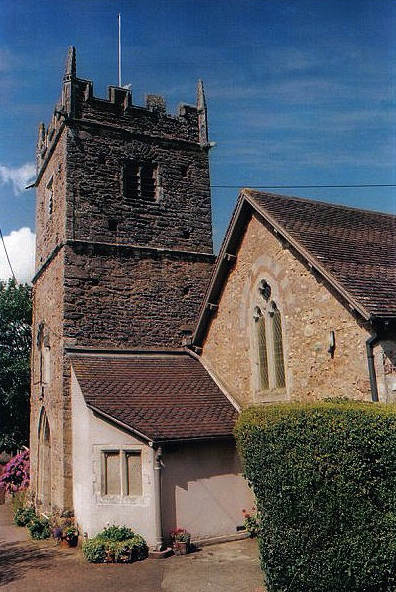
St Luke's, Newton Poppleford
Our Italian evening was, I'd say, average, although the service was excellent - as were the quite different services we attended on the Sunday. The first was in St Luke's, Newton Poppleford, which Rosemary took us to in the morning. A delightful friendly relaxed yet reverent Communion service. It reminded somewhat of Stanford, which is quite high praise! After a cream tea in the afternoon we headed off to see the sea and then to join our friends at Christ Church, Exmouth. Here we had excellent worship music, and a memorable sermon on Psalm 1 and pee charts! On the way back we sampled Krispies' award-winning fish and chips, which I have to say were just as good as their reputation. Back at the B&B we were plied with sloe gin and red wine - "and so to bed" after a great day.
Christ Church, Exmouth

Jane returning with the clotted golden treasure!
Before coming home on Monday, we had to pick up some clotted cream for a member of our family (and ourselves, to be fair) from what is agreed to be the best supplier in Sidmouth. We spent another couple of mellow hours with Jane's parents, this time in Sidmouth Garden Centre's remarkably good and reasonably priced restaurant. Our progress was almost brought to a halt by an accident blocking both directions of the A303. However instead of following the official diversion we successfully circumvented it and were home in time to feed the dog. Although physically taxing, as all changes from routine inevitably are, with a disabled body to look after, we both returned stimulated and ready to enjoy the week of unbroken sunshine which followed. Breaks are physically tiring and take a bit of recovery time, but mentally they are essential for riding the stresses of disability - which is the reason why funding which makes them possible must not be cut. The alternative, carers being unable to carry on, would cost the tax-payer much more, with two casualties to deal with. I await with some trepidation the government's proposals for creating a viable care system.

Saturday, 2 July 2011

A plaudit and postscripts

If for nothing else, one has to give Mr Cameron and his government credit for tackling some of the hottest potatoes that have been cooking for decades, like the pensions problem, the benefit system and the social care time-bomb, and of course end of life care. You may not agree with their exact approach to dealing with the financial crisis (I don't think I do), but without doubt they haven't ducked the task of deficit reduction. Of course commissioning reports isn't the same as tackling the problems. I suppose the acid test will be the extent to which they act on the various reports they've received. Will they follow them up as rigorously as they've laid in to cutting public expenditure? There is naturally a lot of political debate ahead, but I honestly hope that, while he listens, Mr Cameron isn't persuaded to let the grass grow up around these issues yet again.

I'm sad to learn that the Witney Town Council has not allowed the charity LIFE to hold a rally to celebrate its 40th anniversary in the Leys. There's been a bit of a hoo-ha about it, as you can discover in the delightfully reactionary Archbishop Cranmer's blog.

In what I hope will be my last word on Terry Pratchett's BBC programme about "Dingitas", I was a bit shocked to be alerted on Facebook to a news item in the Daily Mail. I did describe the programme as "creative" in the Guardian, but I hadn't realised just how creative it had been. The death of the young man with MS, Andrew Colgan, wasn't shown. What we did see was Sir Terry and his assistant back at their hotel playing Elgar's Nimrod variation and toasting him at the moment of his dying. In What the BBC didn't reveal his brother tells how his dying took 90 rather than the usual 20 minutes to take place.
"My mother cuddled him for the first 40 minutes but she was advised to let him go because knowing she was there may have caused him to cling to life. She did so with tears in her eyes."  The implication would seem to be that either Sir Terry was toasting his brave demise prematurely, or that the filming was - well - creative. Whichever, the BBC were, let's say, selective with the truth, as the impression was given of a normal Dignitas "dignified" death.

Monday, 6 June 2011

Back to reality

As we sped south down the M6, we passed a very unpleasant accident on the north-bound carriageway, three fire engines, an ambulance or two and any number of police cars. Unsurprisingly there were miles of nearly stationary traffic. It was a bit of a reality check, as was the news of the Southern Cross care homes fiasco which could leave 31,000 elderly and vulnerable people without care and a home, and of course all their carers jobless.

I don't pretend to understand all the convolutions of the private equity companies that have played their part in bringing the company into this parlous state, but some people have clearly made a lot of money out of it, such as Wall Street financier who made £500 million out of it, and its former chief executive, Philip Scott, who sold his shares in the company for a mere £13 million four years ago.

And then there came the horrible Panorama programme about Winterbourne View, the "care home for adults with autism and learning disabilities run by Castlebeck, a company which has a £90 million turnover and runs more than 50 other care homes. The company charges the NHS and local authorities up to £3,500 a week to care for patients" (according to the Telegraph). The care there amounted to torture of utterly vulnerable people, here in the UK. The Panorama programme shocked even the owners.

I hope it shocks the government too, so that, if it decides to go down the line of using private companies, it doesn't invest in firms like those. I can't help remembering that when we were up in Stockport, by far the best old people's home was one owned and run by the local authority. It was the only one that invested in training its staff, for example. Not surprisingly, private homes didn't bother - well, training cost and didn't maximise profit. Now here's an idea. How about laying down minimum qualifications for staff in homes, and an obligation to train, in every contract? If we dogmatically insist on going down the private road. Otherwise I fear our health and care services could be heading for a horrible crash.

Friday, 22 April 2011

And now for something completely different...

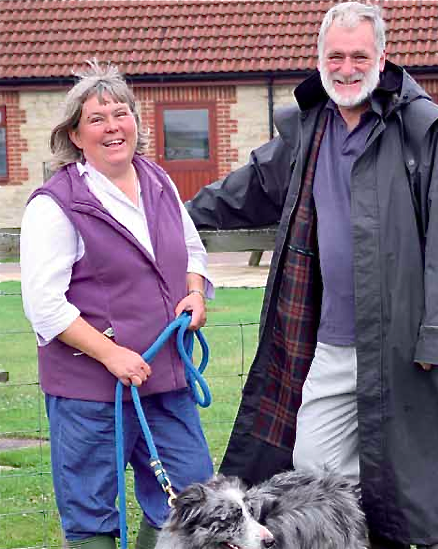
Lydia and Richard, with Badger
But come to think of it, there is a connection as on Tuesday we met two participants of a Palm Sunday procession, to whom nobody could object. We'd been invited to visit Pennyhooks Farm, about which, you may remember, I blogged in January after it was featured on BBC Countryfile. It's a care farm, the only one in the country that's geared for adolescents and young adults with autism spectrum disorders. It's also where Rachel does some teaching. There's a good article about it here: Pennyhooks Farm article in current edition of Organic Farming.

Feeding the cattle (from www.pennyhooks.com)
It's a family farm near Shrivenham in Oxfordshire. It's now run by Lydia Otter (whose family have run the farm for 50 years) and Richard Hurford, the farm manager. Lydia is a teacher who has specialized in special needs' education. She saw the potential of a farm to develop the latent skills of young people with severe educational needs - and this place is working beautifully and successfully in doing just that. It, of course, is experiencing the economic squeeze. Sadly, these particular young adults don't feature highly on councils' lists of priorities, and they are voiceless in the political arena. And Lydia's busy educating, Richard too, and they run the farm. So who will be advocate for these vulnerable citizens with so much to learn and to give? And who will be a fund-raiser for their benefit? There is such a big-hearted vision behind the project. It should be nurtured, not neglected.

The garden, the 'shop' and Appletree House behind Richard & Badger
We were there in a week's break. So there were no students there, but we were shown the heart of the farm.
The main study room
The boot room


On the way to the animals
Jaguar, the young bull
Octavia, the Saddleback sow

Not easy holding a new chick with uncooperative hands!
But what about those Palm Sunday processors? Ivanhoe and Linnet are their names, and two days before they had been walking down Shrivenham High Street into the parish church with perfect decorum, I'm told - and of course to the author of My Donkeybody they gave great pleasure. I like to think we had a real understanding! As you may sense, I thoroughly enjoyed my time there and could well understand its being both a therapeutic and educating (in the fullest sense) place for young people who have the dice of life heavily loaded against them. Gertrude Jekyll it was, I believe, who said that you're nearer to God in the garden than anywhere else on earth. Well, I'd say this was one better, as it has not only a garden, but also an organic farm; and what's most important people running it who genuinely care about their visitors - whether casual like us or regular like their young people. Thank you, Lydia and Richard - and best wishes.
Ivanhoe and Linnet

A quiet conversation with Ivanhoe


Saturday, 5 March 2011

Public policy affects individuals

After Wednesday morning appreciating the NHS, we mosied down to Cornerstone to meet Jean, who’s recently been diagnosed with MND, and her husband, John. What a nice couple! They’ve lived in Grove all their married life. We share a number of the same professionals, like physio, GP etc. They were waiting for a stairlift to be fitted on Thursday, which will mean Jean will be able to sleep upstairs again. It does feel better going upstairs to bed. No doubt we’ll meet up again. In fact we’ll be seeing them again next week at the local MNDA meeting in Thame - about benefits. How timely!
I wonder whether they’ll have any light to shed on Moira’s plight. She has MND much worse than me (for example she can’t speak and can’t move), and lives on her own with a son and a full-time carer. Hitherto she has had Continuing Care funded by the local NHS Primary Care Trust. Now they’ve reassessed her and decided she’s not eligible after all - interesting idea since MND is degenerative. So they say she’ll have to apply to Social Services to fund her care. That will not come cheap, of course. One wonders, naturally, whether it’s more a matter of healthcare economies than patient needs. As far as I can see she should qualify for the NHS funding for her Continuing Care on more than one priority criterion. She’ll no doubt appeal, but in a fortnight she’ll have her funding discontinued and be left fending for herself. That seems a plain injustice. Why can’t her funding be maintained until the appeal is made (within 28 days) and a decision reached? I guess there’ll be more stories like this in the months ahead as public bodies tighten their belts. The sad thing is, it’s the vulnerable who get squeezed in the process.

Dr David Starkey
On Thursday evening there was an unexpected and most welcome item on BBC1’s Question Time from Derby, where the foster-parents, Owen and Eunice Johns, live. They’re the Pentecostal Christian couple who as a result of a jointly requested judicial review were declared unfit to foster children between 5 and 8 years old, because of their views on homosexuality. The judges ruled that they were potentially harmful to children entrusted to their care. Irrespective of the rights and wrongs of their views, that does seem to exclude everyone with opinions which are not politically correct. This was sadly illustrated by the two politicians on the panel, Margaret Beckett and Ian Duncan-Smith who in particular tied himself in knots about the case. 

By contrast, popular and trenchant historian, David Starkey was clarity itself. “I’m gay, and I’m atheist,” he began, “but I have profound doubts about this case. It seems to me that what we’re doing is producing a tyrannous new morality which is every bit as oppressive as the old.” He went on to describe his early experience of being hounded as a gay man, but he said we now have a ‘liberal’ morality which is in danger of being equally intolerant. He also talked about being a gay son of a Christian mother, who passionately hated his homosexuality, and he said it did him no harm. “It made me what I am.” We live in a complicated pluralistic society, and it’s hard. But we're in danger of creating 'thought crime'. “Just having a reach-me-down, off the hanger, imposed morality is a very bad idea.” I must say I warmed to him surprisingly and found myself thinking, “There’s a wise man. Refreshing to hear an atheist defending Christians’ and everyone's freedom with such intellectual rigour.” That of course cuts both ways, including Christians not imposing their morality on atheists. Argue for by all means but not impose. It’s worth listening to the discussion on the subject: BBC Question Time re Foster Parents.

Thursday, 4 November 2010

Please don't hijack care


First, an apology: I fell into the oldest trick in the politician's PR book, viz "When you've got some unpopular policy to announce, leak a worse version first and then when you make the real announcement people will think, 'Well, that's not so bad, is it?'" The cap on student loans is going to be "only" £9,000 per annum, but, unlike now, there will be an additional 3% p a over inflation to repay. It's still quite a hike from the present and still, of course, means students ending up in debt. Graduates on the national average wage of £31,000+ would pay 19.3% more tax than their non-graduate contemporaries, while paying off their loan. One mysterious (to me anyway) rule is that graduates will be penalised if they pay the loan off early.... (http://www.independent.co.uk/news/uk/politics/ministers-set-to-unveil-tuition-fee-plans-2123847.html)

This week car manufacturer, Toyota, are having yet another recall, this time of 12,000 of their iQ models in this country (bringing the grand worldwide total over the past months to 10 million of various models). It's extraordinary how successful they still are. First it was a braking problem ("Keep your distance; the car in front is a Toyota"); this time it's a fault with the steering. I know they're not the only car maker to recall cars, but they seem to have more than their fair share.

It's ironic then that Care Services minister, Paul Burstow, should be so keen on another Japanese invention, Hureai Kippu. I don't know how likely it is to crash, but it's a very bad idea. In case you don't know, it means "Caring Relationship Tickets", and it's a way of rewarding voluntary carers with credits they could later redeem to fund their own care when they need it. So, for example, if someone were to shop for me or wash me or help me on the toilet - out of mere concern or love - they could log it and put it in a "bank" of credits for when they needed care. Good idea, you might think on a superficial level. However, there are two things fundamentally and profoundly wrong with this. 

One is that everyone, whether or not they've been nice or nasty, whether they've clocked up Hureai Kippu points or not, ought to be cared for when they're in need. Compassion should be free at the point of need. 

The other is that care, voluntarily and freely given, is just that. To link it to self-serving reward is to pollute its very nature. Certainly caring for someone else brings incredible personal reward, but as a by-product, not as its purpose. The caring professions, of course, are incomparable and I rely on them, but the care of those who stand to earn nothing from it is of a different order. To incentivise it would be to compromise it tragically.

I'm reminded of the prayer of St Ignatius of Loyola - which I think I learned in my brief career as a Cub Scout -. It would be an immense loss to abandon the profound principle of disinterested service which remains a beautiful part of our country's Christian heritage, even if so clearly enunciated by a Spaniard!

Teach us, good Lord,
to serve Thee as Thou deservest;
to give and not to count the cost;
to fight and not to heed the wounds;
to labour and not to ask for any reward,
save that of knowing that we do Thy will.
through Jesus Christ Our Lord.

Thinking of volunteering, the episode of The Secret Millionaire on 17th October contained a good example. "Travel website entrepreneur and self-confessed geek Chris Brown confronts painful memories and undergoes a life-changing experience as he looks for people to help in north Manchester." Among the charities he visited was The Mustard Tree where Paul works. What Chris Brown found hard to get his mind round was when he offered £15,000 to Oscar, who works in the refuse centre and does up thrown out bikes and gives them to families who couldn't afford one. Oscar turned the money down, because he simply loves doing it. He does it out of love. That is worth the world. To give Chris Brown his due, he respected Oscar's decision. Let's hope the government gets the point too. http://www.channel4.com/programmes/the-secret-millionaire/4od#3129925