Showing posts with label Care homes. Show all posts

Thursday, 15 November 2012

Rare generosity

Our week began with two contrasting but hugely moving events. The first was the funeral of a fifteen-year old girl with life-limiting disabilities (which I've already written about here "Thank you, Beth"). To one way of looking, this girl had no quality of life herself and impoverished her family's lifestyle. However I would disagree - and if the family were to be believed so would they, vehemently and utterly. Their testimony was simply how much good their daughter had brought into their lives. Not that they minimised the difficulties and heartache, but one simply has to know them to recognise how much love and joy (of a depth and quality few of us ever experience) she brought to them and to others - of whom I was fortunate enough to be one.

I first met her and her parents three summers ago when we were at a churches' convention and they were across the gangway from us. The attentiveness of her parents to her life-sustaining needs was constant and unconditional. It was clearly their way of life - and it lasted up to and beyond her premature death. Her send-off was no ordinary funeral. It plumbed the depths of grief and soared on heights of hope, all enveloped with extraordinary love. I have absolutely no doubt that if you asked the family whether they'd rather not have had the past fifteen years they would be astonished at the very question.

Then on Tuesday we visited an old friend who'd lived in the next village to us and in whose farmhouse I always received a warm welcome. She is now in a care home for dementia sufferers. We think she recognised us, but it wasn't easy to be certain. What was clear is that she was the same person we always knew, with the same sweet and cheerful nature, the same lady who used to sing a capella after communion in the small country church where she worshipped month by month. We were particularly glad to have spent an hour with her in that eccentric lounge, with disorientated women and men, with all their fluctuating emotions. It's hard to pin down why it wasn't depressing, but it wasn't. I dare say it might feel that way after a while. In fact it was rather the reverse. I think an important factor was the care of the staff. They were an international group, from at least three continents I'd guess. But they were all patient and quiet. It was impressive. We commented to one of them as we were leaving how patient they seemed and she said, "You have to be to work here."

I'm glad neither our young friend nor our old friend was thrown on the scrap-heap, but both have been valued and cared for, whatever the cost. Their lives were and are infinitely precious, as are all lives, however "useless". May we never set foot on the road which denies that value.

Simone Weil
I was listening to Melvyn Bragg's admirable programme In Our Time this morning and learned about the remarkable Simone Weil, about whom I was woefully ignorant. Born in France, she died in England in 1943 aged 34, and is buried in Ashford. Her understanding of pain was unusually vivid. One thing she said has really struck me, “Attention is the rarest and purest form of generosity.” That, it seems to me, is what both my friends received. One could use other cognate words, such as attentiveness and attending to, or being totally aware of, or focusing on. It's the sort of care that gives itself to the other at the expense of the self - that is "the rarest and purest form of generosity". And I'm grateful to have seen it in the unpromising milieu of a dementia care home and particularly in one family's devotion to their helpless dependent child. I have had a privileged couple of days.

Thursday, 11 October 2012

Vulnerable AND valuable

The headline yesterday was: 

"Care home staff 'abused elderly': six arrests made

A former matron and five nurses who worked for a care home have been arrested over 'serious allegations' of mistreatment and neglect of 'very vulnerable' elderly residents."


You may remember I was writing about the importance of recognising that all, including disabled people, should be treated with respect (Do not resuscitate) and valued as persons. The Telegraph report illustrates the danger of abuse of the vulnerable, even in places where they are meant to be cared for. The nursing home in question specialises in caring for severe Alzheimer's sufferers, who are, in my view, in the front line for abuse - which, at its extreme, includes euthanasia.


"Chief Superintendent Richard Bayly, from Lancaster Constabulary, said the 'serious allegations' involved 'very vulnerable, elderly residents' and regarded 'a significant number of cases'.
"He said: 'These arrests are a culmination of a thorough investigation into serious allegations of mistreatment of residents at Hillcroft Slyne nursing home.
"'The inquiry is complicated and we have a team of specialist detectives working on this case who are also offering support to those families who may have had loved ones identified as being allegedly mistreated.'
"In May, Lancashire County Council's social care department made police aware of a complaint they had received about the level of care provided to some residents at the home."

After my "Do not resuscitate" post, a severely disabled friend wrote to me about her own experience
"I've been ill for most of the time for the last 3 years, and have spent all too much time in hospital.  The last time was in July 2012, and I came across a nurse with a sickly sweet voice, but who bullied me mercilessly.  She knew that if I swallowed tablets by mouth I would retch and/or be sick, but refused to use the canula, which had been put in (with much difficulty) on doctors' orders only the previous day.  She shouted at me, and refused to use the canula.  I became quite afraid of her.  I phoned my carer and he came immediately.  He managed to put her in her place while remaining entirely polite and calm, but it was a very unpleasant experience.  It made me think of the terrible predicament of those who have no one to stand up for them, or who cannot communicate, or are very elderly, perhaps with dementia. It is such a scary situation for all of us."

My friend is a lovely person who struggles with multiple disabling conditions with amazingly good grace. Yet even for her the sense of helplessness faced with insensitive caring was enough to scare her, and clearly not everyone is fortunate enough to have a competent advocate to call on in time of crisis. As a country, we really must heed the warning signs of a trend, despite Paralympic euphoria, of diminishing our regard for the disabled. Just over a month ago, there was great optimism that an irreversible change of attitude had taken place. If we are not vigilant, it will be more than reversed: disabled new borns and vulnerable elderly will be regarded as legitimately disposable. Then we will have entered a morally bankrupt "brave new world".

Monday, 2 April 2012

Sunny days in Devon

I have to apologise, not least to the friend who wondered whether my blogging silence meant something was wrong. I'm sorry to say it means approximately the opposite - that I've been having rather a good time, partly because I've been in the book-writing "zone" and partly because we went away for a long sunny weekend to South Devon coming back a week ago.

We stayed in Newton Poppleford for two reasons: a) it's near Jane's revered and lovely parents, and b) it's where I found a promising disabled friendly bed and breakfast. Brookfields proved to be better than I'd dared hope. It's run by a couple, David and Rosemary, who'd previously owned a nursing home and therefore understood my needs well. Our bedroom had a wetroom en suite which, of course, is ideal. There was plenty of room both sides of the bed. And the breakfasts were amazing. David and Rosemary seek out the best from every source, working on the principle that they give their guests what they themselves would like. And they are excellent and generous cooks. When we eating out with Jane's parents at midday, we had the continental option - well, you can't do much with that, can you? It was fine, but not as extraordinarily yummy as the full English.

I suppose what was best about Brookfields was the hospitality. It isn't the hotel-type B&B; it's a home. Even Axy, the dog, is friendly and welcoming.

Friday was Sport Relief day. We'd decided to make use of our National Trust card and visit Killerton House, just on the other side of the M5. It's an impressive house, built originally as a stop-gap, for the Acland family. Happily they decided to stick with it rather than build a grandiose permanent house on top of the hill. It's grand enough as it is, with beautiful grounds (not that wheelchair friendly) and an accessible ground floor. Jane indulged one of my vices at lunchtime with a packet of quavers, which was kind of her.

About midday there was an influx, a torrent of primary school children, 200 of them in blue, yellow, green and red tops. They were, we realised, marking Sport Relief, competing in ages round different distances, including a course of up to a mile. It was beautiful sunny afternoon; parents and peers shouted encouragement. What better way to end the week - pupils and for teachers! And for us it proved diverting entertainment.

St Luke's, Newton Poppleford
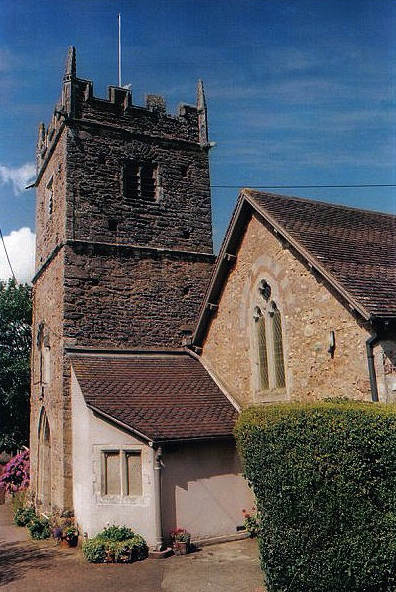
Our Italian evening was, I'd say, average, although the service was excellent - as were the quite different services we attended on the Sunday. The first was in St Luke's, Newton Poppleford, which Rosemary took us to in the morning. A delightful friendly relaxed yet reverent Communion service. It reminded somewhat of Stanford, which is quite high praise! After a cream tea in the afternoon we headed off to see the sea and then to join our friends at Christ Church, Exmouth. Here we had excellent worship music, and a memorable sermon on Psalm 1 and pee charts! On the way back we sampled Krispies' award-winning fish and chips, which I have to say were just as good as their reputation. Back at the B&B we were plied with sloe gin and red wine - "and so to bed" after a great day.
Christ Church, Exmouth

Jane returning with the clotted golden treasure!
Before coming home on Monday, we had to pick up some clotted cream for a member of our family (and ourselves, to be fair) from what is agreed to be the best supplier in Sidmouth. We spent another couple of mellow hours with Jane's parents, this time in Sidmouth Garden Centre's remarkably good and reasonably priced restaurant. Our progress was almost brought to a halt by an accident blocking both directions of the A303. However instead of following the official diversion we successfully circumvented it and were home in time to feed the dog. Although physically taxing, as all changes from routine inevitably are, with a disabled body to look after, we both returned stimulated and ready to enjoy the week of unbroken sunshine which followed. Breaks are physically tiring and take a bit of recovery time, but mentally they are essential for riding the stresses of disability - which is the reason why funding which makes them possible must not be cut. The alternative, carers being unable to carry on, would cost the tax-payer much more, with two casualties to deal with. I await with some trepidation the government's proposals for creating a viable care system.

Sunday, 12 June 2011

Friday Night Theology

I hope Marijke won't mind me reproducing this article from "Friday Night Theology", which I loved.

Shalom in the home

10 June 2011
Men sitting on a bench
Three years ago, my dad passed away following a long illness. He died in the house he built, overlooking the trees he planted, cared for by the doctor he mentored and the family he raised. Collectively we did well in honouring him in the final stage of life. Family, friends, and carers - each contributing to the best of their ability. Peace in the house.  
Last weekend, the author Diane Athill described her care home: "This place is a dream. I'd been here for about a week and I thought: 'What is it about this place that's so marvellous?' And I realised, it is goodness - an extraordinary feeling of goodness. None of these people are anything but genuinely kind. That's the secret of a decent place."  
There's been little peace recently as far as the topic of caring for the elderly is concerned. A report earlier this year on healthcare revealed an attitude - both personal and institutional - which fails to recognise the humanity and individuality of the elderly and to respond to them with sensitivity, compassion and professionalism. A survey of residential care homes and providers of outreach services found that older people face isolation, a lack of community and funding. The drastic public sector cuts and disastrous manoeuvres in privatisationcontribute to an increased sense of vulnerability in the already vulnerable.  
In his final book The Radical Disciple, John Stott reflects on the final part of life: "We come into this world totally dependent on the love, care and protection of others. We go through a phase of life when other people depend on us. And most of us will go out of this world totally dependent on the love and care of others… It is part of the design, part of the physical nature which God has given us."  
We all have a lot to gain in the season of parent-care, as Dr Emily Ackerman explores in A Time to Care. The transformative element does not merely concern our heart and home. It is wider than that. In ancient Greece, the oikos referred to the house and everything included, such as extended family, slaves and farmland. Nomos means act, law, or principle. The Ancient Greeks first combined these two roots to form oikonomia. Eventually, the word 'economy' was born, which literally means "the principles to maintain our house". Whether that "house" is government or family is relative.  
There is a Christian imperative to develop good practice and challenge political and entrepreneurial malpractice. For poor care for the elderly is not only a tragedy, but also a scandal. Bishops have rightly called for rightdecisions and a new framework of trust. We need a vision and ardent advocacy concerning our collective 'house-keeping'. And in view of the ageing society, we need a long-term commitment. Demographic projections indicate there will be more than 11 million people over the age of 65 within 10 years. 
God's word gives us a glimpse of shalom in the community: "Once again men and women of ripe old age will sit in the streets of Jerusalem, each of them with cane in hand because of their age. The city streets will be filled with boys and girls playing there."   The imagery is one of communal wellbeing, shalom. Collectively - government, service providers, families and community - we need to do well.  
And, as far as the household of faith is concerned, caring for, and advocating on behalf of the elderly is an intrinsic part of radical discipleship.
Marijke Hoek, coordinator Forum for Change

Monday, 6 June 2011

Back to reality

As we sped south down the M6, we passed a very unpleasant accident on the north-bound carriageway, three fire engines, an ambulance or two and any number of police cars. Unsurprisingly there were miles of nearly stationary traffic. It was a bit of a reality check, as was the news of the Southern Cross care homes fiasco which could leave 31,000 elderly and vulnerable people without care and a home, and of course all their carers jobless.

I don't pretend to understand all the convolutions of the private equity companies that have played their part in bringing the company into this parlous state, but some people have clearly made a lot of money out of it, such as Wall Street financier who made £500 million out of it, and its former chief executive, Philip Scott, who sold his shares in the company for a mere £13 million four years ago.

And then there came the horrible Panorama programme about Winterbourne View, the "care home for adults with autism and learning disabilities run by Castlebeck, a company which has a £90 million turnover and runs more than 50 other care homes. The company charges the NHS and local authorities up to £3,500 a week to care for patients" (according to the Telegraph). The care there amounted to torture of utterly vulnerable people, here in the UK. The Panorama programme shocked even the owners.

I hope it shocks the government too, so that, if it decides to go down the line of using private companies, it doesn't invest in firms like those. I can't help remembering that when we were up in Stockport, by far the best old people's home was one owned and run by the local authority. It was the only one that invested in training its staff, for example. Not surprisingly, private homes didn't bother - well, training cost and didn't maximise profit. Now here's an idea. How about laying down minimum qualifications for staff in homes, and an obligation to train, in every contract? If we dogmatically insist on going down the private road. Otherwise I fear our health and care services could be heading for a horrible crash.