Yesterday I was presented with a work of art which left me speechless. It was crafted by a relatively unknown South Devon artist. Here it is in its temporary resting place.
 | ||||||||||
| © Pietá by David Milnes |
David Milnes and I have been friends since schooldays. In correspondence with him in August, I wrote: "As for the 'commission', in one of my novels I wrote about someone facing the loss of someone she loved identifying with Mary at the cross. She seems to me the person who most experiences the desolation of dereliction in the Bible. And I’ve long thought that evangelicals have failed to engage our imaginations in the gospel story. What must it have been like at the moment of Jesus’ death? So I’ve been looking for something that expresses the grief, disappointment and pain as they begin to take the body down. The characters I was looking at around the cross were Mary the mother, John the friend and Mary Magdalene who’s in love with Him (parent, saint and sinner - all humankind). It seems to me that all of us in our dark moments think the God we believed in and who is love has died and abandoned us. For many a resurrection morning never dawns. Which, I guess, we all fear and which is why, I think, we need each other to hold on to as we wait."
David immediately set to work. He'd picked up, to his relief, that I wasn't looking for an serene scene carved in marble like Michelangelo's masterpiece. He'd been impressed by Fenwick Lawson's Pietá in Durham cathedral carved from "the rough split rawness of large logs".
 | |
| © Picture Durham Cathedral |
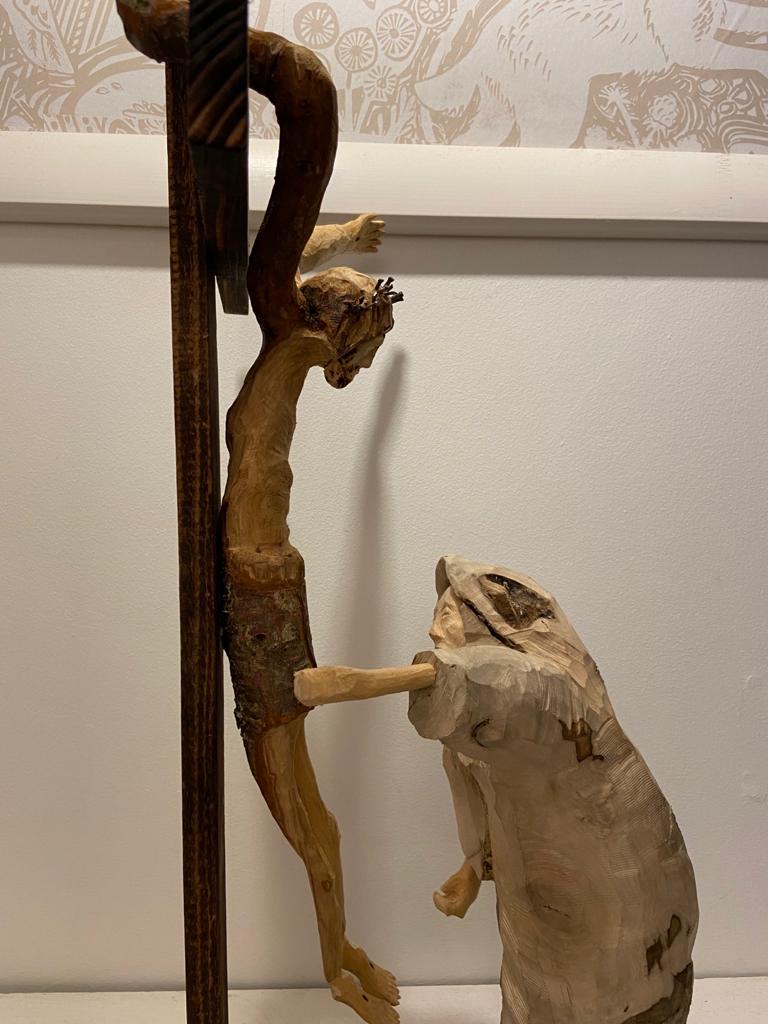
This is David's description of his own work. "For the figure of Christ I have used a section of a plum tree in our garden. It is dead, twisted and covered in lichen. Two side branches looked like contorted arms writhing in pain and desolation. The connection between the arms is not realistically correct but suggests dislocation and extreme pain. The main branch is thinner than the body should actually be, but elongated bodies suggesting suffering were good enough for El Greco, so why not? In order to make the hands, feet and face stand out and in order to emphasise their vulnerability, I carved them separately in lime wood that enabled me to include greater detail. The marks of the nails and the spear in his side were burnt into the wood.
"The cross is not a beautiful, smooth and varnished piece of neat carpentry. It is a rough piece of pallet wood which I have scorched. Burning has close associations with pain and destruction.
"For the figure of Mary, as she reaches out to help remove her badly mutilated son from the cross, I used a piece of holly wood which is solid and heavy with sorrow. It has twists and knots and rotted areas which are indicative of the terrible trauma and devastating blows that she has endured. It is very different wood from that used for the figure of Christ but it suggests suffering which is different but just as all consuming."
I love the rawness of this Pietá. It is certainly a discomforting addition to a sitting room. I like the fact that Mary is not portrayed as a beautiful young saint but as a middle-aged mother whose years of bringing up children in occupied territories have taken their toll on her physically. She is one of the many middle-eastern women grieving for their sons killed in a reprisal air raid. I like the proportions of the carving. To her Jesus is still the small child she held in her arms. I like David's choice of woods: Using for Mary the wood of the holly tree, which two Christmas carols associate with the suffering of Mary - "the holly bears a bark as bitter as any gall". And he has used fruit wood for the body of Christ. Humankind's fall from grace came through eating the forbidden fruit; its restoration to grace comes through "eating my body", as Christ put it. And the wood on which he hangs, a discarded pallet to crucify the rejected carpenter's son. The artist's brother pointed out that Mary is seen as left-handed - so maybe represents despised minorities and those considered weak. Theologians may recognise in the emaciated crucified body a depiction of what they call κένωσις, Christ emptying himself "taking the form of a slave and becoming obedient even to death on a cross".
As my son commented, "What a gift!" Whether he meant what a talent or what a present, I don't know. Probably both. And on both counts he's right.
 |
| © Photo Courtesy John Milnes |
 |
| © Photo Courtesy John Milnes |
 |
| © Photo Courtesy John Milnes |
 |
| © Photo Courtesy John Milnes |


