Showing posts with label peace. Show all posts

Tuesday, 8 November 2022

Reaping the whirlwind

During Liz Truss’s ill-fated premiership, anxious to build on Boris Johnson’s Ukraine-bolstered popularity, Ben Wallace, the UK Defence Secretary, was sent to the United States to discuss with his American counterpart. We were told this was because of the villainous Vladimir Putin and the "very real" threat of his launching a dirty bomb attack on Ukraine. Of course Mr Putin denied this - but then, as we have been discovering here, politicians have a habit of lying in order to save their skins. Well, no doubt, our intelligence services know what they’re talking about - inasmuch as we’re allowed to hear.

Of course, we won’t learn the truth for many years. However there is an irony here. And that is that these foul weapons, which combine conventional and atomic elements, had their origins in our own country. I’m listening to the BBC Radio 4 series “Fallout: Living in the Shadow of the Bomb” at the moment. What a disastrous story! It’s an account of the British nuclear bomb testing after 1952, in Australia and the Pacific Ocean. I learned what I didn’t know before: that it was two scientists in Birmingham University (which even has a blue plaque to commemorate the event) who first wrote about the possibility of airborne nuclear fission and it was Winston Churchill and the UK wartime government who started an atomic weapons project, codenamed Tube Alloys, before the Manhattan Project in the USA. In fact it was we who shared the technology with them, and German and Soviet spies who disseminated it to their respective powers. Talk about reaping the whirlwind!


But then it has always been thus. We discover a new super-weapon, such as the rifle, and we destroy indigenous nations and take their ancestral lands; or chemical and biological weapons and are appalled when they’re employed by dictators. We develop sophisticated landmines and then weep crocodile tears when thousands of children have limbs blown off. Drones were developed in the UK and the USA and used by Germany in the war, and now they are devastating our ally, Ukraine.

As we approach Remembrance Day, in my view it’s vital that we recognise our complicity in this horrific trade and how central the military-industrial complex is in our economy. In his two-part essay, Re-remembering War Alan Storkey writes: “The Military-Industrial Complexes of the World need wars and generate wars. Accumulating arms causes wars and did in 1914. Most modern wars do not have a big disputed reason, but start because the military and the arms sellers need wars for their business. The military-industrial complex, allied to its politicians, cause wars and rumours of wars.” And he quotes Lord Grey: “The person who knew the build up to World War One most thoroughly was Lord Grey, British Foreign Secretary for the preceding decade. He said: ‘The moral is obvious; it is that great armaments lead inevitably to war. If there are armaments on one side, there must be armaments on other sides.. The increase in armaments that in each nation is intended to produce consciousness of strength and a sense of security, do not produce these effects. On the contrary, it produces a consciousness of the strength of other nations and a sense of fear. Fear begets suspicion and distrust and evil imaginings of all sorts…The enormous growth of armaments in Europe, the sense of insecurity and fear caused by them – it was these that made war inevitable. This, it seems to me, is the truest reading of history, and the lesson that the present should be learning from the past in the interests of future peace, the warning to be handed on to those who come after us.’"

As Storkey comments, "There were many other witnesses to the same truth, as we shall see. ARMS CAUSE WARS.” Both developing weaponry and deploying it are pernicious human activities, and we should be more than sad as this weekend we contemplate their effects. Surely we should pressure our politicians actively to resist the siren calls of the arms industry with their well-paid lobbyists and a light grasp of morality? And pledge ourselves actively to seek peace? Or as the Peace Pledge Union has it, "Remember and disarm".

There's a prayer for Remembrance Sunday which goes: "God, our refuge and strength, bring near the day when wars shall cease and poverty and pain shall end, that the earth may know the peace of heaven, through Jesus Christ our Lord. Amen." With due respect to the writer of the prayer, I reckon it isn't just the Almighty's job to work for peace.

Thursday, 23 July 2020

Scaredy dogs - or dangerous dogs of war?

Have you noticed that dogs usually bark, growl and bare their teeth when they are frightened? That, I imagine, is why so many small canines are so yappy and aggressive. They hope that by getting in the first yap or nip they'll scare off what they see a big threatening hulk of a beast. It's apparently what tourists are recommended to do when confronted with a tiger defending her young - not the nipping, just making a loud noise. It's certainly what we were told to do in the Mount Kenya forest if we encountered elephants or, worse, buffaloes. So there was the occasional clashing of pangas on our way up. 
Clipartmag.com

I wonder if this is the reason for the continual shouting about China and Russia indulged in by our government and our large friend across the pond. We're like a Jack Russell terrier and a stout Rottweiler seeing an Afghan hound and a Great Dane in the park. If we had any self-confidence, we'd not bother to see sinister intent whenever they looked at us. Instead we snarl that one looks messy and the other leaves larger deposits than other dogs.

Or maybe we're like street gangs. I gather that often the motive for carrying knives is fear. If I'm threatened, I'll get in first with my weapon, and so we brandish our verbal aggression to forestall a perceived threat. However, what if the threat is imagined but not real? Our politicians and the media whom they feed are busy creating a narrative of threat, which may or may not be real. Certainly China is a major player now in terms of global economic power, and by our standards is among the most repressive states in the world. Russia, geographically huge, was once our ally in fighting the greatest scourge of the last century, but is now a declining economic force.

I don't pretend to know the facts and fiction of all the anti-Russia stories we're fed. (Nor the ones about China, or Iran.) There are a lot of puzzling elements in accounts which go apparently unquestioned. For example, why in a time of supposed international transparency and cooperation should a state bother to hack vaccine research, especially when it had made a deal with Astra Zeneca for the leading contender in the field? Or why should it send two incompetent spies on a plane together in an attempt to bump off another one in a CCTV-abundant country? 

Clearly the government would prefer us not to know as, according to the ISC report, it didn't ask the security services to investigate any potential interference with elections or referendums in the UK, thus leaving it able to say with a straight face, "See, the report found no evidence of Russian interference." Of course, if you don't look for something, you won't find it. (Sadly now it appears that even the Opposition has entered the anti-Russia game questioning the right of RT to broadcast here.)

If a government is in trouble, the traditional way out was to find a war to fight and call the country to unite against a common foe, whether Argentina or Iraq. Failing that, the current policy is to wage a war of words, to create a phoney enemy and maintain a barrage of propaganda, in cooperation with the media - which on the whole your country will believe. The trouble with this policy is that it does not tend towards peace. It tends to real war, economic or physical. And the people who suffer in war are the ordinary citizens. You have only to look at the effects of the United States' sanctions on countries such as Russia or Iran. Personally I don't wish to be part of a nation of self-righteous warmongerers. it may make us feel great, but it doesn't hide the fact that we have feet of fear. 

However, it's reasonable to ask, in what way can our government possibly be "in trouble" with its landslide majority in Parliament? Primarily because it is presiding over a country both divided and economically threatened by Brexit. The more the headlines are dominated by pandemic stories, or failing that Russia and China stories, the less notice journalists will take of the surrender of our EU-won protections (for example of food standards and the environment) and the loss of Parliamentary oversight of our national interest (for example of the NHS). Ironically even the Dominic Cummings' story would have served as a welcome distraction, because there was no way that he would have had to resign. The first "enemy" that presented itself was the Covid-19 pandemic, which our Prime Minister faced with Churchillian bravado. Sadly, although the country was remarkably united in defensive measures, the victory hasn't been won, and if and when it is, it will prove to have been terribly Pyrrhic. And so instead we have let slip the dogs of hostility on our ever useful bogeymen with a succession of stories fed to the horse-leech media.

Or maybe the "trouble" is merely a matter of Mr Johnson's and Mr Trump's approval ratings, which are disturbingly (for them) low.

In the words of the nineteenth-century poem:
"O hush the noise, ye men of strife,
And hear the angels sing." Or, in other words, "Shut up, you warmongers - and give peace a chance!"


Friday, 27 March 2020

Peace in the plague

Further to my last post, I wonder whether the bishops and archbishops had seen this before they sent out their instructions. It might have given them pause. It comes from Facebook and I have no reason to believe it's not genuine.

'A friend posted this and I felt it is worth sharing - It comes from an Italian Doctor:

“Even in my worst nightmares, I would never have expected to see and live the events that have occurred in our hospital over the last three weeks. This horror is increasing every day; it’s become unmanageable and we have become ineffective.

At first, only a few people came, then it was hundreds, and now, we are no longer doctors, but selectors… We have to decide who will live, and who will die by sending them home, even though these people have duly paid their taxes in Italy.

Two weeks ago, my colleagues and I were atheists. Belief in science was the norm. And science eliminates God’s presence. I had always laughed at my parents for going to church.

Nine days ago, a 75-year old pastor came to us with severe respiratory problems. He had a Bible and would read passages every day to those who were dying and hold their hands. We were both mentally and physically exhausted, and bitter, but when we had the time we would sit down and listen. We have to admit that, as humans, we have reached our limits, we can’t do any more! More and more people are dying every day. We are exhausted; two of our colleagues have died and others are barely standing. We realised that mankind’s scientific knowledge is limited and that we need God! We started to pray whenever we had a few minutes. It’s incredible, but even as committed atheists, we came to God and found peace! He helps us persevere so we can care for the patients. Yesterday, this 75-year old shepherd passed away. We were devastated as never before (despite having seen 120 deaths over the last week). Because this old shepherd, whilst he was with us, managed to bring back peace to us, a peace I had had no hope of ever finding.

The shepherd has gone to be with the Lord and we will follow soon. I have not gone home for 6 days; I can’t remember when I last ate and I’ve realised how useless I’ve been to people on this earth until now. I want to help others until my last breath. I am glad to have found God and I want to serve him by helping my fellow men until my final breath."

My revered cousin, Sue, whose father was a consultant surgeon and mother a senior nurse, wrote this today: "We have been taught that cleanliness is next to Godliness in importance. Let’s not forget Godliness comes first!" Like her, my sense is that we have lost sight of that and we're the poorer for it, as individuals and as a nation. After all we'll all die some time, but I suspect the peace which that 75-year old "shepherd" brought outlasts even dying.

Thursday, 5 December 2019

Mr Corbyn - in the spotlight

A comment I heard last night at our local coffee shop has driven me back to my blog. It went something like this, “I don’t know who to vote for. I might put an X by all the candidates and ‘Blow you for spoiling my Christmas’ at the bottom. My grandad was a true Labour man, but I’ve always been a Conservative. I don’t trust Boris but I’d never vote for Corbyn. He’s even worse.” When I asked why, she couldn’t really tell me. But I think I know the reason as I explained a week ago on Facebook. I think she’s been poisoned.

“I'm dismayed by the sustained disinformation attack orchestrated, I suspect, from Conservative HQ on Mr Corbyn ever since he became Labour leader. Like a snake's tongue it is two-pronged - that he is a communist (or as Boris would say, stalinist) when he's in fact a democratic socialist, and that he is anti-semitic, when in fact he's anti-racist but opposed to expansionist zionism. I'm more dismayed that mainstream media so regularly reinforces the myths. And I'm even more dismayed that the poison is so widely swallowed. It is not good for the political discourse in this nation.”

So why, if that’s true, does he not just come out and strongly deny the accusations raised against him and apologise for the few errors of judgement he may have made? I believe that, in fact, once he realises he’s made a mistake, he has admitted it and apologised, for example in the case of the Mear One mural. Partly I think it’s explained by his nature and his manner, perceptively observed by the distinguished linguistics professor, Noam Chomsky, on a lecture tour here a couple of years ago, in an interview with The Guardian. ““There are various reasons for that – partly an extremely hostile media, partly his own personal style which I happen to like but perhaps that doesn’t fit with the current mood of the electorate,’ he said. ‘He’s quiet, reserved, serious, he’s not a performer. The parliamentary Labour party has been strongly opposed to him. It has been an uphill battle.’
“He said there were a lot of factors involved, but insisted that Labour would not be trailing the Conservatives so heavily in the polls if the media was more open to Corbyn’s agenda. ‘If he had a fair treatment from the media – that would make a big difference.’”
 

And there is of course an honourable tradition of silence in the face of false accusations both in literature and life, from Cordelia to Jesus. If an accusation is groundless, an answer merely fuels the myth-making. We’re all familiar with journalists pressing for some slip-up. The fiercer the denial, the greater the doubt.
 

One line of criticism often raised against Jeremy Corbyn is that he has met our “enemies”, such as Palestinians, Irish Republicans, Libyans or Venezuelans, and even talked to them. When he reasonably asks in Parliament for evidence a precipitate government action, we’re told it demonstrates his lack of patriotism, not the scrutiny appropriate to a responsible opposition. As even Donald Trump recognises, progress in diplomatic relations depends on meeting the “other side”, talking to them, listening to them, building a relationship, even a friendship, with them. To demonise your “enemy” is only to deepen divides; whether individually or corporately one does not love one’s enemy by ignoring them. Accepted, as Mr Corbyn does, that defence of the realm is a priority, it's still true that jawing is better than warring. If we ever hope for peace with our “enemies”, escalating the means of violence is the answer of fools.
 

Of course, the most insidious accusation raised against Mr Corbyn is that of anti-semitism. This has most recently been voiced by the Chief Rabbi, the leader of the United Synagogue (membership about 40,000, out of the estimated 284,000 Jews in this country). This was unfortunately soon followed by a general comment about hate speech by the Archbishop of Canterbury, eagerly seized upon by the press as an endorsement of Rabbi Mirvis’ attack on Mr Corbyn. It’s worth examining his record which seems consistently to contradict the verdict, for example since being elected leader 20 new measures to counter anti-semitism in the party have been introduced. 

The Jewish author and poet, and former Children's Laureate, Michael Rosen’s Facebook comment on the matter is worth reading in full. Here are the last five paragraphs:
“Further: the whole question of 'antisemitism' has been fogged by an unknowing or unwilling lack of clarity over distinctions between slurs, prejudice, bias, discrimination, persecution, incitement to antisemitic violence, and the violence itself. There are times when you might have thought that UK Jews were experiencing a pogrom.
“Secondly, the minimum requirements for a claim that there is a 'problem' in a given area (e.g. antisemitism in the Labour Party) is that it is distinctly and measurably worse than in other places or in society as a whole. If that hasn't been shown (and it hasn't been), it's not a Labour Party problem it's a societal problem.
“I've known Jeremy Corbyn for 30 years. He is no antisemite. He has put his neck on the line hundreds of times in opposing racism, antisemitism, far right fascism, holocaust denial.
“For the record the sudden loss of Jewish support for Labour came when Miliband was leader who the Jewish Chronicle described as 'toxic' for Jewish voters. Miliband is Jewish. It was his support for recognition of Palestine before negotiations that did for him, they said. Being Jewish was no shield against this hostility.
“Ask me, who am I 'safer' with: a Johnson-led government with its record of the 'hostile environment', persecution of Windrush generation, and persistent antisemitic jibes from leading party members or this Labour Party, and I say, Labour every time.”
 

The witness of a 30-years’ friendship to me outweighs the slurs of a plutocratically owned press and broadcast media which generally dance to their tune. My observation of Mr Corbyn has been of a principled politician who sincerely wants the best for ordinary people, and they certainly need a champion. Mr Corbyn was initially a reluctant leader, but how much this country needs integrity, honesty and principle in its leader now! He's no more a saint than I am; yet I for one have to concur with Michael Rosen’s conclusion.

Friday, 8 February 2019

In defence of Dr Nikki Alexander and Dr Donald Tusk

As you may know, I’m an avid viewer of BBC Television’s Silent Witness. I’m always sad when a series comes to an end, as No 22 did on Tuesday. As ever, it was a contemporary storyline and it had an individual conundrum running through it. That was a crisis of trust in one of the team of forensic pathologists around whom the series revolves. Dr Nikki Alexander (played by Emilia Fox) is the scrupulous lead pathologist whose results are challenged in court in an appeal concerning the death of a policeman. Somehow the original evidence has been corrupted by an interested party. Here ends the plot spoiler.
The episodes end with Nikki as witness, as the individual responsible for sabotaging the forensic evidence appears in court. She is asked by the prosecuting barrister:
Dr Alexander, what are the consequences of the defendant’s actions on your work?
She replies:
“What’s the point of experts if nobody trusts them? What’s the point of evidence if it can so easily be contaminated? The whole integrity of what we strive to achieve could have been catastrophically undermined. What my colleagues and I seek to do is understand the cause and manner of a person’s death. But we don’t only deal with the dead; we deal with the living – the families, the judiciary, the coroner, the police, the public, the press. And they all have to trust us, and if there is a betrayal of that trust, there is a crime. The opposite of truth is not just a lie; the opposite of truth is chaos, chaos that is in danger of bringing down the institutions we depend on – to deliver justice.”
Thank you, Dr Alexander.

During the referendum campaign, The Daily Telegraph reported on 10th June 2016:
“I think people in this country,” declared Vote Leave’s Michael Gove, “have had enough of experts.” His fellow Brexiteers were quick to back him up. “There is only one expert that matters,” said Labour MP Gisela Stuart, also of Vote Leave, “and that’s you, the voter.” Nigel Farage, the leader of Ukip, suggested that many independent experts were actually in the pay of the Government or the EU. This concerted undermining of experts was a major tactic of the Leave Campaign. Warnings of the complexity and potential consequences of exiting from real experts were poo-pooed, and who can forget the nonsense of the red bus? "The opposite of truth is not just a lie; the opposite of truth is chaos, chaos that is in danger of bringing down the institutions we depend on…" And we are now reaping the whirlwind.

Which explains Donald Tusk, the European Council President’s comments: “I have been wondering what the special place in hell looks like for those who promoted Brexit without even a sketch of a plan to deliver it safely.” And I guess it also explains the intemperate response of leading Brexiteers to his musings. Commons leader, Andrea Leadsom, who campaigned for Britain's exit from the EU, said Mr Tusk should apologise for his "disgraceful" and "spiteful" comments.

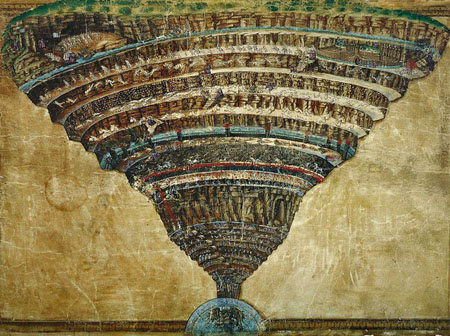
No doubt some of the Brexiteers realise that Donald Tusk might have been thinking about Dante’s Inferno (of which Wikipedia gives a useful summary for those who don’t want to read the whole allegory). “In the poem, Hell is depicted as nine concentric circles of torment located within the Earth; it is the ‘realm ... of those who have rejected spiritual values by yielding to bestial appetites or violence, or by perverting their human intellect to fraud or malice against their fellowmen’.”

Each circle is reserved for increasingly bad people. The bullseye at the bottom is reserved for the epitome of evil, the Devil. Two circles out from there is the eighth, the Circle of Fraud, which is subdivided into ten evil “ditches”, the Malebolge. Writing in the 1950s Dorothy L. Sayers described this as, "the image of the City in corruption: the progressive disintegration of every social relationship, personal and public. Sexuality, ecclesiastical and civil office, language, ownership, counsel, authority, psychic influence, and material interdependence – all the media of the community's interchange are perverted and falsified".

In the penultimate ditch Dante sees the “Sowers of Discord: In the Ninth Bolgia, the Sowers of Discord are hacked and mutilated for all eternity by a large demon wielding a bloody sword; their bodies are divided as, in life, their sin was to tear apart what God had intended to be united; these are the sinners who are 'ready to rip up the whole fabric of society to gratify a sectional egotism'. The souls must drag their ruined bodies around the ditch, their wounds healing in the course of the circuit, only to have the demon tear them apart anew.”
 
I don’t imagine at all that Donald Tusk sees the EU as God-given, merely as a proven instrument of peace and prosperity for Europe. Neither do I have reason to suppose his wondering went as far as consigning “those who promoted Brexit without even a sketch of a plan to deliver it safely” to the ninth ditch of the eighth circle of hell. But I wonder whether the cap fits.

Of course I am not so naïve as to suggest that the promoters of Brexit were the first or only perverters and falsifiers of all the media of the community's interchange. It was certainly one of their weapons, but we have seen it in such monsters as Cambridge Analytica, we have seen it in the political life of the USA, and in the widespread use of targeted disinformation used to justify military and economic interventions designed to destabilise societies. In this, patently, the internet is a pervasively powerful instrument, with the potential to cause more damage than an atom bomb. However, it is clear that the Brexit-movement has had the effect of magnifying unrest in many of whom we used to call our European friends, and who remain our European neighbours. Some Eurosceptics no doubt rejoice at witnessing the opening of Pandora’s box and anticipate Europe’s disintegration with glee.

“The opposite of truth is not just a lie; the opposite of truth is chaos, chaos that is in danger of bringing down the institutions we depend on…” We are now discovering that Dr Alexander was right. And “the living”, who are the next generation, are the ones who will have the task of bringing back truth, and rescuing order from the chaos.

Wednesday, 22 June 2016

I am voting REMAIN

I'm a bit upset to find that my post in which I expressed my doubts about the EU has widely been taken as an indication that I was in favour of Brexit. It is true that I was leaning that way, but all in the end I said was that "I ha'e my doots". Since then I have clearly said that I am going to vote to Remain. That however has not had such wide circulation.

So I want to make my position quite clear. As the final days of the campaign have unfolded, the barely disguised racism and xenophobia of the Brexiteers has more than saddened me, appealing as it does to the basest tribal instincts in us. Moreover, although they talk about the fear tactics of the Remain campaign (with a modicum of justice), their scaremongering is even worse. As a Christian one of things that most saddens me is to hear other Christians implying that the middle-east refugee crisis is an Islamic plot to flood "Christian Europe" with Muslims, and thus imperil the Church in this country. The corollary of this that they would choose a religion-based immigration policy (similar to Donald Trump's "no Muslim" policy). It seems to me that this totally fails to see the fact that the refugees are not seeking to invade but to escape unimaginable destruction and suffering caused in part by so-called Christian powers. It seems to me utterly inhumane. It's also a failure of faith in  Christ's promise that not even the gates of hell would prevail against his Church.

That is to say nothing of the immorality of the Brexit cure-all for immigration, the quota system. This is based on a points system such as the one used in Australia, which is designed to limit entrance to those with skills that are needed here. Skills like doctors, nurses, teachers, for example. Sounds sensible - until you take the trouble to think of the consequences for the émigrés' nations. These will generally be poor and developing countries who have funded these professionals' training and who need their skills more than we do. In fact their development depends on such people far more than on aid. What the quota system does is contribute to increasing the rich/poor divide in the world. It is the epitome of unneighbourliness.

It is a pity, it seems to me, that we have not heard more of the positive reasons to remain, which I briefly alluded to previously. The best summary I have come across is this.


"We are convinced that working together is vital for our human family. Our vision is for a world where all people live in peace with the opportunity to thrive. We believe that Britain’s membership of the European Union is a key way we can help make that happen. Here are five reasons why:
1. Peace and security. The European Union was established in the aftermath of two world wars to build and maintain peace in Europe. In 70 years, it has made European war unimaginable by bringing together leaders in co-operation, not conflict. Against the borderless threat of terror, the people of Europe are stronger together. By remaining in the EU, Britain will not only continue to be a part of this project but help lead it.
2. Community. Through our membership of the EU, Britain belongs to a community that crosses national borders to work for our mutual benefit. A community that celebrates inclusion and diversity enriches all its members.
3. The environment. Climate change and air pollution do not stop at borders. Every nation needs to take action to tackle them and protect our environment worldwide. The EU has taken a strong lead through binding agreements that commit its members to specific action leading to lasting change. Our membership of the EU has the welfare of all humanity in its sights by protecting the planet that is our common home.
4. Human dignity and social justice. The EU was founded on a strong emphasis on the solidarity that promotes and protects human rights. By being part of the EU, many basic rights we now take for granted have been protected. The EU also stands up for justice for those outside the EU, for example in relation to international development and human trafficking, matters that can only be tackled with international cooperation.
5. Prosperity. Inside a free trade area with access to its markets, British businesses – small and large – are able to export goods and to prosper. Millions of jobs have been created, and hundreds of billions of pounds of investment have helped strengthen our economy." (from Christians for Europe)
That the future of the planet could be affected might seem far-fetched, and yet it is true that global warming knows no boundaries. A friend, Martin Hodson, who's a leader in environmental studies, wrote this, "I work a lot in this area, and the EU has been very good for the environment. We need to work together to tackle problems like climate change." 
I watched John Snow interviewing the war veteran, Franklin Medhurst, on Channel 4 last night. His message was clear. He wrote it in a moving letter to the Guardian. 
"It is helpful to be old, for in my lifetime I have seen world population increase threefold; a stable seasonal climate become wildly unstable with drought, forest fires and floods; the pollution by humanity of the planet’s earth, air and waters to a stage where all life is threatened; and violence become a permanent, continuous tragedy in a world of great uncertainty.

The only stable community in this universal upheaval has been the European Union, formed from the wreckage of a continent for which I and millions of others fought six years of war. I write as a former airman, having flown well over 2,000 hours against three despotic enemy nations. That victory for the democracies has given Europe 70 years of peace and security in a widely unstable world. The “leave” chancers are campaigning to abandon this steady progress, citing values false or irrelevant, while they have no plan of what to do after jumping ship.
If the nation should fall for this deceit I can only conclude that the lives of my comrades – Irish, Scots, Welsh and English – were lost in vain. They will be rattling their bones, wherever in the world they fell, at the loss of the beliefs for which they fought.
Britain in Europe will enhance progress to higher values in the greater world; Britain out means a return to the early-20th-century chaos of warring states against each other.
I am 96. I remember how far we have come. I know what we stand to lose.
Franklin Medhurst, DFC (RAF 1939-46)
Carlton, County Durham"
It seems to me tragic that so many are now wishing the break-up of the union that rose from the ashes of two dreadful wars and has been the basis for peace and stability since then. I know it is dressed up in jingoistic language, like taking back control and Britain being great again. But actually it is such a little vision. As the great poet said, "No man is an Iland, intire of itselfe; every man is a peece of the Continent, a part of the maine; if a Clod bee washed away by the Sea, Europe is the lesse, as well as if a Promontorie were, as well as if a Manor of thy friends or of thine owne were; any mans death diminishes me, because I am involved in MankindAnd therefore never send to know for whom the bell tolls; It tolls for thee." The fact is that Europe needs us - and we need Europe. It's not that the EU is perfect. No one on either side of the Channel believes that. So we need to be a part of it in order to be part of the discussions which will contribute to its reform and improvement, for our neighbours' and for our own sake. We will be better remaining together. 
Hence I shall be voting that we Remain.

Saturday, 4 June 2016

Hard reading

I’ve recently read two books which have been hard to take. One is End to End – with Love x by Lorraine George, an account of her son’s terminal illness of myeloid leukaemia alongside the cycle-ride she did from John O’Groats to Land’s End with a group of her friends. The other is Leningrad: Tragedy of a city under siege 1941-1944 by Anna Reid.  They are both searing accounts of human suffering, and, for me, both raise hard moral questions.

I’ve met both Lorraine and someone whose four great-grandfathers lost their lives fighting for Leningrad in 1942.  So the questions are not merely academic as far as I am concerned.

End to End is described like this on the website of the charity set up to honour Rob George, the young man who died of leukaemia.
This book tells the story of four years in the life of an ordinary mum (Lorraine George).  It’s a book from the heart, that attempts to record and share what it is like to find your life out of control.
Share the uncomfortable juxtaposition of deep sadness alongside enormous fun and pride. On the one hand End to End – with love. x is a journey through the eyes of a mum, as her youngest son faces a life threatening illness. Alongside this runs an account of her journey, literally from the end to end of Britain, on a bike! After all, a promise is a promise!
This is a true-life account of the surprising strength, determination and power that can be found deep within us.
Life will never be the same again for this mum and her family. Perhaps it will inspire you too?
All proceeds from the sale of this book will go to the Rob George Foundation.”

It is, in my view, a remarkable book, in which you can hear the voice of the mother watching her son suffer and die, alongside her vivid account of the cycle ride which seems to affirm life in spite of the apparent triumph of death. It’s a highly personal microcosm of pain.

Leningrad, on the other hand, is a macrocosm of personal pain. In 1941 Hitler extended his plan to establish a pan-Teutonic empire, from eliminating the Jews, to driving the Slav peoples east in Operation Barbarossa. The beautiful city of Leningrad (now renamed St Petersburg) stood in his way and despite Stalin’s paranoid purges of the Soviet military (or perhaps because of them) at the cost of up to two million lives the city survived and the German army got no further. I had no conception of the sufferings and the depths which the population experienced through the siege.

It is a truly magnificent book, very well written, with the diaries and letters counterpointing official accounts and external sources. It shows human strength and weakness. I think it also shows the inhumanity of power, expressed in war and terror. We too easily forget that others sacrificed even more than us in the face of fascist evil. We forget the price that our allies, whom we now brand as enemies, paid as the price of peace. I wrote to my friend who gave me the book, “How stupid hostility is between nations, isn’t it? I find I’m tired of politicians indulging in the rhetoric of suspicion and fear to justify spending on the arms trade. I do realise that Hitler was an exceptional evil, and that there have been and are others like him who need resisting. It’s a complex world. We need a transformation of human nature, transformed by love. That seems the only answer - but maybe it’s Pierre Bezuhov’s unattainable dream. Perhaps it has to be small acts of kindness multiplied exponentially.”

And I suppose both books raise the same question, which Lorraine poignantly put near the end of hers. “And then of course I don’t understand, or feel the presence of a God anymore. I miss that almost as much as I miss Rob. At best, if God exists, I don’t much feel like worshipping him – where exactly was He when he was needed to step up?”

Tuesday, 1 April 2014

A rainbow world


In May 2004 we travelled with our great friends Anthony and Ruth to Florence, staying in the Hotel Berchielli near the Ponte Vecchio. Jane's and my bedroom, I remember looked down on this quiet square, Piazza del Limbo, with the 11th century Santi Apostoli church opposite. That was the first time that I appreciated the relief and the hazards of wheelchair travel. It was an unforgettable four days. Among the sights in one of the large piazzas there was a peace vigil - it was a year after the invasion of Iraq with all the messy mopping up. The vigil was largely young people and students. They were selling peace ('PACE') flags, and so I bought one as my souvenir of Florence, not as beautiful as Tchaikovsky's Souvenir de Florence sextet, but there we go. I still have it.

I remember my family asking me when I proudly showed it them, "Do you know what it means, Dad?" So I told them it was an Italian peace flag and I'd got it from a vigil in Florence. They told me it also was the symbol of the lesbian and gay movement. (In fact I have now discovered that they were wrong for reasons I'll explain.) However at that time I was - I was going to say ambivalent about homosexuality, but that's too kind to myself - I was anti-gay. ("Love the sinner; hate the sin" - that sort of thing.) I put my peace flag away in a drawer. Readers of my blog will know that comparatively recently I have repented of my ignorant arrogance, as a result of encounters, study and reflection - see here, and here, and here. I've concluded that normally sexual orientation is not a lifestyle choice but an innate gift.

I was reminded of my flag with the great celebration in the media of the introduction of equal marriage at midnight on Friday. I was very glad when Archbishop Justin Welby went on record saying, "I think the church has reacted by fully accepting that it's the law, and should react on Saturday by continuing to demonstrate in word and action, the love of Christ for every human being." Strangely, for such a moderate statement, it will no doubt have exposed him to a good deal of hate mail and brickbats, probably from all sides. Nonetheless as The Guardian commented it did represent a shift in tone, rather as Pope Francis's "Who am I to judge?" answer did. I was surprised to read about the reaction to the American charity, World Vision's decision to open employment to people in a same-sex marriage. As one blog put it, the gates of the social media were stormed by people arguing for what they felt was the truth. "Additionally, and almost unbelievably, many chose to withdraw their child sponsorships in order to send a loud, clanging-symbol  of a message to World Vision." I suppose it was not surprising, albeit shameful, when World Vision quickly reversed its decision. A friend of mine was on the receiving end of very nasty trolling when she commented, "Someday the Church will look back on the fight over same-sex relationships with same incredulity & shame as with slavery & women’s suffrage." However, I hope she is proved right - in the not too far distant future.


Meanwhile I am looking forward to joining with lesbian friends of ours who are marrying on Friday. We feel very privileged to have been invited and are looking forward to congratulating them - and I shall be praying that God will bless them as they will have made their lifelong marriage vows to each other. Every such lifelong commitment needs every blessing, I reckon.

The LGBT flag has, you'll notice, the red stripe on top and the purple at the bottom and has the turquoise missing. The stripes represent (starting at the top): life, healing, sunlight, nature, serenity/harmony, spirit.


As I sit in my chair, I still value the rainbow as the reminder of God being utterly faithful and loving us too much ever to destroy the world, despite all our attempts. It reminds me of the eternal love that is at the heart of existence. It reminds me that even I am loved by the creator of everything. Hard to credit, but apparently true. "His steadfast love - for everyone - endures for ever."

PS The reason I have been quite vocal on the issue is the harshness of the criticism heaped on LGBT people, often sadly by followers of Jesus who had nothing to say on the subject but was very explicit on judging: "Judge not, that you be not judged." This is my way of saying I'm sorry.

Friday, 24 May 2013

One Wednesday in Woolwich

I think it was the late Margaret Thatcher who talked about denying terrorists "the oxygen of publicity". In that she was wise.

The media machine and Westminster politicians have gone to town over the act of savagery that took place on the streets of Woolwich on Wednesday. It was a bloody and brutal crime with a young father being hacked to death in broad daylight and his murderers showing no remorse, but rather the reverse. It was an egregious crime. The two young men clearly wanted maximum coverage for what they had done and for their godless slogans of hatred. They clearly wished to be numbered with the dishonourable company of terrorists. And thanks to the media and the united declarations of our politicians - indeed of no less an ally than President Obama - their wish has been granted, beyond, I imagine, their wildest dreams. No doubt they will wear the title "terrorist" as an accolade for their rest of their incarcerated lives - with satisfaction.

What we actually witnessed too many times on Wednesday was no more than a grubby vicious murder by a pair of deluded and feral young men, who dressed up their murder most foul as a political quasi-religious act. The very broadcasting of the murderers themselves was questionable. The repetition of it ad nauseam was merely dancing to their agenda and in my view played to the basest instinct of voyeurism. The elevating (if elevation it is) of the crime to an act of terrorism has been merely to achieve the young men's aim on their behalf, to instil fear. The continual media headlining of the incident merely maintains the spotlight (as, in a small way, I admit, does this - my only comment on the subject).

The East End Imam, Ajmal Masroor, potently denounced the murderers on Sky News. I can't find the clip on YouTube, but the terms he used were very similar to his reaction to the tube bombers in 2005:
An imam talks about so-called terrorists, which is well worth listening to. 

From the Levison enquiry we learned about the positive symbiotic relationship that can exist between press and police - where the publicity given by the press is able to help with official investigations. In this case it seems that the publicity given by the two estates of government and the press have merely added oxygen to a horrible immolation on the streets of Woolwich. It wasn't great news. Last year about a hundred people were murdered in London. But Wednesday was a tragedy for one young man, Lee Rigby, his wife, Rebecca, their toddler son, Jack, and their close family. And they probably don't need to have the details of Lee's death endlessly pored over by the rest of us. May they all have some peace.

Monday, 13 May 2013

Where angels fear to tread

People sometimes ask me if I've ever been to Israel - or to the Holy Land. And the answer is that I have, in 1966! That was before the Six Day War, when the political map so radically changed. As a family we did something which would be impossible nowadays, I suspect: drove overland across Europe, through Turkey, Syria, Lebanon and Jordan, in a black Ford Consul 375, spending a week in East Jerusalem (as it then was) before crossing through the Mandelbaum Gate into West Jerusalem (as it then was). The political arrangement seemed to be working quite peacefully, as far as I in my teenage  years could tell. However the uneasy equilibrium was destroyed when less than a year later Israel launched preemptive strikes against the perceived threat of hostile forces gathering on all its borders.

I'm not one for pontificating on the rights and wrongs of the present situation in the Middle East. I do suspect that meddling by external "powers" only exacerbates the mess. The British establishment has not learned the lessons of Iraq, Afghanistan and Libya, it seems, with its careless encouragement of the Syrian uprising over two years ago. I've just been listening to Katie Melua's thoughtful song:
"If a black man is racist, is it okay
if it's the white man's racism that made him that way,
'cause the bully's the victim, they say?
By some sense they're all the same,
'cause the line between wrong and right
is the width of a thread from a spider's web...". Apportioning blame is a mug's, or a thug's, game.

One thing I am certain of is that isolation and non-communication is not a productive policy. Which is why I am sorry that Stephen Hawking has decided not to attend a conference next month in Israel. At first it was announced "for health reasons"; then it was because of a boycott of Israel by British academics - New York Times report. It's sad, because dialogue is always more productive than silence. It's ironic, because the Hadassah Hospital in Jerusalem appears to be on the threshhold of a breakthrough in an ethical stem-cell treatment for ALS/MND (from which he and I suffer) and other neurodegenerative diseases, and I personally wouldn't want Israel to boycott me or fellow MND patients with the fruit of their research. A further irony is his nifty speech-generation device which is so well known as his "voice" has at its heart "a fiendishly clever silicon chip that was designed in . . . yes, Israel" (Rod Liddle, in The Sunday Times yesterday).

I much prefer the Jewish conductor, Daniel Barenboim's approach with the West-Eastern Divan Orchestra, which he co-founded in 1999 with Palestinian American, Edward Said, which brings together musicians from all over the Middle East, including Israel and Iran. "The aim of the West-Eastern Divan Orchestra is to promote understanding between Israelis and Palestinians and pave the way for a peaceful and fair solution of the Arab-Israeli conflict. Barenboim himself has spoken of the ensemble as follows:
'The Divan is not a love story, and it is not a peace story. It has very flatteringly been described as a project for peace. It isn't. It's not going to bring peace, whether you play well or not so well. The Divan was conceived as a project against ignorance. A project (for) the fact that it is absolutely essential for people to get to know the other, to understand what the other thinks and feels, without necessarily agreeing with it. I'm not trying to convert the Arab members of the Divan to the Israeli point of view, and [I'm] not trying to convince the Israelis to the Arab point of view. But I want to - and unfortunately I am alone in this now that Edward died a few years ago - ...create a platform where the two sides can disagree and not resort to knives.'" (Wikipedia) 

I was recently sent a link to this fascinating YouTube clip about Ulfat Khaider, an Arab-Israeli athlete. On Facebook, she's described as reaching high peaks "not only as a mountain climber, extreme sportswoman and volleyball player (she played for the Israeli national team), but as a remarkable woman striving for peace": YouTube Ulfat Khaider. This comment followed on Facebook: "Et on dit qu'il y a l'apartheid en Israel?! Pas seulement qu'il n'y a pas d'Apartheid, bien au contraire: dans quel pays arabe elle aurait pu devenir la champion qu'elle est? la femme libre et moderne qu'elle est? Bravo Ulfat et merci!" (And they say there's apartheid in Israel! Not only is there not apartheid - quite the contrary. In which Arab country could she have become the champion she is? The liberated modern woman that she is? Bravo and thanks!)

I try not to be naïve about the complexities of the Middle East and the Palestinian "question". Of course, I don't know the solution, but I would say, whether you're a scientist, musician or sportsman, that fighting ignorance is the better way than colluding with it. In Barenboim's words, "It is absolutely essential for people to get to know the other, to understand what the other thinks and feels, without necessarily agreeing with it." 

Monday, 1 April 2013

Mystery of Mary Magdalene

The Mystery of Mary Magdalene: I have just watched this BBC programme on iPlayer and am a bit bemused why Christian Concern announced in advance that showing it on Good Friday was "highly inappropriate and inflammatory" nor why they dubbed it "offensive". Melvyn Bragg concludes, "And I now understand why many Christians feel, despite all the many stories about who Mary Magdalene was, the most important thing is what she witnessed - the very first Easter." It was really rather good, I think.


Titian's Noli Me Tangere in National Gallery, London
Certainly it made me question some of the assumptions I'd previously made, particularly the conflations I'd liked to make bringing the Gospel stories together to make a coherent picture of Mary Magdalene (see God loves the red tops). I'm quite happy living with less certainty about that. Something which also should have emerged for anyone with an open mind was the essential historicity of the central events with which we know she was involved, the crucifixion and resurrection of Jesus. As Professor Tom Wright pointed out, if people had wished to concoct a story of such an improbable event, the last thing they'd have done at a time when women's testimony was inadmissible in a court of law was have a woman as the prime witness.

I just hope that Christian Concern's many supporters did not in the event deluge the BBC with complaints about the programme. It's sad that in this instance CC (who often highlight real issues) prejudged a programme on the basis of a press report and mobilised indignation unjustifiably. In my view it deserves plaudits for being informative and balanced.

I think there's a danger of fuelling religious paranoia unnecessarily. I prefer the confidence of Pope Francis's Easter morning message: “We too, like the women who were Jesus’ disciples, who went to the tomb and found it empty, may wonder what this event means. What does it mean that Jesus is risen? It means that the love of God is stronger than evil and death itself; it means that the love of God can transform our lives and let those desert places in our hearts bloom. God’s love can do this...." And his plea for peace, ending: “Peace in the whole world, still divided by greed looking for easy gain, wounded by the selfishness which threatens human life and the family, selfishness that continues in human trafficking, the most extensive form of slavery in this twenty-first century. Human trafficking is precisely the most extensive form of slavery in this twenty-first century! Peace to the whole world, torn apart by violence linked to drug trafficking and by the iniquitous exploitation of natural resources!" Peace to this our Earth! May the risen Jesus bring comfort to the victims of natural disasters and make us responsible guardians of creation."

Tuesday, 7 February 2012

Jozanne

I was thinking of blogging about the FA's high-handed taking managerial decisions out Fabio Capello's hands, and England cricketers collapsing, and rugby-players surviving, but sometimes such momentous matters are put into perspective by something intensely personal. And so today sport, and politics, can be forgotten.

The reason is that when I opened my laptop this morning there was a message from Dave Moss, which still has the potential to make me well up. It was the news that his wife, Jozanne, had died. She is one of the most remarkable friends I've never met. I think it was Archbishop Desmond Tutu who described us as an "odd couple". He kindly provided the foreword to the book Jozanne and I wrote together, I Choose Everything, with the sub-title, "Embracing life in the face of terminal illness".

We'd been put in touch when Dr Peter Saunders met her on a trip to South Africa and she'd read my first book, My Donkeybody. A young mother of two and a primary school teacher, she'd been diagnosed with MND a few years after me and mine was the first book written from that situation by someone with a similar faith to hers. I'd been wanting to explore further the implications of terminal disease for faith in a book, and when she began to send me things she'd written for friends out of her experience they seemed to me to provide exactly the practical groundings my reflections needed - and so the book came to be written. Jozanne had a translucent sort of faith which spoke to people of all shades of viewpoint. As Jozanne's decline was quite rapid, we were delighted when the publishers, Monarch Books, planned to publish the book in summer 2010. We weren't sure how much longer she had for this world.

Clearly she was a fighter, and of course she had every reason to remain for her children, Luke (13) and Nicole (11), but now her fight is over, as the prayer beautifully puts it:
Support us, O Lord,
all the day long of this troublous life,
until the shadows lengthen and the evening comes,
the busy world is hushed,
the fever of life is over
and our work is done.
Then, Lord, in your mercy grant us a safe lodging,
a holy rest, and peace at the last;
through Christ our Lord. 

Amen.


She died peacefully with her husband, Dave, and her two children beside her at home. My overwhelming feeling is of the privilege of having "known" her and worked on our book together. They say teachers have a greater influence than they are aware of. Jozanne undoubtedly inspired, and will inspire, many more people than she ever dreamed possible. It's a curious aspect of weakness faithfully borne that it can have such an effect. She had no doubt that her ultimate home was "to be with Christ which is far better", and I have no doubt she is now discovering its truth. My only regret is that I never met this lovely woman in the flesh. However, one day, Jozanne, I trust I will meet you and enjoy your smile.


Finally, a quotation which would fit Jozanne from Charles Dickens, born 200 years ago today:
"Have a heart that never hardens, and a temper that never tires, and a touch that never hurts."