Showing posts with label Leningrad. Show all posts

Thursday, 3 March 2022

Ash Wednesday - Confession

I was wrong.

Those who know me well will know that I have a soft spot for Russia. I enjoy Russian literature and its music and art. I have a relative whose husband's forebears left the Soviet Union shortly after the Revolution and I have a good friend who was born in St Petersburg and visits her family there. I felt sure that the Russian/Byelorussian military "exercises" which were interpreted as sinister by Western governments were no more sinister than those which NATO regularly carries out in Eastern European countries - ie. merely defensive. Even ten days ago, I couldn't believe that anyone would be so stupid or misguided as potentially to start a war in Europe. But I was wrong. One man was.

My grasp of East European politics and history, in particular that Ukraine could not rely on NATO protection if attacked, was woefully lacking. Mr Putin clearly realised that attacking Ukraine would elicit no military response from its so-called Western friends and presumably assumed that a weaker Ukraine would crumble before the might of the Russian military machine. But apparently it hasn't. Whether there are Russian-speaking Ukrainians in the south and east who welcome his invasion ("special operations", or "peace-keeping operation") we can't know, because we won't be told. It's clear however that there is an heroic unity among the Ukrainian people and a desire to be sovereign and independent. One irony of the invasion is that its effect so far has been the opposite of the objective. It's pushed Ukraine westwards rather than eastwards. I can't imagine it ever being a willing satellite state of the Kremlin after this, even if a Putin puppet government were to be installed.

Among the many shocking pictures of the war, tanks and armoured vehicles, shattered buildings, frightened refugees packing railway stations, families sheltering in bunkers, cellars and underground car-packs, one which chilled and shocked me almost more than them all was footage (which I assume was contemporaneous and posed) of Vladimir Putin kissing an icon, crossing himself, and lighting a candle. At about the same time he had put his nuclear forces on high alert. "What sort of man is this?" I wondered.

A few years ago an artist friend gave me a print of an icon she had painted at the Bethlehem Icon Centre. It's of St Michael (of angel fame). I'm not in the habit of kissing it; but it has a certain poignancy at the moment, as an early news report of the invasion was filmed overlooking St Michael's Cathedral in Kyiv (one of the city's many cathedrals). Ironically this beautiful Byzantine building was destroyed by the Bolsheviks between 1934 and 1936, but magnificently rebuilt and restored around the turn of this century. Now it's at the heart of the Russian assault on the city.


My friend from St Petersburg once gave me Anna Reid's horrifying account of that city's siege by the Nazis from 1941 to 1944, in which a quarter of the citizens died of starvation in the first year: Leningrad. The horrors of those years, just ten years before Vladimir Putin himself was born there, exceed anything we in Britain experienced or have cared to contemplate.

So how, I wonder, can he even contemplate investing Ukrainian cities and forcing them to similar straits? Ukrainians after all suffered just as terrible atrocities in World War 2 as their Russian brothers and sisters, such as the massacre of 33,771 Jews in two days at the Babyn Yar ravine in Kyiv.

I've this afternoon heard of a family whose sons had been conscripted, one into the Ukrainian army and the other into the Russian army.

As a Christian I am perplexed. I believe that we're all made "in the image of God" (imago Dei), in other words that there's a core of goodness in each person. I also know, and it's transparently clear, that we're all flawed and fail short of even our own hopes of goodness. When I blogged about Leningrad, I wrote: "I find I’m tired of politicians indulging in the rhetoric of suspicion and fear to justify spending on the arms trade. I do realise that Hitler was an exceptional evil, and that there have been and are others like him who need resisting. It’s a complex world. We need a transformation of human nature, transformed by love."

I suppose one thing I learned as a teacher is that if you tell a child they're bad or hopeless they're likely to believe you and fulfil your low expectations. You may criticise or condemn their actions or omissions, but when you condemn their character you kill some of their humanity. Another thing I learned is you should never sanction a whole group for the misdemeanours of an individual. It is counter-productive and teaches a faulty view of fairness and therefore of justice. 

In my view Vladimir Putin is as human as the rest of us. No doubt there are others, even among our allies, who have committed dreadful crimes as well. However his actions in Ukraine are exceptionally evil, even if there's a rationale of fear behind them. We must nevertheless resist evil specifically and not generally.

“Jesus, Lamb of God, have mercy on us.
Jesus, bearer of our sins, have mercy on us.
Jesus, redeemer of the world, grant us peace.”  

AFTERWORD
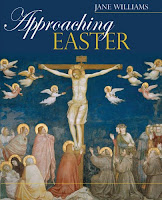
I've just begun to read for Lent Jane Williams' Approaching Easter. In her preface she writes: "The history of how and why Jesus died on the cross is at least partly an analysis of what we all do to one another when we are controlled by fear, or greed, or love of power, or too much love of ourselves. At every turn, Jesus challenges us to be brave enough to step out of our self-made prisons and turn towards the source of life and freedom, which he calls God. Unfortunately, too many of us don't see fear, greed, love of power, and love of ourselves as prisons. We see these emotions as necessary to grab what we think we need for our own security; we might even be prepared to kill for them, just as people 2,000 years ago were prepared to kill Jesus rather than hear his challenge." I suspect that, as I continue to read, I'll discover that Putin is not alone in a prison of fear, greed, love of power, or too much love of self. I may be there too.

Saturday, 4 June 2016

Hard reading

I’ve recently read two books which have been hard to take. One is End to End – with Love x by Lorraine George, an account of her son’s terminal illness of myeloid leukaemia alongside the cycle-ride she did from John O’Groats to Land’s End with a group of her friends. The other is Leningrad: Tragedy of a city under siege 1941-1944 by Anna Reid.  They are both searing accounts of human suffering, and, for me, both raise hard moral questions.

I’ve met both Lorraine and someone whose four great-grandfathers lost their lives fighting for Leningrad in 1942.  So the questions are not merely academic as far as I am concerned.

End to End is described like this on the website of the charity set up to honour Rob George, the young man who died of leukaemia.
“This book tells the story of four years in the life of an ordinary mum (Lorraine George).  It’s a book from the heart, that attempts to record and share what it is like to find your life out of control.
Share the uncomfortable juxtaposition of deep sadness alongside enormous fun and pride. On the one hand End to End – with love. x is a journey through the eyes of a mum, as her youngest son faces a life threatening illness. Alongside this runs an account of her journey, literally from the end to end of Britain, on a bike! After all, a promise is a promise!
This is a true-life account of the surprising strength, determination and power that can be found deep within us.
Life will never be the same again for this mum and her family. Perhaps it will inspire you too?
All proceeds from the sale of this book will go to the Rob George Foundation.”

It is, in my view, a remarkable book, in which you can hear the voice of the mother watching her son suffer and die, alongside her vivid account of the cycle ride which seems to affirm life in spite of the apparent triumph of death. It’s a highly personal microcosm of pain.

Leningrad, on the other hand, is a macrocosm of personal pain. In 1941 Hitler extended his plan to establish a pan-Teutonic empire, from eliminating the Jews, to driving the Slav peoples east in Operation Barbarossa. The beautiful city of Leningrad (now renamed St Petersburg) stood in his way and despite Stalin’s paranoid purges of the Soviet military (or perhaps because of them) at the cost of up to two million lives the city survived and the German army got no further. I had no conception of the sufferings and the depths which the population experienced through the siege.

It is a truly magnificent book, very well written, with the diaries and letters counterpointing official accounts and external sources. It shows human strength and weakness. I think it also shows the inhumanity of power, expressed in war and terror. We too easily forget that others sacrificed even more than us in the face of fascist evil. We forget the price that our allies, whom we now brand as enemies, paid as the price of peace. I wrote to my friend who gave me the book, “How stupid hostility is between nations, isn’t it? I find I’m tired of politicians indulging in the rhetoric of suspicion and fear to justify spending on the arms trade. I do realise that Hitler was an exceptional evil, and that there have been and are others like him who need resisting. It’s a complex world. We need a transformation of human nature, transformed by love. That seems the only answer - but maybe it’s Pierre Bezuhov’s unattainable dream. Perhaps it has to be small acts of kindness multiplied exponentially.”

And I suppose both books raise the same question, which Lorraine poignantly put near the end of hers. “And then of course I don’t understand, or feel the presence of a God anymore. I miss that almost as much as I miss Rob. At best, if God exists, I don’t much feel like worshipping him – where exactly was He when he was needed to step up?”