Showing posts with label PLS. Show all posts

Sunday, 6 December 2015

1st National PLS Study Day


 Photo: Tripadvisor
There are a handful of us in Oxfordshire who have Primary Lateral Sclerosis, the slowest and rarest type of MND, and, I suppose, there's an equally sparse distribution nationwide. In fact its pathology, the way it develops, is so unusual that the experts aren’t agreed on whether it is truly a type of MND or an entirely separate condition. Anyway, that means that it is a Cinderella of MND research. In Oxford we are lucky to have a concentration of MND expertise, that PLS is not neglected, and is a hub for understanding the condition. I believe the idea of PLS Study Day originated with Professor Martin Turner; it was certainly organised by the Oxford MND Centre.

So on Friday 23rd October about 120 of us – professionals, researchers, carers and people with PLS – gathered at the Oxford Spires Four Pillars Hotel on the Abingdon Road, to hear mercifully short presentations from our home team and from some “away” experts. “Mercifully” – not because they were boring, far from it, but because my attention span is limited. We heard about the characteristics of PLS – that was reassuring as I learned I wasn’t such a freak after all, but rather my symptoms and the way they progressed were pretty characteristic; we heard about what MRI and MEG scanning showed up, and a bit about genetics. What was most obvious was that a lot of very sharp minds were focused on the condition.

After a rather good lunch and the keynote lecture given by Dr Mary-Kay Floeter, the world’s leading specialist in PLS, based in Maryland, USA, which was brilliant, the focus switched from research to management, and again the home team led in this. It was informative, practical and helpful. All was well until Rachael Marsden, the Centre Coordinator, talked about a new smart phone app called Sex Diary, of which she showed a discreetly blank screen. As is the way with PLS, the collective risible nerve was tickled and only with difficulty pacified. Both the morning and afternoon sessions ended with patients’ questions answered by a panel of the experts.
It was an exceedingly good day, not least because of the opportunity to meet many others with the same condition with similar but different stories to tell. As we all know it helps to know that you’re not alone; and it helped to have explained what’s happening inside us. It was also brilliant to discover how many people are interested enough to devote their lives to studying the disease and to caring for us.

Tuesday, 6 October 2015

An antidote to World Cup Fever

No doubt by now my English readers are recovering from Saturday's experience of cold turkey so heartlessly administered by our Australian cousins, and the owners of ITV are vainly trying to persuade advertisers that the viewing figures for future fixtures will be unaffected. And meanwhile some women are refraining from reminding their dearly beloveds that, after all, it's only a game.

The Rugby World Cup, anticipated as the next great sporting event in the country after the Olympic and Commonwealth Games, already shows signs of going the way of all flesh. I suppose the consolation for the RFU is that they have already sold tickets for the potential "hot" matches at vast prices to corporate clients and individuals. The best hope for them and the broadcasters must be that at least one of the home nations comes good and so preserves some great British enthusiasm for the whole show.


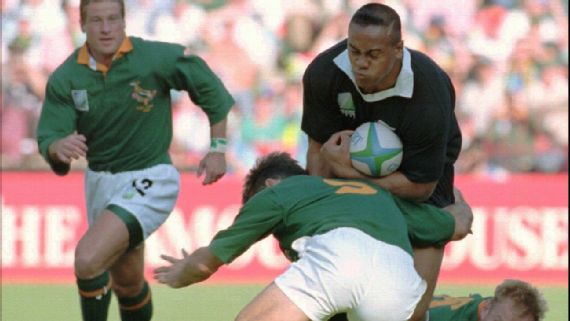
The famous tackle on Jono Lomu in 1995 (AP Photo/John Parkin)
Meanwhile it was all put into perspective for me by Miles Pilling who's in the middle of raising cash and awareness for MND with brilliant photographer, Cristian Barnett (26 Miles 4 MND). Miles, like me, has the PLS form of MND. I spent a couple of hours a few weeks ago on a photoshoot with them for their project. He sent me a link to the story of Joost Van Der Westhuizen. I did know about this legend of South African rugby, their scrum half in the World Cup winning team celebrated in the film, Invictus. The championship took place in 1995, a year after Nelson Mandela being elected president of South Africa, and the alliance between Mandela and Francois Pienaar, the team captain, did much to heal the rift left by apartheid.

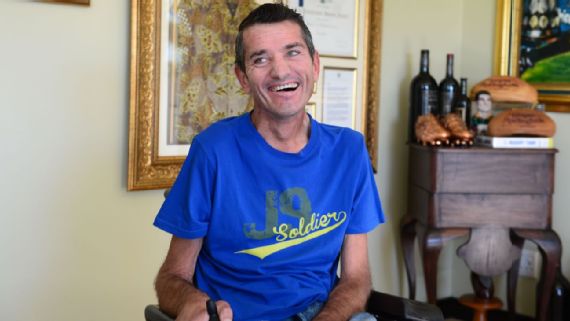
Van Der Westhuizen's first symptom occurred seven years ago, but it was not until 2011 that he was finally given the diagnosis of Amyotrophic Lateral Sclerosis (ALS), the commonest, rapid form of MND, with a prognosis of two to five years. Last night I watched a series of YouTube clips (a documentary and some interviews) which vividly and painfully illustrate the nature of the disease. Early on he talks about about his determination to fight the disease and to set up a foundation mainly to provide care and facilities for sufferers of MND (the J 9 Foundation) - 9 being the scrum-half's shirt number. Here are three of the clips: A Life of Two Halves, with Jim RosenthalInterview with Dr Mol (South Africa)The Rugby Show.
At home with his rugby memorabilia (Gallo Images for ESPN)

I ended by reading an article by James Peacock for BBC Sport, Joost Van Der Westhuizen: still fighting on his deathbed, which, despite its sensationalist headline, is well worth a read. At one point he reminded me of my co-author of I Choose Everything, Jozanne Moss, also a young parent of a boy and a girl, when he says, "'But I know that God is alive in my life and with experience you do learn. I can now talk openly about the mistakes I made because I know my faith won't give up and it won't diminish.
'It's only when you go through what I am going through that you understand that life is generous.'"

You do realise that even for an outstanding sportsman such as Joost Van Der Westhuizen there is much more to life than the glamorous and lucrative world of professional sport - there's his family, there's the gift of being alive, and there's God. There are more important things than winning. There's living.

(PS Apologies for the malfunction of the link to the good BBC article. My fault. It now works.)

Monday, 14 September 2015

A politically momentous weekend

What an interesting weekend on the domestic political scene! Great rejoicing among Corbynistas as their man was elected as the Leader of Her Majesty's Loyal Opposition. It's a very important role. There was a helpful blog-post by theologian Ian Paul: Why Jeremy Corbyn is just what we need, in which he argues that "there are lots of reasons why anyone concerned for truth, justice and Britain’s long-term welfare should welcome Corbyn’s appointment, as it challenges some key features of the current political scene." He suggests that despite the media's prejudging assault on him and some bonkers policies he might provide just the shake-up or wake-up that Westminster politics needs. It's certainly true that the majority of the population feel alienated from politics and voiceless, despite the proliferation of mass communication. On the other hand one of my Labour-supporting friends believes he's a danger to the country and "unfit" to be leader, "let alone PM".
All pictures from BBC website - note the sample
of our bumper apple crop in the foreground 

Then on the Friday there was the debate in the Commons about assisted suicide. Jane and I gained a certain amount of opprobrium (and friendly comments) as we were interviewed by the BBC's remarkable Caroline Wyatt and featured quite a bit on radio and TV. We are sometimes mistakenly regarded as campaigners. The truth is that we are just two individuals who will say what we think about the issue when asked. And like anyone who has been associated with MND we also understand the dilemmas and pain of terminal illness; we realise what a complex issue it is. 

There were two points in the day when I thought proponents of the Bill were quite illogical. One was when Lord Carey (retired Archbishop) cited Tony Nicklinson as his prime example of why the bill was needed. The bill would have done nothing to help Tony, whose prognosis was more than six months and who would have been incapable anyway of self-administering a lethal dose. The example illustrated in fact the direction that supporters of the bill hope to take it: to extend it to those who are not terminally ill and to legislate for others (medical professionals) to take life. It implies the beginning of euthanasia. Which is why I am glad it was so resoundingly defeated in the vote.

The other thing I noted was when Rob Marris was proposing his bill, near the end, he said, "I do not know whether I would, if I had a terminal illness and a prognosis of less than six months, but I and many others would find it comforting to know that the choice was available—to have the option of choosing a dignified and peaceful end at a time and place and in a manner of my own choosing at my own hand." I couldn't divine why this principle should be limited to the last six months of life. We none of us know when we're going to die, but this doesn't stop us from living full and fulfilling lives. To say, "If only I could choose my time and manner of death, I'd be happier," seems to me illogical and immature, and a carte blanche for suicide. However, maybe I'm not entirely logical to say I understand and would not condemn someone who felt desperate enough to take their own life....

We need to accept that life is a gift of which we are privileged to be part. Life and death - it's the circle of life.

 • You can read further thoughts of mine here: I'm ill with MND but still don't want assisted dying in Britain - Daily Telegraph. The headline isn't mine. I think it's unhelpful to call PLS a 'terminal' disease.
 • You can see Jane and me being interviewed in the last video clip on this report: http://www.bbc.co.uk/news/health-34208624?SThisFB.

Monday, 20 January 2014

Primary Lateral Sclerosis uncovered


In our monthly newsletter, someone with PLS (the sort of MND I have) sent in this description by a chap called Galen trying to explain the condition. It’s rather good. (I hope he won't mind me quoting it verbatim. As you can tell he has a sense of humour - which is quite helpful in the circumstances.)

If I start telling people about upper and lower neurons I can almost see their eyes glaze over as they decide I must have some need to tediously explain PLS. They then avoid me. If I launch into how PLS may be a "gentler and kinder" form of ALS, or Lou Gehrig’s Disease, people often fixate on the ALS part and have even asked me why I'm not dead yet and how much longer do I expect to live. When I tell them I have a rare condition that causes a loss in communication between the brain and motor functions, most people feel I've been technical enough and sufficiently succinct.

If folks are still curious I can launch into examples. Walking over to a table to set down a glass of water is something that is done almost without thought by most people, however, the communication with my brain and the rest of my body has gotten so that I have to concentrate hard to even walk to the table. Trying to carry a glass of water is likely to overtax the limited capacity I have remaining, with the likely result being that both I and the glass will wind up on the floor. Or it can be more insidious. If I'm about to get out of a chair I may have devote virtually all of my resources into planning and executing exiting the chair, and may actually wind up ignoring anyone trying to talk to me while I try to stand. It isn't because others are boring or anything, rather I have to focus so hard on getting up, it blots out other things.

It's not a problem with the brain, we remain as sharp as ever. It's not our muscles, they work fine. It's communication between the two that is the problem. Walking requires intense communication with our balance sensors, our brain, our legs, feet, even our toes. Our consciousness isn't aware of it, yet it requires constant fine- tuning. Throw a monkey wrench into that communications system and you wind up with someone who can barely stagger anymore, a symptom many of us can relate to. Sometimes one side is affected more than the other, and you get someone like Ronnie, or it can be pretty symmetrical, like Flora, or it can add to an already serious personality disorder, like me.

It can have strange results. You can be at a funeral and your brain can be saying: "Whatever you do, don't make a scene," but because the message gets garbled, your mouth muscles say: "Roger, brain. Commencing uncontrollable laughter immediately." Or you can think you told your mouth to say to the UPS guy: "I'm feeling fine, and you?" only to have him look up at the sky and say: "You're right, it does look like rain."

We are constantly compensating, whether or not we are aware of it. Maybe that is why we get tired all the time "for no reason." We are always having to figure out new ways for our brain to signal our muscles to do stuff. Our brain may be so busy devoting time to keeping essential functions going that it can't worry about things like walking and talking.