Thursday, 2 June 2011

Having a ball in Blackpool

LMS poster outside our room - note Jane & me on left
from benandstefanie.com

As you'll have gathered, we enjoyed our taste of the Blackpool Dance Festival 2011. I do hope there'll be dancing in heaven, probably not of the Rumba type, and, if there is, I hope there'll be as many free lessons as you need - and that I'm cured of my two left feet inter al! Although we were watching amateurs, I'm aware that hours and years of practice lie behind those beautifully coordinated and expressive movements. I read on one dancer's profile (Ben Taylor) that he'd started dancing aged 8 and his partner (Stefanie Bossen) at 5. 15 years' dedicated practice!

Our day wasn't quite over when we left the Winter Gardens. Next stop the Ashley Victoria Hotel, where, you may remember, Nikki Duckworth of the Lancashire & Blackpool Tourist Board had fixed us up instead of the disabled-unfriendly original place. From the start it was good news. Wally, our host, had kept a parking space for us right in front of the hotel and helped us to our room on the ground floor. I'll have more to say about being disabled in Blackpool. It's enough to say that Nikki had found an ideal place for us. It was clean, nicely decorated and unpretentious.

Our next move was finding somewhere to eat. We tried Frankie & Benny's, but we'd have to wait 3/4 hour for a table. Having sat for 5 minutes listening to rather too loud music, we decided to cut our losses and headed across the car park to McDonalds, where the music was quieter, the food cheaper and the tables dirtier. But, to be honest, we didn't need more. And so to bed, anticipating the excitements of another day.

Monday dawned cool and damp, though the hotel heating kept us warm plus a full English breakfast at a very civilised hour! Then it was out to explore the delights of the North Beach Promenade. I couldn't help noticing the generously proportioned profiles of many of the holiday-makers - perhaps it was just a contrast with the super-fit dancers of the day before! For some reason, Jane wasn't attracted by the Fun Palace. Trade at that time was slow. No doubt it had picked up when the sun came out in the afternoon. We looked at the hats, and the rock and candy-floss, but weren't tempted. Jane quite liked one of the tee-shirts, but then we remembered our age....
The Big One

Fairhaven Lake, Lytham St Annes
Having exhausted the delights of the north, we headed south in the car, passing the Pleasure Beach with The Big One in action. By an exercise of immense will-power, we resisted going in, and drove on south. On the Lytham road, there was a reminder of the changing face of tourism - a shut-down and decaying holiday village. Perhaps one day a use will be found for it. Driving into Lytham St Annes brought us into the other face of Lancashire's seaside holiday industry. Very polite (mainly). Home of the Royal Lytham & St Annes Golf course when next year's Open is scheduled. Great sand dunes, which seemed unsuitable for a wheelchair, and so we settled instead for Fairhaven Lake, a park-cum-nature-reserve, with a very wheelchair-friendly path right round the perimeter. While we were there, the sun came out.

St Annes Pier
We moseyed around looking for postcards and came across the St Annes' pier - a rather half-hearted affair, especially as the sun-deck at the end was closed. This is clearly where the Lythamites let it all hang out. Sad to see there's a clairvoyant here as well as few in Blackpool - what a waste and blot on the landscape! There was one redeeming feature here, however.

At Tiggis, Lytham St Annes - highly recommended
We thought we'd look out for somewhere to eat in the evening, and ended up having a cappuccino and a mocha in Café Nero. Jane's experience from Cornerstone came in handy there. There were some dark chocolate brownies on display. When we asked for one, they apologised but said they were still frozen. "Could you give it a few seconds in the microwave?" Jane suggested. So they did - and it was worth it. Yummy! Cornerstone, Grove, teaches Café Nero, Lytham St Annes a useful wrinkle! In return they recommended the local Tiggis for our evening meal - which proved an excellent tip. Very good food, excellent service, and good disabled access. A great finale to an fun- and action-packed day.

As we drove back to the hotel, along the Golden Mile under repair, a solitary figure was gazing out over the sands as the sun set.

Wednesday, 1 June 2011

Blackpool rocks

At 1 o'clock in the morning of Friday 27th May Blackpool was shaken by an earthquake of 1.5 on the Richter scale. It might have been a tremor at the prospect of our impending visit. Or it might just have been caused by the "fracking" explosions which are part of the filthy shale gas exploration process just inland. Anyway the company behind the tests, Cuadrilla, has suspended operations. And I'm happy to be able to report that the Tower is still standing, even if surrounded by security fences while they work on repairing the Ballroom roof (not as a result of recent tremors, as far as I know).

Because we've just spent an amazingly fun weekend in Blackpool. It will no doubt take more than one post to relate all we got up to, but I'll try not to bore the pants off you.

The prelude on Saturday was a five-hour drive up the M40/M5/M6 with snarled-up bank holiday traffic followed by a lovely evening and morning of recuperation with the nicest family in Manchester (imho, as they say). Restored and refreshed, we set out mid-morning for                        
                                                                           Blackpool. David Gore, Events' Manager at the Winter Gardens, who had been involved in linking with Classic FM for the competition which you may remember was what was taking us on this unlikely pilgrimage - see my previous post - had told us to phone him when we were close. So, as we paid our respect to the sorely lamented Blackpool Town Football Club, we rang, and in a few minutes he was showing us to a reserved space under the Winter Gardens complex. Then it was through locked doors, the business end of the building, up in to the posh parts. And soon we were in the ballroom itself. There in the front row was a seat reserved for Jane and a space for my wheelchair. A programme, coffees - and so we found ourselves watching the third round of the British Amateur "Rising Stars" Ballroom Competition.
Ballroom - Ben Taylor & Stefanie Bossen (England)

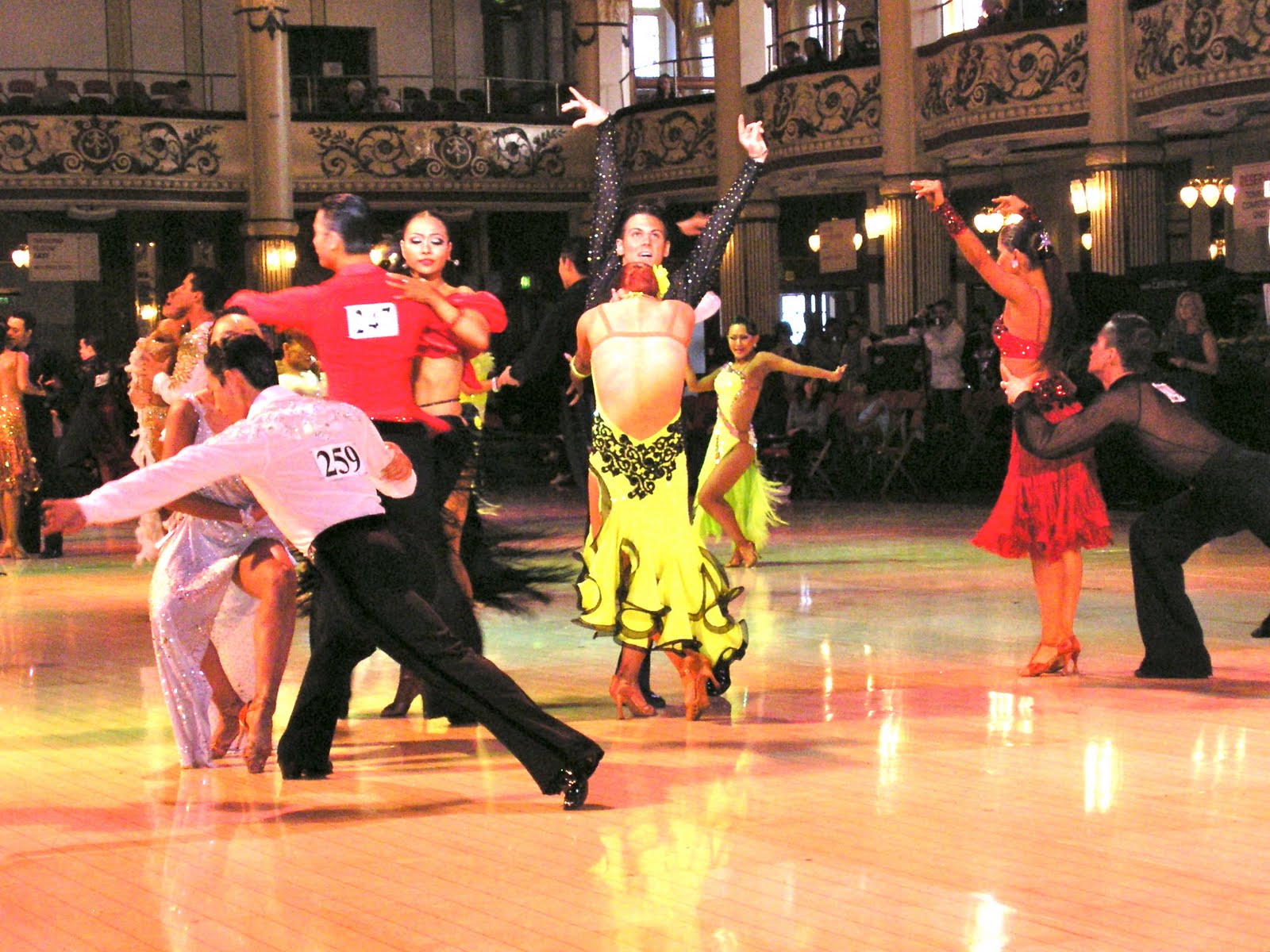
I suspect that the Blackpool Dance Festival is one of the prestige events of the ballroom dancing calendar, not least because of its longevity. This is its 86th year. Certainly the competitors came from all over the world, a lot from Europe and the Far East. The only continents unrepresented seemed to be South America and Antarctica. And there are multitudes. We were there for the final rounds of the Amateur "Rising Stars" Ballroom and Latin competitions - which seemed to me a pretty good day to be there: amateur - people who dance for the love of it; rising stars - the best of the up and coming youngsters. It didn't take us long to get into it. I have to say Jane was a better talent-spotter than me. By the semi-finals, I'd picked out a couple who ended 5th, but she'd chosen the eventual 2nd and 3rd. Of course there was NOTHING technical in our spotting. I'd like to think it was more than a matter of the prettiest gown! But I was interested that mere impression to some degree mirrored technical merit.

The teller collecting scores
For Strictly fans, I'm sorry to report that there was only one representative there, adjudicating, namely the dapper Darren Bennett. It was an added bonus that there was a live orchestra, the Empress, to accompany rounds 3 and onwards, and in between sessions a real live organist accompanying the open floor dancing, which included people limbering up for the Latin. The whole day is run with practised precision, so that the final presentations take place on the dot. I was amused by the sober suited senior officials who between each dance would go round the adjudicators collecting their score sheets while the next dance was already under way.


During the lunch break the sun was out; so a wander down to the sea seemed a good idea - until we hit the wind! So back to the WG, where a young Chinese dancer asked Jane if she'd take her photo and then offered to take ours. I was impressed by the trans-national camaraderie of the whole competition. In the morning there'd been an enthusiastic posse of Australian flag-wavers who fell silent when their couple were knocked out and in the afternoon a larger contingent of Chinese whose couple were eliminated for the final.

In the Latin Jane and I weren't outstanding talent spotters. I think one of my pairs ended in the 100s. Jane particularly favoured the modest dresses - which aren't characteristic of Latin dancing, although I must say that I don't think I saw many as revealing as Strictly often indulges in, but none as modest as Widdy. Our favourite pair (English, as it turned out, Danny Stowell and Kate Moore) reached the semi-final but that was all. However, I backed 3rd and 4th - but neither of us went for the 1st and 2nd, both from the USA. And so, after "Ladies and gentlemen, please stand for the Queen", we were on our way, but not before the general manager came across, having just presented the prizes, to see that we were OK, say goodbye and open the lift doors for us. I was impressed. We felt that, in the midst of an incredibly busy day, we had been shown unusual hospitality - or maybe it's normal Lancastrian hospitality. More tomorrow. Meanwhile thank you to the folk who who made us so welcome.
Danny Stowell & Kate Moore

Thursday, 26 May 2011

Things that move

from Iceland Review
I believe I slept on a volcano last night. Well, that's what I like to think. Jane had hung the washing out in the day and it ended up with shiny black specks on it, especially the fleece I rest my heels on to prevent them chafing in bed. Of course, I'm no expert, but I like to think they were from the Grimsvötn volcano in Iceland rather than Didcot power station down the road. Apparently Grimsvötn produced more ash on its first day than the unpronounceable Eyjafjallajökull let out in 40 days last year. A vivid eye-witness account described it as a black wall of ash. Possibly I've been to sleep on some of it!

The Radio 4 programme The Choice, in which Michael Buerk interviews individuals who have had to make momentous personal decisions, has returned this week. They are often gritty stories. On Tuesday he was talking to 'Mikey Walsh' who's from a Romany family which has a tradition of bare-knuckle fighting. When he was born, his father hung a gold chain with an ornament of boxing gloves round his neck. As he grew up, despite his family's best efforts, it was clear that he was just not the fighting type. He was soft. Eventually in his teens he realised he was gay and made the decision to run away from his family, cutting himself off from the whole Gypsy world. The cost to him and the hurt to his father were immense. Eventually he moved into acting and wrote his story in Gypsy Boy. That stirred up a buzz of anger among his some of his former community, whom his father personally set about pacifying, by admitting that the details were true. What struck me was the end of the programme, when Mikey told how one day he rang his mother, who passed the mobile straight to his father. He said, "I've got something to tell you: you're more of a fighting man than any of 'em, and I'm proud of you." I found Mikey's honesty and his father's humility very impressive, and the at least partial reconciliation very moving.

Tuesday, 24 May 2011

A day in London

Yesterday Jane and I enjoyed one of our occasional forays to the capital. I'd been invited to talk at St Paul's and St Mellitus' College, which is based at St Paul's, Onslow Square, in Kensington. I would have looked at the whole building with a different eye had I realised that the recent restoration of the church was designed by Sir Norman Foster. Hence the headline which Brotherly Love pointed out to me later, "Foster turns to religion". The article from World Architecture.com is accompanied by a nice picture:

First church for Lord Foster

Foster and Partners have revealed plans to transform a Grade II listed, 1860 church into a church for the 21st century. Incorporating a ‘Family Life Centre’ a Theology College, café, bookshop, lecture facilities and 3 residential units the building will become a modern place of worship. The design approach for a maximum capacity of 1,200 is founded on a sensitive restoration of the original building together with the insertion of an adjacent contemporary building. Major improvements will be made to the energy efficiency. Replacing the existing vicarage and church hall, the new extension meets the building with a glazed atrium, ensuring links between the functions of worship with education, community and living. Comp oct 2008.
I didn't see enough to judge. It looked pretty impressive to me. However I know you'll expect me at least to comment on the disabled facilities! Entry ramp fine. Loo... I'm afraid to say, it was simply too small. Even with Jane helping me there wasn't enough room to manoeuvre a wheelchair. In fact we ended leaving it outside. How someone on their own manages I don't know. On the plus side there was a good supply of grabrails. However, the emergency alarm-pull was, for some reason, wrapped round the central light fitting out of reach! As at the new Ashmolean it seems that disabled toilets are an Achilles' heel of even eminent architects' practices. 

The welcome, however, left nothing to be desired. Genuinely warm people, real coffee, M&S sandwiches...! It really looks like a place that open-minded people who reckon Christian faith is moribund or irrelevant should check out before reaching a final conclusion. Anyhow, the students seemed to appreciate what Jane and I had to say about disability and terminal illness. I mentioned then a couple of stories I'd recently come across in the news.

from Sheffield Telegraph Kate leading off a local run
One was about Kate Allatt, a 40-year-old mother of three, who'd suffered a massive stroke and ended in a "locked-in" state for months. Amazingly she's now doing the "impossible", talking and running :
"Doctors said stroke victim was brain dead". On her website, she says, "Whilst I wanted to die in intensive care, I'm glad I didn't, now." It's quite a story, and a good news story what's more. She's just had a book published. Which might make you wonder why you didn't hear more about it on the BBC. She got interviewed on Sheffield and Northampton radio, and a short piece on the Jeremy Vine Show.

The other was about a survey carried out for Scope, the leading Disability Charity, about legalising assisted suicide. Among other things it showed that 70% of disabled people are opposed to it.  Scope's press statement ended with this telling paragraph from Richard Hawkes, its chief executive: "We have serious concerns about the so-called ‘Commission’ on Assisted Dying, which despite its name is nothing to do with the Government. It feels like their findings are a foregone conclusion, with the debate loaded in favour of assisted suicide. The Government needs to form its own independent non-biased commission to explore this.” The BBC, who featured a voters' poll in January in favour of assisted suicide, were absolutely silent about this one.... One wonders why.

Sunday, 22 May 2011

Nuttiness and sanity

Last week I had the dubious distinction of appearing on the Atheist United Front facebook site.  It was of course because of my article about Stephen Hawking's dismissing heaven as a "fairy story for those afraid of the dark", which was so much commented on. I did look at what the seven people on facebook had to say, which frankly wasn't much. Some had a pavlovian reaction to the headline only, one dismissed my view because I used an Apple (! - apparently a sign of deficient intellect!), one suggested I should write a book about the evidence for the resurrection (he apparently hadn't noticed I'd cited one. Sorry, I'm not inclined to reinvent the wheel. Read JND Anderson, Jesus Christ the evidence of history. You can still get copies via Amazon.), one appeared to have read my article and complimented it on being well written, while still disagreeing with me.

Normally I'd feel quite honoured to have been singled out for mention, but I say it was a "dubious distinction" because they also had it in for one Howard Camping. In fact they, and extraordinarily, our major news outlets such as the BBC majored on him. You'll be aware that he is the octogenarian President of Family Radio (the Californian Christian radio station) who predicted the end of the world for 6 pm (his time, I think) with a cataclysmic earthquake. I think I buy into the theory that it made the headlines because it's the first such nutty prediction to have hit the internet - and sadly there are a lot of gullible Christians out there. The odd thing, of course, is that the only thing the Bible, from where Mr Camping gets his ideas, says about the time of 'the end of the world' (as it's popularly known) is
“But about that day or hour no one knows, not even the angels in heaven, nor the Son, but only the Father” (Matthew 24: 36). I'm a bit irked that the likes of the pastor expose faith to such universal ridicule. He'd already got it wrong once before in 1994 - "miscalculated". It's sad that he didn't learn from his mistake.


On a more cheerful note, the Queen did a rather good job in the Irish Republic. There was a rather good piece about her in Friday Night Theology just eight days ago, which pointed out that she is now the second longest reigning monarch in British history. "Fewer than 1 in 6 Britons will be able to remember a time before Elizabeth...  For everyone else, she has always been – unobtrusively but reliably – there. As indeed has her Christian faith. Queen Elizabeth has made it clear in various broadcasts over the years that her faith in Jesus Christ is extremely important to her; a foundation stone of her life of duty. That is obviously a delicate message to convey if you are head of state, there being ample opportunity to offend or alienate those of no or different religious faith, and it is to the Queen's great credit that she has managed it so well.


"Her Christianity serves a good example of the nation's. Discreet, unassuming, but subtly pervasive, Christianity has shaped and defined the United Kingdom, just as has its monarch, for far longer than anyone can remember." 


The article finishes with mentioning the influence of the Bible, "the single most important influence on our national politics". "This is not to say that it has been the only influence or that it has always been a positive one. It hasn't, rather it is to point out that our political life is shot through with ideas and convictions that are grounded in our Christian heritage. Why are we committed to the idea that all humans are of equal worth? Why are we convinced all, no matter how rich or powerful, are equal under the law? Why are we prepared to tolerate differences in religious opinion? Why is freedom of religion and of conscience so important? Why do we (or, perhaps, some of us, now) believe that government is justified by its commitment to the common good? Why do we think that the people should have a voice in selecting their political rulers?


"These beliefs are grounded ultimately in our historic Christianity. It is impossible to say whether they would have developed without those Christian foundations, just as it is impossible to say whether they will be maintained if we persist in eroding those foundations. But it is possible - indeed, today, sadly necessary - to say that they did develop in, through and because of the nation's Christianity and not, as some like to claim, in spite of it." Jennie Pollock, who wrote that, it seems to me, is a good deal more sensible than Howard Campling - but less newsworthy in the world of sensation-seeking media.

Thursday, 19 May 2011

"Fools rush in...

... where angels fear to tread." I seem to recall that's Alexander Pope. But it's certainly something I've been waking up feeling, especially after the article was headlined: "I'd stake my life that Stephen Hawking is wrong about heaven"!  
It all started on Monday morning listening to the Today programme in my semi-somnolent state, when I thought I heard about an interview with superstar physicist, Stephen Hawking, in The Guardian, in which he said that heaven is a fairy story for those afraid of the dark. As I say, I was half asleep, but the idea must have lodged in my mind. "Half a mo," I thought. "That's not why I believe in life after death. Whatever happens, I imagine it'll be quite a relief for me when I get to dying. Well, he's just another chap with MND like me. Perhaps I can write an answer."


And so after breakfast I read the interview which was part of a long article. It went like this:

What is the value in knowing "Why are we here?"
The universe is governed by science. But science tells us that we can't solve the equations, directly in the abstract. We need to use the effective theory of Darwinian natural selection of those societies most likely to survive. We assign them higher value.
You've said there is no reason to invoke God to light the blue touchpaper. Is our existence all down to luck?
Science predicts that many different kinds of universe will be spontaneously created out of nothing. It is a matter of chance which we are in.
So here we are. What should we do?
We should seek the greatest value of our action.
You had a health scare and spent time in hospital in 2009. What, if anything, do you fear about death?
I have lived with the prospect of an early death for the last 49 years. I'm not afraid of death, but I'm in no hurry to die. I have so much I want to do first. I regard the brain as a computer which will stop working when its components fail. There is no heaven or afterlife for broken down computers; that is a fairy story for people afraid of the dark.
What are the things you find most beautiful in science?
Science is beautiful when it makes simple explanations of phenomena or connections between different observations. Examples include the double helix in biology, and the fundamental equations of physics."
So I wrote an answer and sent it to the Guardian's Comment is free editor, and was not a little surprised to receive an enthusiastic reply accepting it. It went up on the website on Tuesday, and proved the most viewed Comment is free article of the day and far the most commented on (1500+) - not that the latter's much comfort as normally most comments on the internet are negative. I refrained from reading them, having better things to do with my life. But I also received enough personal emails saying thank you to keep my pecker up.
Patrick Joyce's portrait in the Incurable Optimists series
I did think I'd been a bit rash to contradict Professor Hawking, but then I reflected that he's just such a man as I am. As Shylock observed to his Christian adversaries: "If you prick us, do we not bleed? If you tickle us, do we not laugh? If you poison us, do we not die?" We are both frail human beings. We both wrestle with the same frustrations and the same big questions. We can both learn from each other, admittedly me rather more from him! And one day we'll both be facing the same big doorway.
By the way, my visit to the dentist again today was just as satisfactory as the last one - a longer procedure but excellently performed.
And one by-product of this week is that I'm now featured on  The Spiritual Bookclub blog...!

Wednesday, 18 May 2011

Hi ho! Hi ho! It's off to ... I go!

Tomorrow I'm off to the dentist for the second time within six days.  I'm not worried about it - really not - because of my experience last time. I've waxed lyrical before about the virtues of this NHS provision of 'special needs' dentistry. There's a local one-woman clinic attached to our GP Health Centre, but for more difficult procedures (such as the awkward tooth extraction I needed) they play safe by referring you to the hospital or to a larger clinic.

So last Friday Jane took me over to the Didcot Special Access clinic to be seen by another dentist there. I presume that this has the benefit of having other dentists and nurses at hand - as well as the adjacent cottage hospital - should complications arise. They didn't of course. In fact, Sarah, my dentist, was brilliant. Jane and she got me into the chair. She administered some tingly sort of cream and then injected. I don't enjoy injections, but it was fine, first on the inside and then on the outside of the gum. A few minutes of conversation and then it was cooked. Out came the pliers. A firm manipulating of the tooth back and forth, and then she asked the nurse to hold my head, since my muscle control is somewhat deficient. Firmer wiggling of the tooth and it was out, all in one piece. I inspected it, and I have to confess it was a mouldy specimen. "Better out than in," was Sarah's verdict.

I was anticipating trouble when the anaesthetic wore off, but I needn't have taken even the one ibrupofen I did. I was sent home with instructions and a gauze pad in case it began to bleed. But in fact the oozing was minimal. The whole operation was a success. And so tomorrow I'm off to have a filling sorted. There's of course no way a private company would provide this sort of service - for children and adults with all sorts of disabilities, for people with Down's Syndrome, for autistic children, and for people like me. We can't 'nip on to the chair', swallowing is a problem and breathing when you're tipped back can be too. It takes time to deal with patients with special needs. Health insurance wouldn't take them on. And private companies want profits. So the National Health Service is a necessary blessing.

What struck me about the whole experience were two things. One was what a difference trust in your medical practitioner makes. From our first consultation I felt Sarah knew her business and I could trust her. Although she didn't insist, her advice to have the tooth out was sound and proved correct. That trust leads to the second thing which is the difference that fear, or the lack of it, makes. I wasn't worried then, and I'm even less worried now, about opening my mouth and being entirely vulnerable to someone else poking sharp instruments and woodworking tools into my maw right under my very awake eyes.

When I put on facebook that I was going to have a tooth out, the sympathetic messages came pouring in: "Ouch!' "Good luck!" etc, all implying that I was to undergo an ordeal, all reinforcing the fear-full myth. Someone told me yesterday that over 95% of what we fear never happens, so that we waste an enormous amount of nervous energy in pointless worry. Fear is a great paralyser. What's disturbing is that much of our culture breeds fear. The insurance industry is fuelled by fear. What if your house fell down? What if you couldn't pay your mortgage? (Wasn't that what the banks said when they sold useless protection plans?) The media are full of scare stories (remember avian flu?). We're frightened to let children play in the streets. And of course some campaigns fuel our fear of pain and dying. It doesn't need to be so.