Thursday, 31 March 2011

Inspiring evening

That was a big night out! Yesterday Jane and I went to the Private View of the Incurable Optimism exhibition in the beautiful Natural Museum in Oxford. Personally I think it's one of the best buildings in Oxford. Victorian neo-gothic at its lightest and most pleasing, welcome relief from all those olde-worlde piles that adorn Oxford's streets - to say nothing of its fascinating contents.

The exhibition which runs to 6th May is of the first 18 paintings of his projected 100 by Patrick Joyce, an artist who has aggressive MND. Patrick the optimist's website. You can see the portraits of people who've inspired him on his website, and the short films he's also made. They include his consultant, Martin Turner, carers like his wife and fellow sufferers of MND including Stephen Hawking. Patrick wants to have reached the 100 before he dies.
Patrick Joyce, the artist

That's half of the exhibition. The other half focuses on the cutting-edge research carried on by the MND team in Oxford, to do with finding a biomarker for diagnosis of MND (The BioMOx project). The BioMOx project has already found a "finger print" which can be detected by sophisticated MRI scans. It's led by Martin Turner. If you want to understand more about the human and scientific impact of the disease, here's a very good place to start - with no admission charge of course.
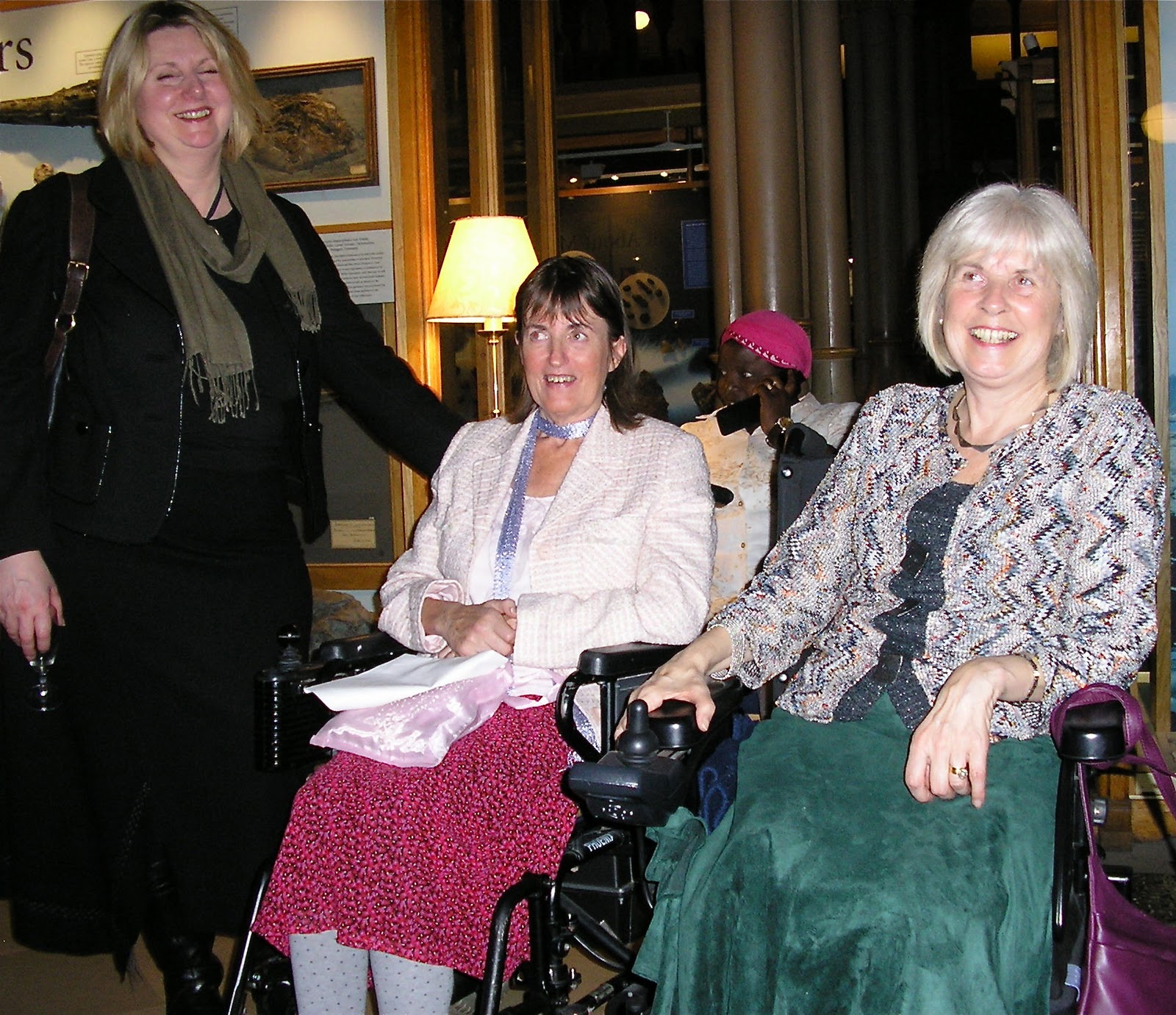
A good number of our Oxfordshire friends were there, most of us in our wheelchairs. Professor Colin Blakemore opened the exhibition, followed by Martin Turner explaining his research and his friendship with Patrick, who then also said a little. There was bubbly and juice and a host of canapés. Only shame restrained me! I met up again with Matt Jones (Blog:1st February) whose mother, Lorraine, was diagnosed last autumn. You may remember he was intending to run the Reading Half-Marathon to raise money for the MNDA. His target then was £500. He's since run it, and raised over £5,000 with more coming in. He told me about someone whose aim was to raise £100,000 in ten years; he still has some years to go but has already topped £70,000. I also met a friend's husband who is off to China for a week to walk along the Great Wall (not all 5,500 miles of it!) to raise money.
Jane, Moira & Jean

Mel, MNDA communications, & Jean, trustee

I suppose the severity and mystery of MND, as well as its relative rarity (compared for example with cancer), provokes urgency in those involved in any way to find its causes and treatments for it. I've commented before on the positive friendships that exist between MND patients. Anyway, as darkness fell outside, I remembered to take some photos before we descended in the lift and wended our way home.
Exhibition stands with great hall behind
PS If you come on Easter Saturday afternoon, you might find Jane and me manning the exhibition.

Thursday, 24 March 2011

Sun and shadow

Another lovely day! As Marijke wittily remarked, "Good thing sunny days have remained tax-free - for now." Jane raised an interesting question over breakfast this morning: if fuel is taxed at more than 80p per litre now, how will the government get all that revenue when we're all driving electric cars? Anyway, for the moment, I'll enjoy the Brimstone and Peacock butterflies which occasionally dip into our garden, free as the air.

Well, I would have, had I not heard the old cricketer Geoffrey Boycott's comments about Michael Yardy's depression. His comments frankly made my blood boil. Not only was he very arrogant - "I've been, with respect, a better player" - seemingly unaware of the endless frustration he caused to England supporters by his interminable snail's-paced opening innings! He also showed himself totally lacking in emotional intelligence and empathy. ""I'm surprised, very surprised," he told the 5 Live Breakfast Show. "But he must have been reading my comments about his bowling, it must have upset him... Obviously it was too much for  him at this level. If any blame is attached it's partly to the selectors because, I'm sorry he's not good enough at this level." (Partly? Who else is to blame, Mr Boycott? You don't think he's to blame, surely?)  


Later, when it was pointed out to him that depression is an illness, he tried to excuse himself by saying that he wasn't a doctor and that he'd never had it himself, though he had been upset in 1978 when he'd lost his mother and had the Yorkshire captaincy removed within a couple of days. Then he'd played in Australia "like a lemming". It's clear that he hasn't a clue about the black dog (as Churchill described his depression). Although he's been defended on the grounds that he's an expert on cricket not medicine, he really has no excuse. A serious cricket commentator should have read Coming Back to Me, the brilliant batsman, Marcus Trescothick's autobiography, in which he vividly describes the depression which twice brought him home from overseas test tours, including this harrowing account of India 2006: Marcus Trescothick in India.  


One might "partly blame" the BBC for allowing his comments to reach the airwaves, but in this case I think the responsibility lies squarely on Geoff Boycott's shoulders. In my opinion, his batting was boring, but his broadcasting is plain boorish. It's time for him to be put out to pasture. The BBC have an excellent Yorkshire replacement in the shape of Michael Vaughan, who's well-informed, less opinionated, sympathetic and easier on the ear.  


I have friends who are plagued by depression. They can't "snap out of it", any more than I can pull myself together and walk and talk normally. They can establish a hard-won modus vivendi, but it is hard won, and depression constantly dogs their heels, ready to pounce. I am grieved for them when I hear such ignorant (or as the Times sports correspondent described them, "antediluvian") attitudes expressed and defended in public service broadcasting.


I was pleased to read what Sussex County Cricket Club (David Sheppard's county, by the way) had to say about their captain, “Sussex are very proud of Michael Yardy and very supportive of his decision, not only to come home but also to be prepared to go public with the reasons.


“He’s always been a person admired for his utmost honesty and integrity, and his courage in dealing with this issue emphasises that. As captain and one of our leading players, we’ll give him all the time and all the support necessary so that he can continue to lead this club forward.

"As a club we request that everybody, including both supporters and the media, respects his privacy as he looks to spend some time with his family, having been away for five months. In due course, Michael will make a statement and in the meantime the Club, its members and supporters wish him a speedy recovery." That's more like it.

Pledges, pledges, pledges

I was wryly amused by the juxtaposition of headlines on this morning's BBC website. Two pledges were reported one immediately above the other: "Osborne to pledge 'growth' budget" and "Defiant Gaddafi pledges victory". Now, as I sit out here in the garden in my shirtsleeves (!) at 4.30 in the afternoon, I've not really digested the budget - but who has yet, except the Treasury boffins who put it together? I gather there are crumbs of comfort for charities and a small refund of the money taken from science research in the autumn spending cuts, which sounds like long-term good news for the MNDA. Mark you, the growth forecast sounds pretty long term as well. As I understand it's particularly good news for the large multinationals, rather than small businesses. Maybe freeing up planning and other regulations might help them, though it sounds a bit worrying to me. However as one commentator, Niall Cooper, pointed out there was not a single mention of people in poverty - which is sad from a government pledged to protect the vulnerable. (Budget ignores plight of the poorest)


However I enjoyed my time in the sunshine. Jane's bulbs are out again, the scent of hyacinths surrounding the new French windows. Talking of which, last week we had our windows replaced by the excellent Nick Ponting and his merry men. We've had to sacrifice the bowed tops to the windows and have replaced wooden frames with plastic - against my professed aesthetic principles. But practicality won in the end. The workmen, I must say, were wonderful. Highly recommended. Here are two pictures. In the first you can see old-style downstairs with replacements upstairs; in the second work in progress downstairs. 

We're pleased with the result. It made an immediate difference in warmth and light, we thought. That's been appreciated as, before the sun shone on us, our boiler's been misbehaving again and the heating unpredictable. Not that that worried our guest at the weekend, the towering Tony Cheslett, our energetic friend from Stockport who introduced us to the joys of the Lake District. He's bagged all the munros. He is well known around the UK for corny stories and for the advice, "If you've got cold feet, wear a hat."

Tuesday, 22 March 2011

Manipulation and information

I'm a bit concerned. I've just typed in my email address on a website beneath a grey square with the word "GOD" in white diagonally across it, and I've clicked on a lozenge beneath saying "Unsubscribe". I imagine my atheist friends will be sighing (or chuckling with glee), "At last. Physics is being proved right. 'Religion is set for extinction' - and here's the evidence! The rot's well and truly set in, if Michael's unsubscribing from God." I don't know if you've seen the news item - which I'm glad to see the BBC has filed under Weird and Wonderful (along with 'Germany's star polar bear Knut dies' and 'Colombian keeper to run for president') - Religion's last legs? . It goes some way to substantiate the old aphorism, "Lies, damned lies and statistics" (Disraeli, via Mark Twain to West Wing Episode 21).

The story, as far I can see, is about some apparently serious academics in America who have been looking at census figures in 9 countries over a century (not the US or Britain) and deducing a mathematical model which "proves" that religion will eventually become extinct. As a dodo? I don't think so. Wasn't it meant to expire in communist Russia and China? Far from it, it came up fighting fit. Funny that, sounds a bit like the resurrection.... I guess too that's why atheism's Militant Tendency is getting so up-tight. They can see that religion is far from moribund. Otherwise they could just put their feet up and watch it wither and die.

By the way, I was just unsubscribing from the God Channel's mailing list, mainly because I don't have time to watch it, but also because every mailing has a big Donate Now! appeal attached.

I was interested in the mini-storm over the musical background to the Wonders of the Universe led by the master of the Queen's Music, Sir Peter Maxwell Davies, who berated the "muzak morons". I have to say I sympathise with him, and with the hard of hearing for whom serious discursive programmes are rendered unintelligible. Documentary becomes drama. For example, wildlife filming has background music which imposes an entirely specious emotional response on it. It is merely manipulative. Significantly Professor Brian Cox admitted as much in his defence of the music's volume. The programme, he said, "should be a cinematic experience - it's a piece of film on television, not a lecture". So next time you watch a programme with a musical undercurrent, remember it's entertainment, not education. I don't think Professor Sandels' excellent series on justice had muzak accompaniment.

Friday, 18 March 2011

Home thoughts from home

I hope you'll forgive me if I bring my blog down to domestic matters while the tragedy of the Japanese earthquake aftermath continues to unravel. The immensity of the death and missing toll (17,000) and number who are homeless (over a million), the collapse of infrastructure, the sub-zero temperatures and the unfolding nuclear power station disaster - no wonder their Prime Minister, Naoto Kan, described it as the country's worst catastrophe after the 2nd World War and said that the whole nation would have to rebuild from scratch.

The home story that heated my sub-collar area most was the report that Westminster City Council have dreamed up a scheme to make it a criminal offence to give food or drink to homeless people and to fine people sitting on the streets £500. It's variously surmised that this is the first step to clearing up the streets of London before the 2012 Olympics, or preempting the expected increase in homelessness following changes in housing benefits. More charitable people wonder whether the council might have plans to provide shelter and food to the nearly 150 homeless in the area. Watching David Cameron giving his statement about Libya in the Commons today, I noticed sitting on the front bench next to Nick Noddy Clegg, Sir George Young, Leader of the House and Lord Privy Seal, who once famously, or infamously, defined 'the homeless' as "people you step over when you leave the opera". Words like "whoever gives one of these little ones even a cup of water" came to mind and the reward, as far as I understood, wasn't a criminal charge. I'm not quite clear whether this is already a by-law or being considered. I sincerely hope it's the latter and will be dropped with the contempt it deserves.

Yesterday the BBC published research they'd commissioned from 'a leading firm of accountants' about the new rate of student loans. They concluded that if a student took out a loan over three years of £39,000 and had above-average pay-increases, he'd end up paying more than double what he borrowed. Apparently, according to the minister, this is half way between a credit card debt and income tax, and is "a good deal". It certainly is for the government. But I imagine loan sharks say the same!

I was pleased to see internecine strife amongst journalists when Panorama did a programme on the dark arts, in particular practised by The News of the World. This involved illegal phone tapping and computer hacking. A bit disturbing was the alleged obtaining of police information with money. Scotland Yard, we were told, had reopened the case. Hopefully they will be rigorous even in examining themselves.

And finally in the week when the BMA (the doctors' professional association) Council voted for a withdrawal and reshaping of the government's NHS Bill I was interested to learn that Richard Branson already owns a number of GP practices. I assume it's through Virgin Healthcare. I don't think my local practice could be improved, nor the services I receive, but I can believe that he might do a good job running services - though, come to think of it, I'm not sure that Virgin gives us a better service on our phones than the good old Post Office phone service used to. However the image isn't bad!

"Your surgery's either got it or it hasn't."

Cameron's War

So we are going to get involved in, or above, Libya. I have to confess that I agreed with Simon Jenkins' scepticism about military intervention. He argued that once you get involved you are inevitably sucked in further and further, because failure is not an option. "That Britain has been fighting and not winning two wars already in Muslim countries seems to teach nothing in Libya.... If the rebels win it should be their victory, emerging from a new balance of power inside Libya. If they fail, they must fight another day. There is no good reason for us to intervene. However embattled they feel, Obama and Cameron should find other paths to glory" (Guardian 9th March). That was until Thursday when I heard the Syrian writer and broadcaster, Rana Kabbani.


Rana Kabbani
She was contributor to that day's Letters to the Arab World on Radio 4. It was a series in which five writers from North Africa and the Middle East considered the momentous events that are reshaping the Arab world. As the political and cultural landscape shifts around them, these authors and thinkers use open letters to reflect on the consequences for the region and for its people. She addressed hers to the 81-year old Riad al-Turk, a Syrian dissident artist and activist who after 20 years of imprisonment by the Assad régime is now in hiding. For me it was an eye-opener. She talked about the reality and brutality of the oppression by the dynastic régimes of the Arab world, describing the inhumane conditions Riad had to endure. Contrary to popular western belief, Arab people are not apathetic under tyranny. The north African uprisings this year have not come out of the blue; they are the culmination of a harshly suppressed longing and working for freedom. She used, I think, the phrase, "the prison cells which are our Arab nations". Now they are at last breaking out. It's a moving and revealing piece. Rana Kabbani's letter  


I'm not sure quite how it changed my attitude, but I think it was to see that this whole thing is important, and that actually it's to do with freeing prisoners unjustly held in captivity, as well as preventing the slaughter of innocent lives. Maybe it will go down in the UK as "Cameron's War" (and in France as "la guerre de Sarkozy"), and at the moment it seems to have got off to a good start with the announcement in Libya of a ceasefire - not that I'd trust the wily old fox Gaddafi. However to give M Sarkozy his due he did stick his head above the parapet in denouncing Gaddafi, recognising the rebels in Benghazi and rattling his sabre, and David Cameron came on board fairly soon on the diplomatic front - as Sir Humphrey might have said, a courageous decision. 

Typhoon: lined up against Col Gaddafi's forces


Of course this isn't the end of the story. In all the twists and turns that Muammar Gaddafi will undoubtedly perform in order to retain power, I am sure there will be more blood to be shed. And then, if he ultimately is toppled from power, there will still be questions hanging over us, notably where will we stop? Bahrain has imported (our ally's) troops to suppress their "prison-cell" breakers. Yemen has fired on theirs. We've seen unrest in many of "the prison cells which are... Arab nations": Algeria, Morocco, Jordan, Iran, Saudi Arabia (who, incidentally, are lined up for our most advanced combat aircraft, the Typhoon). Will we be as assiduous in support of their uprisings as we have been in Libya? Simon Jenkins has a point. We need to pray for our politicians.
To end, a quote I recently came across: “Although the world is full of suffering, it is also full of the overcoming of it” (Helen Keller).

Monday, 14 March 2011

Local scenes and global perspectives 2

I must say I was having something of an argy-bargy with God over the weekend. It doesn't happen often, but last week's events got under my skin. That documentary about Kibera in Kenya, as you'll have gathered, moved me a lot. A million people crammed into one and a half square miles of mud huts with corrugated tin roofs, with communal toilets (up to 1000 sharing) with open sewers running down the centre of the alleys, awful child mortality. As Angela Rippon commented, "Here 'hand-to-mouth' literally means hand to mouth." Lennie Henry was lodged with five orphans, living in squalor, and couldn't take it. He was so upset that he broke the 'rules' of the film and asked to buy them a house with his credit card. It was an expensive house (£800) for Kibera, but hardly a palace. Samantha Womack was put with a young mum who worked as a prostitute to support her children and extended family up-country. Contrary to my expectations I understood why she did so, and how Jesus loved and forgave 'sinners'.

"Why, God, don't you get out your celestial credit card and rehouse the whole lot of them?" Actually, I know there is something much larger, more systemic, than bad housing conditions behind places like Kibera. My friend, Katie, recently wrote from holiday in Cape Town, that she "has been blown away by the poverty in the local township here... 40.000+ people crowded into a small space....." And, of course,  I know that God doesn't use American Express and doesn't bale out every result of human or satanic folly. That's something to do with free will, isn't it? I guess one of his questions is "Why don't you feed, or house, this multitude?"
Tsunami debris (Photo: Reuters/Kyodo)

And then came the earthquake happened off northern Japan, and its devastating consequences started to dawn us like the tsunami it caused, so that now Japan holds its breath lest a plutonium reactor melts down and explodes. Already the radiation levels have increased 100 miles away. Tens of thousands of people are dead or missing as the tsunami swept all in its irresistible path. And, what's more, the Tokyo stock market has plunged. I've heard it all described as "an act of God", an instance of the awesome power of nature, an example of the limits of the most sophisticated human technology, and the result of Adam and Eve's fall from innocence.... I find it very hard to understand as either the first or the last of those. I don't think we can thank God for the good things about it, such as the tsunami not causing damage in other Pacific Rim countries, if we rule him out of the bad parts. And while I'm happy to believe that "the whole creation has been groaning with the pains of childbirth until now", as Paul of Tarsus put it, it feels too simplistic a correlation to make to primal sin.

Rescue in Japan with body-bags (Photo ABC Australia)
I guess it's just part of inhabiting a planet formed as ours was. And a consequence of rising populations and increasing urbanisation, so that although the incidence of earthquakes hasn't noticeably increased, their human effects have become more catastrophic. We have an odd instinct to blame when disasters occur, blame someone or something for things going wrong. Blame whoever built nuclear power station on seismic fault lines, blame whoever built cities on them (though I gather that humans have chosen to live in such places from the beginning), blame authorities who allowed it all, and in due course blame someone for failures in rescue operations and in the reconstruction effort.

Photo © Ian Salisbury
And then today I've heard that another of my lovely young friends has cancer. Give us a break. Maybe it's copping out, but I'm cornered into concluding, as I was about my illness, that God is love (for which I have good evidence), but that love is far more incomprehensible than I'd imagined - so that somehow personal and international catastrophes both fall within that love, as does rescue from them. So I move backwards from Psalm 135.6, "Whatever the Lord pleases, he does in heaven and on earth, in the seas and all deeps", to Psalm 131.1, "O Lord, my heart is not lifted up... I do not occupy myself with things too great and marvellous for me."

We certainly live in a mysterious and beautiful universe. This is a picture I was sent last week of the moon over the North Pole, with the sun just above the horizon. I understand the moon has recently been nearer than usual.
(Unknown source)