Tuesday, 8 November 2022

Reaping the whirlwind

During Liz Truss’s ill-fated premiership, anxious to build on Boris Johnson’s Ukraine-bolstered popularity, Ben Wallace, the UK Defence Secretary, was sent to the United States to discuss with his American counterpart. We were told this was because of the villainous Vladimir Putin and the "very real" threat of his launching a dirty bomb attack on Ukraine. Of course Mr Putin denied this - but then, as we have been discovering here, politicians have a habit of lying in order to save their skins. Well, no doubt, our intelligence services know what they’re talking about - inasmuch as we’re allowed to hear.

Of course, we won’t learn the truth for many years. However there is an irony here. And that is that these foul weapons, which combine conventional and atomic elements, had their origins in our own country. I’m listening to the BBC Radio 4 series “Fallout: Living in the Shadow of the Bomb” at the moment. What a disastrous story! It’s an account of the British nuclear bomb testing after 1952, in Australia and the Pacific Ocean. I learned what I didn’t know before: that it was two scientists in Birmingham University (which even has a blue plaque to commemorate the event) who first wrote about the possibility of airborne nuclear fission and it was Winston Churchill and the UK wartime government who started an atomic weapons project, codenamed Tube Alloys, before the Manhattan Project in the USA. In fact it was we who shared the technology with them, and German and Soviet spies who disseminated it to their respective powers. Talk about reaping the whirlwind!


But then it has always been thus. We discover a new super-weapon, such as the rifle, and we destroy indigenous nations and take their ancestral lands; or chemical and biological weapons and are appalled when they’re employed by dictators. We develop sophisticated landmines and then weep crocodile tears when thousands of children have limbs blown off. Drones were developed in the UK and the USA and used by Germany in the war, and now they are devastating our ally, Ukraine.

As we approach Remembrance Day, in my view it’s vital that we recognise our complicity in this horrific trade and how central the military-industrial complex is in our economy. In his two-part essay, Re-remembering War Alan Storkey writes: “The Military-Industrial Complexes of the World need wars and generate wars. Accumulating arms causes wars and did in 1914. Most modern wars do not have a big disputed reason, but start because the military and the arms sellers need wars for their business. The military-industrial complex, allied to its politicians, cause wars and rumours of wars.” And he quotes Lord Grey: “The person who knew the build up to World War One most thoroughly was Lord Grey, British Foreign Secretary for the preceding decade. He said: ‘The moral is obvious; it is that great armaments lead inevitably to war. If there are armaments on one side, there must be armaments on other sides.. The increase in armaments that in each nation is intended to produce consciousness of strength and a sense of security, do not produce these effects. On the contrary, it produces a consciousness of the strength of other nations and a sense of fear. Fear begets suspicion and distrust and evil imaginings of all sorts…The enormous growth of armaments in Europe, the sense of insecurity and fear caused by them – it was these that made war inevitable. This, it seems to me, is the truest reading of history, and the lesson that the present should be learning from the past in the interests of future peace, the warning to be handed on to those who come after us.’"

As Storkey comments, "There were many other witnesses to the same truth, as we shall see. ARMS CAUSE WARS.” Both developing weaponry and deploying it are pernicious human activities, and we should be more than sad as this weekend we contemplate their effects. Surely we should pressure our politicians actively to resist the siren calls of the arms industry with their well-paid lobbyists and a light grasp of morality? And pledge ourselves actively to seek peace? Or as the Peace Pledge Union has it, "Remember and disarm".

There's a prayer for Remembrance Sunday which goes: "God, our refuge and strength, bring near the day when wars shall cease and poverty and pain shall end, that the earth may know the peace of heaven, through Jesus Christ our Lord. Amen." With due respect to the writer of the prayer, I reckon it isn't just the Almighty's job to work for peace.

Wednesday, 6 April 2022

Channel 4 and Cadbury's

 On Monday Channel 4's Dispatches programme focused on the operations of Mondelez in Ghana. You might be forgiven for asking, 'And who or what is Mondelez?' It's Mondelez International, one of the two foreign companies which eventually gobbled up our pioneering ethically inspired chocolate industry - consisting of the three Quaker founded firms of Fry's from Bristol, Cadbury's from Birmingham and Rowntree's from York. The first two are now part of Mondelez (annual profits £3.3bn), and Rowntree's part of Nestlés (annual profits £13.8bn). 

From Channel 4 programme

 In the programme, 'Cadbury Exposed', Antony Barnett visited the farms which supply Mondelez, i.e. Cadbury, with the cocoa, some of which goes into Cadbury's Creme Eggs and Dairy Milk bars. Mondelez claims to be an ethical producer. 'Mondelēz, which made global profits last year of more than £3.3bn, has a sustainability programme, Cocoa Life. Its logo is marked on its products, including Cadbury Dairy Milk, and its website states: “No amount of child labour in the cocoa supply chain should be acceptable”' (Observer, 2nd April 2022).

From Channel 4 programme

In fact the cocoa farmers are forced to use child workers as young as ten, as they themselves are paid only £2 a day and therefore cannot afford to hire adult workers. And this by a company that makes a profit of £3.3,000,000,000 a year. I think the most effective way to make Cadbury's (aka Mondelez) live up to their Cocoa Life claim by paying their farmers a fair rate would be to boycott their products and buy truly fairly traded chocolates - which can bought on the high street from the cheapest to the poshest shops. See https://www.fairtrade.org.uk/media-centre/blog/15-fairtrade-chocolate-choices-you-can-find-on-the-high-street/. My favourite local coffee shop also supplies The Real Easter Egg products. I gather commercial firms mind a bit when their custom drops.

On the same day as the programme the government announced its plans to sell off the admirable Channel 4. The reason it wants to is opaque. Although publicly owned, it costs us and the government nothing as it's financed by advertising. The Secretary of State says it needs to compete with the 'new online platforms' like Netflix. That it can't is far from obvious. It seems to have very creative staff, producing programmes of variety and independence. I wonder if I'm alone in wondering whether the latter is the real motive for privatization - as well as the cash it would contribute a welcome boost to the stressed coffers of the Exchequer. I for one can't see a commercial tv company wanting to commission such investigative programmes or encouraging the probing interviews which are the hallmark of Channel 4 news. Perhaps the real reason for the government's vendetta against Channel 4 is the discomfort that ministers often experience at the hands of interviewers - or avoid.

Saturday, 5 March 2022

A Word for the Day

We read Reflections for Daily Prayer most days. Today's, by Philip North, Bishop of Burnley, was particularly apt. As my wife commented, "I don't suppose he had any idea how appropriate it would be when he wrote it." Could Putin be a contemporary Pharaoh? I wonder.


"We live in a world in which the colossal global strongholds of political power, military might and corporate dominance seem all pervasive - a world in which the gentle teaching of a roving preacher who lived 2,000 years ago in Galilee can so swiftly be drowned out or perceived as irrelevant.                                                                                         "But just as mighty Pharaoh needed the jailbird, so even the powers of the twenty-first century need with all their hearts the man nailed to the cross."

Thursday, 3 March 2022

Ash Wednesday - Confession

I was wrong.

Those who know me well will know that I have a soft spot for Russia. I enjoy Russian literature and its music and art. I have a relative whose husband's forebears left the Soviet Union shortly after the Revolution and I have a good friend who was born in St Petersburg and visits her family there. I felt sure that the Russian/Byelorussian military "exercises" which were interpreted as sinister by Western governments were no more sinister than those which NATO regularly carries out in Eastern European countries - ie. merely defensive. Even ten days ago, I couldn't believe that anyone would be so stupid or misguided as potentially to start a war in Europe. But I was wrong. One man was.

My grasp of East European politics and history, in particular that Ukraine could not rely on NATO protection if attacked, was woefully lacking. Mr Putin clearly realised that attacking Ukraine would elicit no military response from its so-called Western friends and presumably assumed that a weaker Ukraine would crumble before the might of the Russian military machine. But apparently it hasn't. Whether there are Russian-speaking Ukrainians in the south and east who welcome his invasion ("special operations", or "peace-keeping operation") we can't know, because we won't be told. It's clear however that there is an heroic unity among the Ukrainian people and a desire to be sovereign and independent. One irony of the invasion is that its effect so far has been the opposite of the objective. It's pushed Ukraine westwards rather than eastwards. I can't imagine it ever being a willing satellite state of the Kremlin after this, even if a Putin puppet government were to be installed.

Among the many shocking pictures of the war, tanks and armoured vehicles, shattered buildings, frightened refugees packing railway stations, families sheltering in bunkers, cellars and underground car-packs, one which chilled and shocked me almost more than them all was footage (which I assume was contemporaneous and posed) of Vladimir Putin kissing an icon, crossing himself, and lighting a candle. At about the same time he had put his nuclear forces on high alert. "What sort of man is this?" I wondered.

A few years ago an artist friend gave me a print of an icon she had painted at the Bethlehem Icon Centre. It's of St Michael (of angel fame). I'm not in the habit of kissing it; but it has a certain poignancy at the moment, as an early news report of the invasion was filmed overlooking St Michael's Cathedral in Kyiv (one of the city's many cathedrals). Ironically this beautiful Byzantine building was destroyed by the Bolsheviks between 1934 and 1936, but magnificently rebuilt and restored around the turn of this century. Now it's at the heart of the Russian assault on the city.


My friend from St Petersburg once gave me Anna Reid's horrifying account of that city's siege by the Nazis from 1941 to 1944, in which a quarter of the citizens died of starvation in the first year: Leningrad. The horrors of those years, just ten years before Vladimir Putin himself was born there, exceed anything we in Britain experienced or have cared to contemplate.

So how, I wonder, can he even contemplate investing Ukrainian cities and forcing them to similar straits? Ukrainians after all suffered just as terrible atrocities in World War 2 as their Russian brothers and sisters, such as the massacre of 33,771 Jews in two days at the Babyn Yar ravine in Kyiv.

I've this afternoon heard of a family whose sons had been conscripted, one into the Ukrainian army and the other into the Russian army.

As a Christian I am perplexed. I believe that we're all made "in the image of God" (imago Dei), in other words that there's a core of goodness in each person. I also know, and it's transparently clear, that we're all flawed and fail short of even our own hopes of goodness. When I blogged about Leningrad, I wrote: "I find I’m tired of politicians indulging in the rhetoric of suspicion and fear to justify spending on the arms trade. I do realise that Hitler was an exceptional evil, and that there have been and are others like him who need resisting. It’s a complex world. We need a transformation of human nature, transformed by love."

I suppose one thing I learned as a teacher is that if you tell a child they're bad or hopeless they're likely to believe you and fulfil your low expectations. You may criticise or condemn their actions or omissions, but when you condemn their character you kill some of their humanity. Another thing I learned is you should never sanction a whole group for the misdemeanours of an individual. It is counter-productive and teaches a faulty view of fairness and therefore of justice. 

In my view Vladimir Putin is as human as the rest of us. No doubt there are others, even among our allies, who have committed dreadful crimes as well. However his actions in Ukraine are exceptionally evil, even if there's a rationale of fear behind them. We must nevertheless resist evil specifically and not generally.

“Jesus, Lamb of God, have mercy on us.
Jesus, bearer of our sins, have mercy on us.
Jesus, redeemer of the world, grant us peace.”  

AFTERWORD

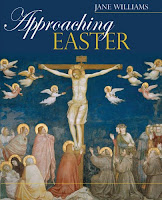
I've just begun to read for Lent Jane Williams' Approaching Easter. In her preface she writes: "The history of how and why Jesus died on the cross is at least partly an analysis of what we all do to one another when we are controlled by fear, or greed, or love of power, or too much love of ourselves. At every turn, Jesus challenges us to be brave enough to step out of our self-made prisons and turn towards the source of life and freedom, which he calls God. Unfortunately, too many of us don't see fear, greed, love of power, and love of ourselves as prisons. We see these emotions as necessary to grab what we think we need for our own security; we might even be prepared to kill for them, just as people 2,000 years ago were prepared to kill Jesus rather than hear his challenge." I suspect that, as I continue to read, I'll discover that Putin is not alone in a prison of fear, greed, love of power, or too much love of self. I may be there too.

Wednesday, 10 November 2021

Our war on the climate

 Last week I caught a news item on BBC radio telling us that our spanking new (relatively) aircraft carrier, HMS Queen Elizabeth, was now in the Gulf of Oman having returned from the South China Sea where it had been carrying out exercises - presumably to frighten the People's Rebublic of China. Now our Defence Minister was saying it could also be useful in fighting terrorism.... Rather a blunt weapon, I'd have thought. However the part of the report that most caught my attention was that during its voyage there had been daily sorties by the 'elite' F-35 fighter-bombers. Whether these are UK or US planes I don't know.

But I thought, "Every day? Are you joking? When in Glasgow world leaders are talking about climate change..." I imagine each of those planes burns a load of fuel each time it takes off. Well, today I find I wasn't wrong. In fact I was thinking far too small. Will de Freitas, Environment and Energy of the admirable Conversation wrote this.

"At full speed, a fighter jet can burn through hundreds of gallons of fuel per minute. When you add up the emissions caused by all the planes, ships, tanks and missiles used by militaries across the world you get a substantial “carbon bootprint”.

But though every country in the world is represented at the COP26 climate summit in Glasgow, their militaries are not. That’s despite the total emissions of armed forces and their suppliers being larger than civil aviation and shipping combined. In fact, thanks to exemptions written into the Paris Agreement, militaries don’t even need to report how much carbon they are emitting or where. One group of academics has done their best to track these emissions."

So I of course looked at the article referred to: "COP26: how the world's militaries hide their huge carbon emissions". I think this is what a former would-be US president would call an inconvenient truth, but it's one governments and media would prefer us not to dwell on. Maybe the world won't be destroyed by nuclear weapons, as we used to fear in my younger days, but by our attachment to being global superpowers.


Tuesday, 19 October 2021

My bid for an Eco Oscar!

I was intrigued to hear on today's news that at the Earthshot prize ceremony tbe celebrities walked down a green not the traditional red carpet. How apt! I believe the podium used no plastic. And strikingly none of the delegates used airflights to attend. (I wonder how the COP 26 will compare...) The Earthshot prizes, AKA the Eco Oscars, seem to me an entirely worthwhile intitiative with its potential to scale up some excellent local projects and to encourage some very bright young minds on whom our planet's future might well depend. To me one of the most encouraging aspects is that the finalists came from around the world. It wasn't the global north telling the developing world what's good for it.


Photos from The Independent


I'm neither young nor especially creative, but if I entered for an Eco Oscar it would be with a very simple idea; and it's to do away with artificial turf. I know I used to play hockey before the days of astroturf. But to put a roof on God's good earth is the height of perversity. The ball may travel a bit more predictably on a surface imitating a snooker table, but very seldom is that dangerous, and plastic burns in soccer victory slides in are more likely to cause damage. However the real harm is below the plastic. Here soil is deprived of its natural nutrients, and a subterranean desert is created. As far as I can see there are no advantages - except for the multi-millon industry that makes and markets the stuff - only contributions to climate degradation. In my view it should outlawed. See the  Guardian's article here. So there's an easy starting point - and so I propose myself for one of next year's Earthshot prizes, your Highnesses - in common with the USA's excellent women's football team.

Monday, 11 October 2021

A new Pietá

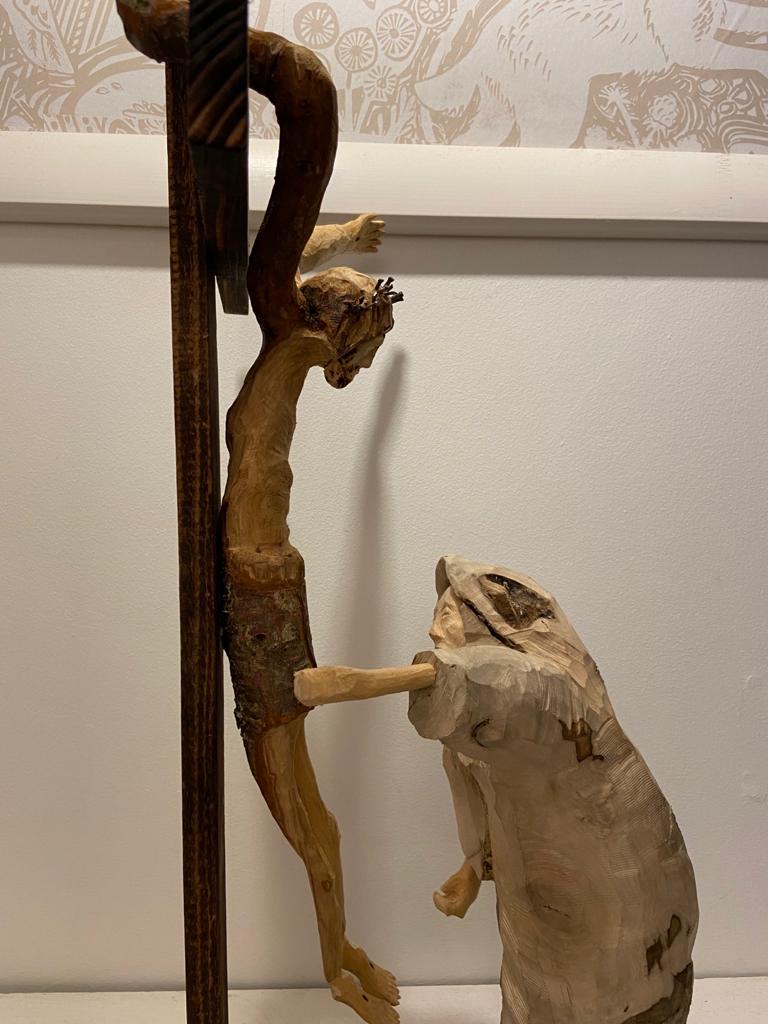
Yesterday I was presented with a work of art which left me speechless. It was crafted by a relatively unknown South Devon artist. Here it is in its temporary resting place.

 © Pietá by David Milnes


David Milnes and I have been friends since schooldays. In correspondence with him in August, I wrote: "As for the 'commission', in one of my novels I wrote about someone facing the loss of someone she loved identifying with Mary at the cross. She seems to me the person who most experiences the desolation of dereliction in the Bible. And I’ve long thought that evangelicals have failed to engage our imaginations in the gospel story. What must it have been like at the moment of Jesus’ death? So I’ve been looking for something that expresses the grief, disappointment and pain as they begin to take the body down. The characters I was looking at around the cross were Mary the mother, John the friend and Mary Magdalene who’s in love with Him (parent, saint and sinner - all humankind). It seems to me that all of us in our dark moments think the God we believed in and who is love has died and abandoned us. For many a resurrection morning never dawns. Which, I guess, we all fear and which is why, I think, we need each other to hold on to as we wait."  

David immediately set to work. He'd picked up, to his relief, that I wasn't looking for an serene scene carved in marble like Michelangelo's masterpiece. He'd been impressed by Fenwick Lawson's Pietá in Durham cathedral carved from "the rough split rawness of large logs".

© Picture Durham Cathedral
 

This is David's description of his own work. "For the figure of Christ I have used a section of a plum tree   in our garden. It is dead, twisted and covered in lichen. Two side branches looked like contorted arms writhing in pain and desolation. The connection between the arms is not realistically correct but suggests dislocation and extreme pain. The main branch is thinner than the body should actually be, but elongated bodies suggesting suffering were good enough for El Greco, so why not? In order to make the hands, feet and face stand out and in order to emphasise their vulnerability, I carved them separately in lime wood that enabled me to include greater detail. The marks of the nails and the spear in his side were burnt into the wood. 

"The cross is not a beautiful, smooth and varnished piece of neat carpentry. It is a rough piece of pallet wood which I have scorched. Burning has close associations with pain and destruction.

"For the figure of Mary, as she reaches out to help remove her badly mutilated son from the cross, I used a piece of holly wood which is solid and heavy with sorrow. It has twists and knots and rotted areas which are indicative of the terrible trauma and devastating blows that she has endured. It is very different wood from that used for the figure of Christ but it suggests suffering which is different but just as all consuming."

I love the rawness of this Pietá. It is certainly a discomforting addition to a sitting room. I like the fact that Mary is not portrayed as a beautiful young saint but as a middle-aged mother whose years of bringing up children in occupied territories have taken their toll on her physically. She is one of the many middle-eastern women grieving for their sons killed in a reprisal air raid. I like the proportions of the carving. To her Jesus is still the small child she held in her arms. I like David's choice of woods: Using for Mary the wood of the holly tree, which two Christmas carols associate with the suffering of Mary - "the holly bears a bark as bitter as any gall". And he has used fruit wood for the body of Christ. Humankind's fall from grace came through eating the forbidden fruit; its restoration to grace comes through "eating my body", as Christ put it. And the wood on which he hangs, a discarded pallet to crucify the rejected carpenter's son. The artist's brother pointed out that Mary is seen as left-handed - so maybe represents despised minorities and those considered weak. Theologians may recognise in the emaciated crucified body a depiction of what they call κένωσις, Christ emptying himself "taking the form of a slave and becoming obedient even to death on a cross".

As my son commented, "What a gift!" Whether he meant what a talent or what a present, I don't know. Probably both. And on both counts he's right.

© Photo Courtesy John Milnes

© Photo Courtesy John Milnes

© Photo Courtesy John Milnes


© Photo Courtesy John Milnes