Thursday, 17 October 2019

In praise of physiotherapists

Dedicated to Emily
I'm fortunate to have had excellent physiotherapists, starting of course with my lovely wife (MCSP [distinction]). Then in addition for many years the specialist neuro physio, Lesley, who last year passed me on to Emily. When you've been used to someone, there's always uncertainty when you have to transfer to a new professional; but I needn't have worried. Emily is brilliant. How lucky am I!

To give you a small example: I have been finding walking round the house with my rollator (zimmer frame on wheels) increasingly difficult and slow. My legs have been tending to cross over and my feet land on each other. Every now and then I had to call Jane to untangle me. Emily suggested a free metronome app on my phone might help. She set it at 42/60 - not fast but my sort of average rate. It has transformed my walking. The reason is, I think, that walking is now no longer a reflex action but I have consciously to move each leg. ie I have to concentrate on each step. Before the metronome, my brain, willy-nilly, would wander down its own wayward neural pathways. Now the metronome calls my brain to attention every beat and doesn’t let it  wander.

I now have a heavy cold and am feeling unduly sorry for myself, but still the metronome dragooned me from the lift to the breakfast table. As Jane commented when I had sat down without much fuss, “You’d never have been able to do that before the metronome.”

Of course that’s not the only thing Emily sorted out. I have a whole sheet of exercises to stop me going utterly flabby, including boxing (!), stretching and pedalling. I’m having time off, pleading sick leave, at the moment, but the prospect of a phone-call when she’ll check up on me should be sufficient to keep me at it! I’m so grateful for the NHS through whom I receive such skilled treatment – as well as from my dentist, doctor, OTs and hospital clinic. May they never be privatised!

Friday, 17 May 2019

Fatal news fatigue

I have a confession to make. I’m ashamed of it. Really. I was once a news addict, but now I’m suffering from news fatigue – and I’m not sure which is worse.

Once when there was a big news story breaking I would follow it assiduously. And I’d regularly listen to Radio 4’s Today programme, hearing the news every thirty minutes. However, now I’m fed up with it, even though I much prefer the new guns presenting it (like the penetrating but polite Mishal Husain) to the old blunderbuses (like unsubtle and pompous John Humphrys). So my news-listening and watching tends to be restricted to local news and Channel 4 News (and occasionally for a different perspective foreign stations such as Al-Jazeera or Russia Today). Sometimes I’ll send myself to sleep the BBC’s World Tonight or its World Service. Mostly I tend to follow the news on-line on the Deutsche Welle and the Independent’s websites.

What is regrettable about news fatigue is that I am convinced of the importance of political understanding and engagement. Too often do I witness people airing half-baked sound-bite headlines and revealing their ignorance. What used to be pub prejudice is of course now largely replaced by social media reinforcement, as we, the gullible public, have no idea of the source or veracity of what appears to be news and informed opinion. I am sure the BBC have very authoritative people commenting on news stories including their own staff, but I doubt whether the people they use from various “think tanks” are at all objective. In my view their political backers ought to be declared. And as for their vox pop interviews they seem no better than the repeating of uninformed prejudice.

And that is the danger of news fatigue, that we get fed up with hearing the same things about issues which really matter. It’s of course largely a result of the 24-hour news cycle. I’m old enough to recall the days of a morning and evening news broadcast, which seemed to be sufficient. Do we really need to hear hour after hour, day after day, week after week, more about the latest sanctions and bellicose threats of Donald Trump's aims to make the rest of the world conform to his America-first agenda? Do we have to hear repeatedly all the twists and turns, and all the ifs and if-nots of Brexit? The requirement of “news” 24 hours a day means either you hear the same reports and opinions reinforced every hour or even half-hour, or you switch off literally or mentally. And such political disengagement is unhealthy for a society, because, when demagogues such as Trump or Orban, LePen or Farage seize on an issue like dogs with a bone, they are able to play on people’s ignorance and prejudices and create discontent until society itself is divided and eventually broken. In our western world’s case it is arguable that the 2008 financial crash provided the hammer for destroying society’s fabric. What is odd and disturbing is that the rich élite wolves who parade themselves as “ordinary” common-or-garden sheep, those most reponsible for causing our trouble, rather than choking, seem to float to the top.

And now here in the UK the spectre of the ultimate shape-shifting tousle-haired self-styled ram as our next unelected Prime Minister has been raised like a mad spirit of Britain Future. Preserve us! Begone, foul fiend!

Monday, 13 May 2019

Lessons from swapping schools

Jane and I have just finished catching up with Channel 4’s The Great British School Swap. If you’ve not seen it, the series is definitely worth a watch. You’ve just over a fortnight on catch-up. https://www.channel4.com/programmes/the-great-british-school-swap. Clearly there’s some artificiality about the whole project. You sense the film-makers wanting to find (or create) storylines. You realise that a fortnight’s schooling being condensed into three 45-minute programmes leaves a lot of room for creative editing. However one senses that two school headteachers involved are genuinely invested in the scheme.

Having acknowledged that, I still believe there are lessons to be learned from these stimulating programmes. I gather that the show was commissioned after a 2017 report revealed more than a quarter of primary and four in ten secondary schools are ethnically divided. The show was filmed in two Midlands schools which are just 15 miles apart: Tamworth Enterprise Academy in Staffordshire and Saltley Academy in Birmingham, the one almost exclusively white, the other equally Muslim. We saw 12 students from Tamworth being bused to spend a week in Saltley and the reverse happening a week later. It was clear that all the parents had agreed and all the students had volunteered to take part in the swap.

The programmes began with their preconceptions of the other community. For many of the Saltley Academy pupils, they view their white peers as "bacon-loving, lazy, fat poshos", who enjoyed nudist beaches. The Tamworth view was that their Muslim peers were burqa-wearing “Pakis” who were not nice, or even terrorists, and they’d be afraid to walk in an immigrant area for fear of being set upon.
Photo from Birmingham Mail
Many of the prejudices of course are inherited from parents. And the schools go out of their way to involve the parents in the process, and so we see four families exchanging meals – with touching results. The final programme sees the final celebration of the swap, a sort of graduation, and then a carefully planned party, negotiated between the liberal laissez-faire modern style and the stricter traditional Muslim code. The tensions have been honestly faced and a solution which satisfies all found. The final comments of both students and parents about the whole experiment are all positive. Some lasting friendships across the barriers seem to have been forged – in a fortnight!

As the head of Tamworth, Simon Turvey, says at the start, “Now is not the time to be building fences; now is the time for knocking them down.” In our country some popular politicians are the cheerleading fence-builders. They should be ashamed, and resisted. The Great British School Swap demonstrates that not only is this divisive, it is also counter-productive. One of the most telling incidents is when the students have a shared careers lesson. The aspirations of the conventionally poorly achieving white working-class boys are raised to a higher level by their immigrant counterparts. Not only is integration possible, it is enriching for all the community. It is a pernicious myth that immigration and integration harm a country; in fact they enhance it. One thing is needed: and that is inspiring leaders (or teachers in the programme) who believe in the benefits and will hold their nerve when things don’t go smoothly. Nothing worthwhile is achieved without difficulties. The series is, for once, aptly titled The Great British School Swap.

(By the way, a long time ago I taught in an ethnically mixed school, and I think nothing but good came from the mutual understanding which that brought.)

When technology fails

I guess everyone with a neurological condition such as MND is familiar with the frustration when one of the technology aids we depend on gives up on us. It happened for me on Good Friday, when I couldn’t get into my lift to take me upstairs as the door wouldn’t open. In fact that evening, for no obvious reason, it relented and so I got to bed. Just one of those glitches, we thought. But no, on Easter Day, when I’d parked my wheelchair in it after church, it wouldn’t open, and we were going out for what would be a special lunch. There I was trapped in it… In desperation I pushed it with my foot and escaped.
 
That evening, the lift would do nothing. Perhaps I’d kicked it to death. So began a series of visits from engineers and three nights in my riser-recliner, two in a hospital bed and three away for my son’s wedding. I have to say the week was redeemed by our local social services who grasped my predicament and, of course, the wedding. My son married a senior hospital doctor in Bristol. It was a fabulous couple of days. At the end of the reception I had completely lost what voice I have, but I could still smile.

On returning home our joy was completed by finding a message from the maintenance contractors saying their senior engineer had a slot that afternoon: would we like him? We did like him, and even more so when he had tracked down the fault to an erratic loose wire. That night I was able to sleep in our own bed. Bliss! How much trouble a small faulty connection can cause – like faulty neurones, I suppose!

Wednesday, 17 April 2019

Fire in sacred spaces


A good friend of mine from the other side of the world pointed out that on the same day as the cathedral of Notre Dame was almost destroyed by fire in Paris (which I've visited and worshipped in twice), a fire also broke out in Jerusalem’s Al-Aqsa mosque, the third most holy site in Islam (Gulf news report) (which I visited in my teens). My learned friend asked, “Is Somebody trying to tell us something?”

Ever cautious and innately sceptical, my reply was, “I don't know about that. I appreciate the comment of theologian at St Paul's Cathedral in London, Paula Gooder: ‘”Our holy and beautiful house, where our ancestors praised you, has been burned by fire and our pleasant places have become ruins” (Isaiah 64.11). In times like this, the only possible response is lament.’ Incidentally Christopher Wren found a stone from the old St Paul’s after the great fire in 1666 and the word ‘Resurgam’ (I shall rise again) appears in his cathedral along with carvings of the phoenix. Appropriately hopeful this week.”

I believe Resurgam came from an old tombstone and, of course, the phoenix is the mythical bird which emerges from the ashes. I must say when I first saw the Notre Dame fire raging on Channel 4’s news on Monday night I was appalled and later, after a meeting, watching the spire collapse and the flames’ seemingly unquenchable thirst, I wondered whether anything could survive the inferno. Well, it has. And some very brave firemen risked their skins to save most of the precious artefacts and relics. Yesterday it transpired that the three rose windows and the great organ had survived as well as the main structure. The full extent of the damage is yet to be assessed, but I suspect that President Macron’s ambition for its restoration by 2024 may just be realised.

Two things which stuck with me from the reports was an interview with computer engineer, Jean François, an atheist (“I hate anything with religion, but I love this church”), sitting looking at the cathedral with tears on his cheeks (Channel 4 interviews), and then the picture from the west door looking past the firemen and seeing a gold cross catching the light through the huge slender gothic columns.

Well, last night, I was annoyed to hear BBC analysts trying to extract some political story from the tragedy, such as Emmanuel Macron using it to relaunch his flagging popularity. So let me not use it to be overly pious either. However I did notice the irony that the fire took place on the Monday of Holy Week and I wondered where all those who were hoping to worship in Notre Dame this week would be over Easter. For thousands it is a "place where prayer has been valid".

In the meantime, I will recall again the ancient poet’s words, “Our holy and beautiful house, where our ancestors praised you, has been burned by fire and our pleasant places have become ruins,” and, while lamenting, take comfort in the hope of resurrection, however it comes.

Sunday, 24 March 2019

In defence of Members of Parliament


Surprisingly I find myself moved to come to the defence of MPs. Yes, this is in response to our Prime Minister (for how long is in doubt) and her dis-graceful comments concerning her fellow Parliamentarians. I was out when she made her now infamous broadcast appeal to the nation for 10 Downing Street on Wednesday, but I did catch one of her comments in Prime Minister’s Questions at midday. Annoyed by Jeremy Corbyn, she describe the House of Commons contemplating its navel about Brexit and indulging itself in not coming to a conclusion over it. Unusually swiftly Mr Corbyn questioned the respect of Parliament shown by describing its deliberations as self-indulgence. I think Mrs May was attempting to demonstrate anger at the rejection of the deal painstakingly pulled together by UK and EU civil servants over many months, as she repeated the twin charges of navel gazing and self-indulgence as if from a script.

There was palpable anger among MPs at the idea that their honest wrestling with the Hobson’s choice with which they had been presented for the past few months was nothing more than an indulgent waste of time. However it seems that it was not a mere poorly phrased answer in the crucible of PMQs, because she compounded her contempt for her colleagues only a few hours later in her prime ministerial broadcast from Downing Street (which I gather was staged like the Kremlin). “You are tired of the infighting, you’re tired of the political games and the arcane procedural rows, tired of MPs talking about nothing else but Brexit…
“So far, parliament has done everything possible to avoid making a choice.
“Motion after motion and amendment after amendment has been tabled without parliament ever deciding what it wants.
“All MPs have been willing to say is what they do not want. I passionately hope MPs will find a way to back the deal I’ve negotiated with the EU, a deal that delivers on the result of the referendum and is the very best deal negotiable.” She implied an opposition between the people, who want “her” Brexit deal, and MPs, who don’t. “I am on your side.”

No wonder MPs were alienated. It seemed to be designed to undermine the public’s relationship with their representatives. It’s little wonder either that some MPs felt – and were – physically threatened. The Prime Minister appeared to shift responsibility for her own inept negotiating skill on to the shoulders of genuinely conscientious MPs. Her disdain for her colleagues in Parliament reminded me of Brutus’ description of Julius Caesar:
“to speak truth of Caesar,
I have not known when his affections sway'd
More than his reason. But 'tis a common proof,
That lowliness is young ambition's ladder,
Whereto the climber-upward turns his face;
But when he once attains the upmost round.
He then unto the ladder turns his back,
Looks in the clouds, scorning the base degrees
By which he did ascend.” i.e. the upwardly mobile tend to treat the lower ranks through which they rose with contempt.

I recall March wasn’t a good month for Julius Caesar.

As for me, I wish the honourable Members of Parliament every success in their search for a way through to a solution advantageous to the United Kingdom as well as to the European Union.

Friday, 8 February 2019

In defence of Dr Nikki Alexander and Dr Donald Tusk

As you may know, I’m an avid viewer of BBC Television’s Silent Witness. I’m always sad when a series comes to an end, as No 22 did on Tuesday. As ever, it was a contemporary storyline and it had an individual conundrum running through it. That was a crisis of trust in one of the team of forensic pathologists around whom the series revolves. Dr Nikki Alexander (played by Emilia Fox) is the scrupulous lead pathologist whose results are challenged in court in an appeal concerning the death of a policeman. Somehow the original evidence has been corrupted by an interested party. Here ends the plot spoiler.
The episodes end with Nikki as witness, as the individual responsible for sabotaging the forensic evidence appears in court. She is asked by the prosecuting barrister:
Dr Alexander, what are the consequences of the defendant’s actions on your work?
She replies:
“What’s the point of experts if nobody trusts them? What’s the point of evidence if it can so easily be contaminated? The whole integrity of what we strive to achieve could have been catastrophically undermined. What my colleagues and I seek to do is understand the cause and manner of a person’s death. But we don’t only deal with the dead; we deal with the living – the families, the judiciary, the coroner, the police, the public, the press. And they all have to trust us, and if there is a betrayal of that trust, there is a crime. The opposite of truth is not just a lie; the opposite of truth is chaos, chaos that is in danger of bringing down the institutions we depend on – to deliver justice.”
Thank you, Dr Alexander.

During the referendum campaign, The Daily Telegraph reported on 10th June 2016:
“I think people in this country,” declared Vote Leave’s Michael Gove, “have had enough of experts.” His fellow Brexiteers were quick to back him up. “There is only one expert that matters,” said Labour MP Gisela Stuart, also of Vote Leave, “and that’s you, the voter.” Nigel Farage, the leader of Ukip, suggested that many independent experts were actually in the pay of the Government or the EU. This concerted undermining of experts was a major tactic of the Leave Campaign. Warnings of the complexity and potential consequences of exiting from real experts were poo-pooed, and who can forget the nonsense of the red bus? "The opposite of truth is not just a lie; the opposite of truth is chaos, chaos that is in danger of bringing down the institutions we depend on…" And we are now reaping the whirlwind.

Which explains Donald Tusk, the European Council President’s comments: “I have been wondering what the special place in hell looks like for those who promoted Brexit without even a sketch of a plan to deliver it safely.” And I guess it also explains the intemperate response of leading Brexiteers to his musings. Commons leader, Andrea Leadsom, who campaigned for Britain's exit from the EU, said Mr Tusk should apologise for his "disgraceful" and "spiteful" comments.

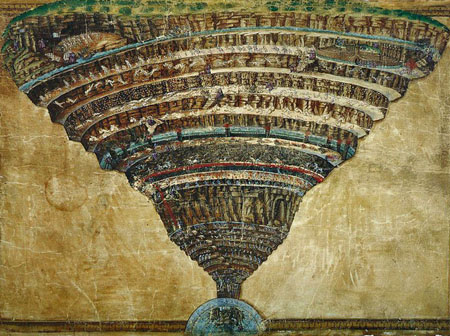
No doubt some of the Brexiteers realise that Donald Tusk might have been thinking about Dante’s Inferno (of which Wikipedia gives a useful summary for those who don’t want to read the whole allegory). “In the poem, Hell is depicted as nine concentric circles of torment located within the Earth; it is the ‘realm ... of those who have rejected spiritual values by yielding to bestial appetites or violence, or by perverting their human intellect to fraud or malice against their fellowmen’.”

Each circle is reserved for increasingly bad people. The bullseye at the bottom is reserved for the epitome of evil, the Devil. Two circles out from there is the eighth, the Circle of Fraud, which is subdivided into ten evil “ditches”, the Malebolge. Writing in the 1950s Dorothy L. Sayers described this as, "the image of the City in corruption: the progressive disintegration of every social relationship, personal and public. Sexuality, ecclesiastical and civil office, language, ownership, counsel, authority, psychic influence, and material interdependence – all the media of the community's interchange are perverted and falsified".

In the penultimate ditch Dante sees the “Sowers of Discord: In the Ninth Bolgia, the Sowers of Discord are hacked and mutilated for all eternity by a large demon wielding a bloody sword; their bodies are divided as, in life, their sin was to tear apart what God had intended to be united; these are the sinners who are 'ready to rip up the whole fabric of society to gratify a sectional egotism'. The souls must drag their ruined bodies around the ditch, their wounds healing in the course of the circuit, only to have the demon tear them apart anew.”
 
I don’t imagine at all that Donald Tusk sees the EU as God-given, merely as a proven instrument of peace and prosperity for Europe. Neither do I have reason to suppose his wondering went as far as consigning “those who promoted Brexit without even a sketch of a plan to deliver it safely” to the ninth ditch of the eighth circle of hell. But I wonder whether the cap fits.

Of course I am not so naïve as to suggest that the promoters of Brexit were the first or only perverters and falsifiers of all the media of the community's interchange. It was certainly one of their weapons, but we have seen it in such monsters as Cambridge Analytica, we have seen it in the political life of the USA, and in the widespread use of targeted disinformation used to justify military and economic interventions designed to destabilise societies. In this, patently, the internet is a pervasively powerful instrument, with the potential to cause more damage than an atom bomb. However, it is clear that the Brexit-movement has had the effect of magnifying unrest in many of whom we used to call our European friends, and who remain our European neighbours. Some Eurosceptics no doubt rejoice at witnessing the opening of Pandora’s box and anticipate Europe’s disintegration with glee.

“The opposite of truth is not just a lie; the opposite of truth is chaos, chaos that is in danger of bringing down the institutions we depend on…” We are now discovering that Dr Alexander was right. And “the living”, who are the next generation, are the ones who will have the task of bringing back truth, and rescuing order from the chaos.