Sunday, 12 June 2011

Friday Night Theology

I hope Marijke won't mind me reproducing this article from "Friday Night Theology", which I loved.

Shalom in the home

10 June 2011
Men sitting on a bench
Three years ago, my dad passed away following a long illness. He died in the house he built, overlooking the trees he planted, cared for by the doctor he mentored and the family he raised. Collectively we did well in honouring him in the final stage of life. Family, friends, and carers - each contributing to the best of their ability. Peace in the house.  
Last weekend, the author Diane Athill described her care home: "This place is a dream. I'd been here for about a week and I thought: 'What is it about this place that's so marvellous?' And I realised, it is goodness - an extraordinary feeling of goodness. None of these people are anything but genuinely kind. That's the secret of a decent place."  
There's been little peace recently as far as the topic of caring for the elderly is concerned. A report earlier this year on healthcare revealed an attitude - both personal and institutional - which fails to recognise the humanity and individuality of the elderly and to respond to them with sensitivity, compassion and professionalism. A survey of residential care homes and providers of outreach services found that older people face isolation, a lack of community and funding. The drastic public sector cuts and disastrous manoeuvres in privatisationcontribute to an increased sense of vulnerability in the already vulnerable.  
In his final book The Radical Disciple, John Stott reflects on the final part of life: "We come into this world totally dependent on the love, care and protection of others. We go through a phase of life when other people depend on us. And most of us will go out of this world totally dependent on the love and care of others… It is part of the design, part of the physical nature which God has given us."  
We all have a lot to gain in the season of parent-care, as Dr Emily Ackerman explores in A Time to Care. The transformative element does not merely concern our heart and home. It is wider than that. In ancient Greece, the oikos referred to the house and everything included, such as extended family, slaves and farmland. Nomos means act, law, or principle. The Ancient Greeks first combined these two roots to form oikonomia. Eventually, the word 'economy' was born, which literally means "the principles to maintain our house". Whether that "house" is government or family is relative.  
There is a Christian imperative to develop good practice and challenge political and entrepreneurial malpractice. For poor care for the elderly is not only a tragedy, but also a scandal. Bishops have rightly called for rightdecisions and a new framework of trust. We need a vision and ardent advocacy concerning our collective 'house-keeping'. And in view of the ageing society, we need a long-term commitment. Demographic projections indicate there will be more than 11 million people over the age of 65 within 10 years. 
God's word gives us a glimpse of shalom in the community: "Once again men and women of ripe old age will sit in the streets of Jerusalem, each of them with cane in hand because of their age. The city streets will be filled with boys and girls playing there."   The imagery is one of communal wellbeing, shalom. Collectively - government, service providers, families and community - we need to do well.  
And, as far as the household of faith is concerned, caring for, and advocating on behalf of the elderly is an intrinsic part of radical discipleship.
Marijke Hoek, coordinator Forum for Change

Friday, 10 June 2011

An afternoon with friends

On Wednesday afternoon the local MND Association branch visited Aston Pottery for a demonstration and then for tea. These are really good afternoons when those of us with MND and friends and families spend time together.
Watching the demonstration

Although it was windy, the rain held off and from time to time the sun came out. Aston Pottery is near Witney and produces its unique brand of tableware, and also has an Aladdin's cave of a gift shop and a big beautiful café. The 18 of us started with the pottery (I believe it's technically known as slipware) demonstration given by Marian, one of the potters. She showed us the processes from pouring to completion - well, not all of them, I seem to remember that there are 27 separate processes in all, taking over two days. She was, I must say, an excellent teacher - well organised, expert and enthusiastic about her subject. I certainly ended with a great appreciation for the skill of the potters and decorators and the vision behind the whole enterprise.
Marian at work

It's amazing how split-second some of the timings need to be: for example, too short and the teapot handle is hollow, too long and the spout is solid. And there's no mass-production here. It all depends on the human factor. I was especially impressed by the glazing process, which is dipping the article into a suspension of four minerals for a few seconds. As it dries the design is completely covered in the creamy deposit. Only after the final firing at 1100+˚C does the deposited suspension melt into a micro-layer of glass.


After the wonders of potting, we proceeded to the joys of eating some of the locally made cakes and having tea from, of course, Aston pottery.

This is always the best part of such afternoons, when you sit and talk (or just smile) with your friends, and enjoy what you might call fellowship. In one way it's tinged with sadness, as you're aware of friends who have died since we began going. But there's also that great optimism and humour which is oddly a mark of the Association members. Anyway the slabs of cake were vast - and delicious.
Anne and Rachael facing us, with the Durkins

In the café
I forgot to mention that I'd been to the MND Clinic in Oxford on Monday morning, to see my new consultant, Kevin Talbot. There I'd been greeted by Anne, the Association visitor, and then was seen by Rachael Marsden, the clinic coordinator, who gave me a peak-flow

breath test and a quick interview, before I went in to see Professor Talbot. He agreed with Dr Donaghy's diagnosis of PLS (where the upper motor neurones are affected). He had a student there, which was interesting as he explained my symptoms to her. It's an excellent set-up.

It was nice seeing Anne and Rachael again at Aston on Wednesday afternoon. It feels like integrated care.

Thursday, 9 June 2011

The good bunny

I was reminded of this true incident by recent news stories. Early one summer morning in 1976 a young couple was going down from Watford to the Isle of Wight. On the A3 road near Micheldever, the two-door beige Morris Minor they'd been conned into buying by a very nice (apparently) man started to steam. As they had a sleeping baby in a carry-cot on the back seat, they pulled over to the edge of the road. They hurriedly took the carry-cot out of the car, and then the young husband opened the bonnet. The engine was scalding hot. The radiator cap was fizzing like an angry pressure-cooker. Using a cloth, he gradually released the cap. The radiator was completely empty.

Of course, this was in the days before mobile phones. There weren't any buildings in sight. Vehicles occasionally sped past, but it was very early. They were bound to miss the ferry. Then a Ford Escort passed them, stopped up the road and reversed. An attractive woman of about their age, casually dressed, got out and walked back. "Can I help?" she asked. Having explained their predicament, she told them there was a garage a mile down the road and offered to take one of them to it. They gratefully accepted the offer. Leaving his wife looking after the baby, the husband went with her and got a container of water, and was then driven back to their car. They thanked their rescuer, and as she drove off, the husband said to the wife, "Did you see the badge on the back of her car?" She hadn't. It looked like this:
 
"You know," he said, "I think we've been rescued by a bunny girl." Presumably she'd been working till the early hours in Park Lane. Now, then, as today, bunnies were despised by men as objects of exploitation and fantasy, and by feminists as willing accomplices of male exploitation, and by respectable people as merely immoral. 

I happen to know this story's true because Jane and I were the couple, and the baby was our new daughter. We actually made the Isle of Wight ferry, and reached Jane's parents safe and sound. I bought some radiator additive to seal the hole - which helped but didn't ultimately solve the problem. So eventually we sold our liability. We never saw our rescuer again. I'd like to think she might read this, and hear me say, "Thank you."

I can't say I applaud the reopening of the Playboy Club in Mayfair this month after 30 years. I could understand Slut-walk marcher Bea Campbell's ire at bunnies as symptomatic of male exploitation: "dressing as Hugh Hefner wants" (Today programme). However, I still reflect, "Who do you suppose was neighbour to that couple stranded on the A3?"

Wednesday, 8 June 2011

Here we go again, Aunty

Summer must be a-coming in. The season of media-created news. Last night I saw a trailer for the BBC's latest salvo in their campaign for the legalisation of euthanasia, fronted by millionaire author Terry Pratchett, about people wanting to decide when to die. We've already been told that it will include a scene in which a man with Motor Neurone Disease is assisted in committing suicide at - yes, you've guessed it - the European euthanasia capital, Zurich's Dignitas facility. This is appears in direct contravention of the World Health Organisation's guidelines about media portrayal of suicide: "Don’t publish photographs or suicide notes. Don’t report specific details of the method used. Don’t give simplistic reasons. Don’t glorify or sensationalize suicide."   


There's an excellent comment in the Christian Medical Comment on the subject, which I do urge you to read. Peter Saunders asks questions which really do need answering, about the impartiality of the BBC on this issue. To balance the repeated programmes advocating and sympathetic to assisted suicide, where are the equivalent about hospice and palliative care? Where are the programmes about the people with terminal conditions who have chosen to live rather than take their lives? Where are the programmes about Matt Hampson, Alison Davies, Kate Allatt, Katherine Araniello? Where are the programmes about disabled people's fears about the consequences of legalisation? Where was the feature about Scope's survey - see my post - ?  


What do we do about the broadcasting medium which we fund through the licence fee - when it doesn't follow even its own guidelines? What does "public interest" mean? Does it mean titillating the public's interest-buds as the tabloids argue? Or does it mean acting in the public's best interests?


However, let me acknowledge a good public interest programme on Radio 5 Live last night: Depression in cricket. It includes Marcus Trescothick talking about his depression, and Matthew Hoggard - and Kevin Saxelby talking about his brother, Mark, who committed suicide. A thoughtful programme.

Tuesday, 7 June 2011

What's a Barnabus?

Last Friday, Pete Beckley and his wife Jane brought round the piece I'd commissioned for my lovely wife's big 6-0. It's a sort of omnibus, for books and bits and pieces and everything. It's a unique creation (though it does have a posher brother). Ever since we moved in, the kitchen table carried a shoe-rack which held her recipes, at an increasingly precarious angle. Well, it did its job, but was a bit of a blot on the landscape of the refitted kitchen.

'Barnabas'
Being friends with a rising star of furniture designers, it was obvious, really, wasn't it? Get an early Beckley original! And that's what we now have. None of your boring four-square flat-pack shelves. I didn't want that. This is a work of art, beautifully crafted and pleasing to the eye. And as for practicality - you wouldn't believe the difference it's made. It's very encouraging.... And I see its posh brother is called Barnabas ("son of encouragement"), which was on display at Blenheim, when we were in Blackpool. You can see it on Pixel Furniture's Facebook site, along with others pieces of Pete's work.

The best way to describe ours is with pictures. It's a thing of beauty. (Wasn't that what Keats said about a Grecian urn?)
Our "Barnabus"

Fly's eye view

In context
Now here it is, in operation:
All on board

   
Even standing room for pens and pencils!

"Craftsman's art..."

Monday, 6 June 2011

Back to reality

As we sped south down the M6, we passed a very unpleasant accident on the north-bound carriageway, three fire engines, an ambulance or two and any number of police cars. Unsurprisingly there were miles of nearly stationary traffic. It was a bit of a reality check, as was the news of the Southern Cross care homes fiasco which could leave 31,000 elderly and vulnerable people without care and a home, and of course all their carers jobless.

I don't pretend to understand all the convolutions of the private equity companies that have played their part in bringing the company into this parlous state, but some people have clearly made a lot of money out of it, such as Wall Street financier who made £500 million out of it, and its former chief executive, Philip Scott, who sold his shares in the company for a mere £13 million four years ago.

And then there came the horrible Panorama programme about Winterbourne View, the "care home for adults with autism and learning disabilities run by Castlebeck, a company which has a £90 million turnover and runs more than 50 other care homes. The company charges the NHS and local authorities up to £3,500 a week to care for patients" (according to the Telegraph). The care there amounted to torture of utterly vulnerable people, here in the UK. The Panorama programme shocked even the owners.

I hope it shocks the government too, so that, if it decides to go down the line of using private companies, it doesn't invest in firms like those. I can't help remembering that when we were up in Stockport, by far the best old people's home was one owned and run by the local authority. It was the only one that invested in training its staff, for example. Not surprisingly, private homes didn't bother - well, training cost and didn't maximise profit. Now here's an idea. How about laying down minimum qualifications for staff in homes, and an obligation to train, in every contract? If we dogmatically insist on going down the private road. Otherwise I fear our health and care services could be heading for a horrible crash.

Friday, 3 June 2011

Disabled in Blackpool

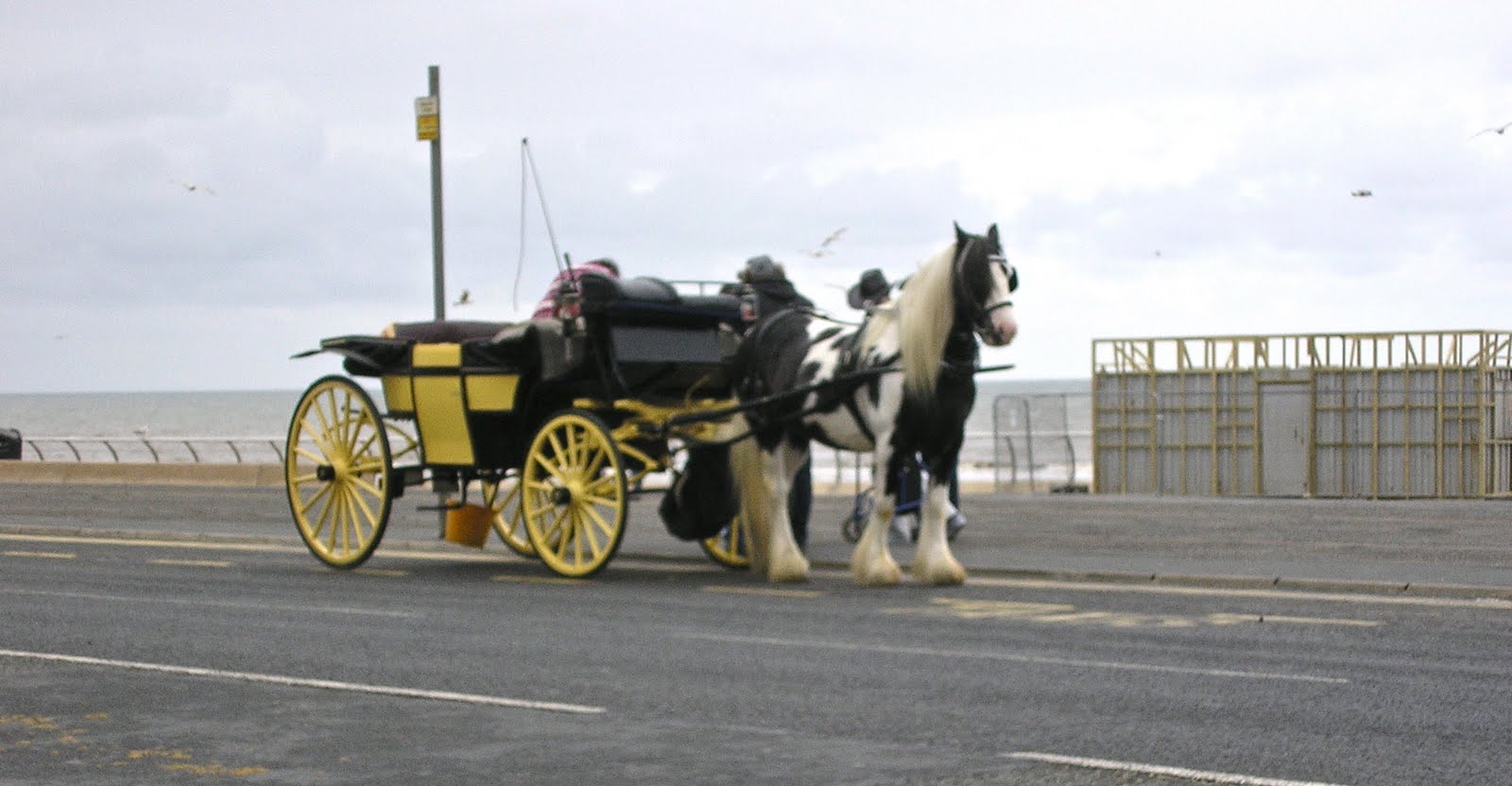
A prom carriage, with Dave's cousin (?)
Or "handicapped", as it's known in the States, so I learned yesterday. This post, I guess, will be of most interest to others who are disabled like me, although it gives me another chance to go on about our fab weekend in Blackpool, before the magic wears off completely! One quarter of Blackpool residents have a limiting long-term illness, and so one would expect it to be a good place for disabled holiday makers. On VisitLancashire's website, there are 84 listings under 'Disabled', including one attraction and 12 hotels in Blackpool, but no events and no restaurants there. I know that such sites rely on people submitting listings, and so this is no criticism of the Tourist Board who, as I've said, did us proud. But come on, you Blackpuddlians, we'd like to know more!

At Tiggis, No 1 for eating
Of course there are a lot of things in a resort like this that being wheelchair-bound makes impracticable, like riding in the carriages on the Prom and, I imagine, in the trams. I suspect the Pleasure Beach rides are also out. But there's plenty one can enjoy in a wheelchair - as we discovered - and, from the friendliness we experienced, I'd guess there'd be no lack of help, for example for a child wanting a donkey-ride. The Winter Gardens were very accessible (with three rather cramped disabled toilets). Frankie & Benny's was accessible and, of course, McDonalds, but, as you'll have gathered, Tiggis in Lytham St Annes was the runaway winner in the restaurant stakes. As I've mentioned toilets, there seemed to be an adequate supply. We found one locked up, in Lytham, but within 100 yards was St Annes' Pier with its redeeming feature, the disabled loo, which is a good size, well-equipped, clean and even smelling nice. I surmise that someone takes a pride in looking after it. So that takes the coveted loo award.

The Ashley Victoria Hotel, No 1 accommodation
As for hotels, clearly we didn't have different experiences to compare ours by, except by location and external appearance. Blackpool, exposed as it is to the westerly winds off the Irish Sea, must be a fiendishly difficult place in which to maintain the outside of buildings. Many hotels and b&bs near the front looked decidedly sorry for themselves. The Ashley Victoria facing north/south and quite newly painted outside and in was at the smart end of the spectrum. Its location, in a street leading on to the Promenade midway between South and North Beaches, suited us admirably. The facilities worked well for me in my wheelchair and with my rollator.
Our wetroom

The ensuite wetroom speaks for itself. Plenty of grab rails, high pedestal, right-height hand basin, shower chair and non-slip floor.
Well done.

Our bedroom
There was just room between the double and single beds for my narrow wheelchair. The decor was tasteful; our room had all the facilities we could want.

Looking seawards


If you sat in the bay-window, you got a glimpse of the sea.

I suppose it would be technically accurate to call it a guesthouse, as it doesn't do full-board, but the breakfasts (to music) make up for it ("Breakfast like a king, lunch like a prince, dine like a pauper"). Its own website describes it as "family accommodation" and specifies no stag/hen/single-sex parties. Indeed it was very quiet, and we slept unusually well.

I have to say that our stay there was made by the hospitality of Diana and Wally who run it. They were welcoming and sorted out our needs cheerfully. Sadly I have a great photo of them, but promised Diana I wouldn't post it, as she hadn't done her hair! It looked fine to me, I have to say. You'll just have to take it from me that they're lovely people. (And I'll post one of the ballroom couples instead!)

So, you may be relieved to read, my Blackpool saga nears its end, but not before I thank the people involved in arranging it:
Caeshia St Paul - of Classic FM
David Gore - of the Winter Gardens, Blackpool
Kate Campbell - of Visit England
Nikki Duckworth - of Visit Lancashire
Diana and Wally Ogunbiyi - of the Ashley Victoria Hotel
Jane - my lovely driver and wheelchair pusher.
"Without whom all this would not have been possible"
I am really a blessed man.